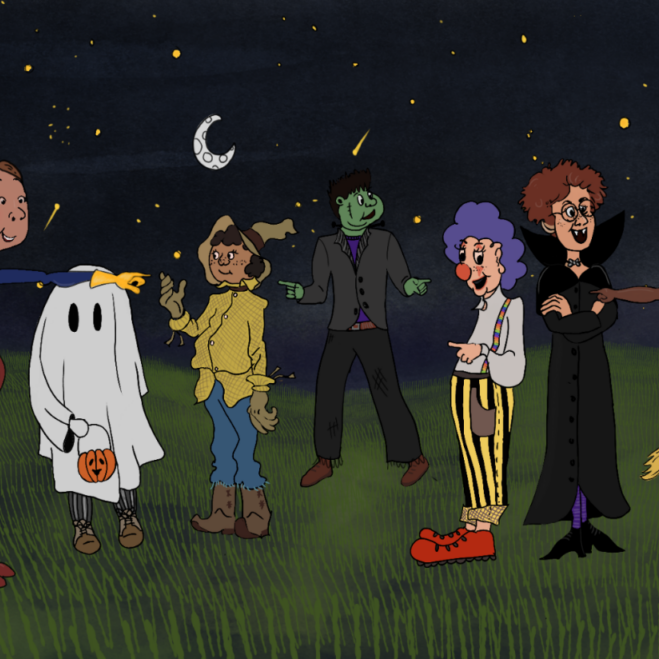
I have always loved Halloween — the falling leaves, haunted houses, candy and knowing Christmas is right around the corner. More than anything, I love the costumes.
Halloween is the one day a year people are actively asked to dress up as someone or something they aren’t. From little kids dressed as princesses and superheroes to costume contests at the local bars, I would argue it’s the best night of the year.
But when does pretending become offensive?
Target recently pulled a children’s circus clown costume from shelves because online critics said the costume, as well as the pose of the model, was similar to racist Jim Crow-era depictions of Black people.
Looking at photos of the costume, the online backlash was instantly justified. When a costume resembles imagery that has historically been used to dehumanize a group of people, it’s worth questioning why that imagery is being sold as harmless fun to children.
Canada has had its own history of problematic Halloween costumes.
Former Prime Minister Justin Trudeau donned blackface and a turban for an Aladdin costume at an Arabian Nights-themed gala in 2001. Consequently, he had to deal with the repercussions from supporters after the pictures started surfacing in 2019. The photos continue to surface whenever the topic of racist costumes is brought up to this day.
Trudeau’s example raises an important question about accountability. As an adult and a teacher, he was in a very different situation from a child wearing a problematic costume.
There is a difference between the costumes we wore as children and the ones we choose as adults. I remember seeing childhood photos of my friends dressed as characters like Pocahontas — costumes their parents chose before they were old enough to understand the implications.
A child doesn’t have the agency or knowledge to question whether a costume is culturally appropriate. As adults, we do.
This is where accountability comes in. Consumers have a responsibility not to participate in harmful stereotypes, and companies have a responsibility to consider what’s being put on their shelves.
While some argue that Halloween has become “trickier” due to social media, I firmly disagree. Being aware of how certain costumes affect others doesn’t make Halloween less fun. Instead, it prompts us to think about what we are representing.
Failing to understand why something could be offensive simply because it doesn’t affect you is an age-old problem.
Royce Mahawatte, a cultural historian at University of the Arts London in the United Kingdom, told BBC Radio that he believes views on problematic costumes come down to whether or not they care about how they’re perceived based on their social circle.
A predominantly white circle might be more relaxed when it comes to the discussion of cultural appropriation and problematic Halloween costumes compared to people of colour.
That being said, Canada operates under the Charter of Rights and Freedoms, which ensures everyone has the right to freedom of expression. That freedom of expression doesn’t mean freedom from consequences, as seen with the response to Trudeau’s costume.
Accountability is an important way to address harm without infringing on an individual’s freedom of expression. If Canada banned every costume that could be found offensive, it would risk limiting freedom rather than encouraging people to take responsibility for their choices.
Just because something is offensive doesn’t automatically mean it should be banned. A sexy nun costume may be disrespectful to someone’s religious beliefs, but is it morally equivalent to a costume that draws on racist imagery?
Not every costume considered to be offensive carries the same weight. Some are distasteful, but others are discriminatory and harmful.
In my first year of university, I saw someone dressed as Jesus. As a Christian, I found it disrespectful to see a figure central to my faith reduced to a Halloween costume. It made me feel uncomfortable.
But being offended doesn’t mean I believe someone should be prohibited from dressing that way.
My discomfort doesn’t have the same history of racial discrimination and dehumanization as blackface. For many, seeing racist imagery isn’t about finding a costume distasteful. It’s about seeing a history of discrimination that still affects their community today.
Freedom of expression may protect the costume, but it doesn’t protect you from being criticized for wearing it.

Read more from the gazette
Hundreds protest against Cape Breton AI data centre in Halifax
Local university series fostered Jewish and Indigenous conversation and connections
Dal Student Life hosts not-so-haunted campus tour
Budgeting tips, from the provincial government
Hungover, Hungry and on a Budget