
The history of Halifax rave culture
Revellers donned glow sticks, sparkly makeup and clothes fit for dancing all night long.
November 20, 2025 / Mia Phillips
Down by the Halifax train station, in the ’90s and early 2000s, there stood a warehouse known as the Elegant Dump. Inside, DJs from the Good Vibe Collective hosted all-night raves.
When the sun rose at 5 a.m., the building’s back doors opened, beaming natural light from across the harbour onto hundreds of party goers, nature’s equivalent of a frat boy flicking the lights and screaming, “Get the fuck out.”
Jamie Cole tagged Halifax with graffiti murals alongside a group called the Halifax Riters Association. In the summer of 1995, when he was a recent high school graduate, Cole’s friends from the HRA brought him to a “party.” Next thing Cole knew, he was surrounded by flashing lights, smoke machines and a DJ blasting dance music for hundreds dancing in unison.
Revellers donned glow sticks, sparkly makeup and clothes fit for dancing all night long.
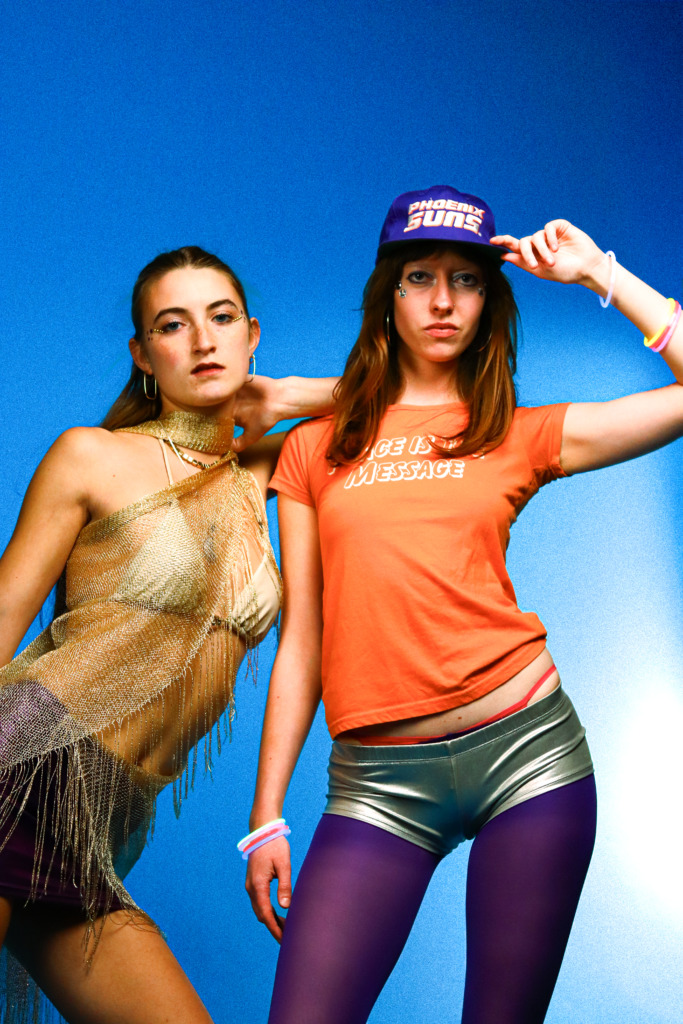
“People got really dressed up, you could tell they put time and effort into what they wore,” Cole says.
He planted himself next to the DJ, overwhelmed by what he heard. Until then, Cole fancied himself a hip-hop fan through and through. His hobbies included writing rhymes, recording music, breakdancing and graffitiing murals.
The party was “like nothing I’d ever seen before,” Cole says. “It was one of the first times I’d ever seen a DJ play records other than what I would see on TV on RapCity.”
Two weeks later, he went to his next rave, Zooted, at the Khyber Centre for the Arts — located on Barrington Street at the time. He showed up early and danced into the morning while drag queens ran around in 10-inch platforms, squirting water guns.
The accepting crowds provided a refreshing contrast from the cliquey dynamics Cole was used to in high school.
“It made me want to keep experiencing that over and over again,” he says.
Cole had no problems raving sober, but did his “fair share of experimentation.”
“Hallucinogens, whether it was acid or mushrooms, added an additional sensory experience.”
Every weekend, he raced to catch a bus scheduled to pick up ravers at the Halifax Public Gardens. He often didn’t know where the bus would take him.
“It’d be really disorientating. You wouldn’t know where you are then boom, you’d show up at Exhibition Park. Or, you’d be shuttled all the way to the Bedford Highway because there was an old furniture store that was three floors, and there’d be a crazy rave going on and music pounding on each floor.”
Instead of looking for hip hop records at Retro Revolution Records — a Halifax staple since 1997 — he shopped in the dance music section. Cole started DJing for his friends at home, practicing techniques he learned from watching rave DJs.
“People that were coming to my house were like, ‘You should play a party, you’d be really dope at that.’”

In December 1996, at Café Ole — an all-ages venue on Barrington Street — DJ City Boy, a.k.a Cole, made his debut. The next year, in the back of a U-Haul at Exhibition Park, he hit a career peak, playing for about 5,000 people.
At the same venue, a September 2000 overdose death marked the beginning of the end for events in Halifax warehouses.
Venue owners started seeing the events as liabilities and stopped renting to rave organizers.
“From there it went to bars and clubs,” says Cole. “It was a different vibe. When you go to a party, there’s a sea of people and everyone’s dancing. At a bar, there’s only a handful of people dancing.”
Halifax’s new rave scene took off during the COVID-19 pandemic, according to Taylor Mooney, an event organizer and DJ. She says throwing events in established bars and clubs is easier, safer and more popular than in warehouses.
“Last May, in the Mic Mac [Amateur] Aquatic [Club], there was a party from like 11:00 p.m. until 6 a.m., but it’s just not as popular.”
One thing hasn’t changed from the ’90s scene.
“Rave culture has always been queer culture,” Mooney says. “If you throw a party and don’t invite the girls and the gays, its going to suck.”

Read more from the gazette
The AUS to ACAA pipeline
Chartwells manages half of SUB food vendors after Abstract takeover
Africville tribute on display at Nocturne
Tigers defeat Moncton 3-2 in a dramatic overtime finish
The Gleeboot could save lives