
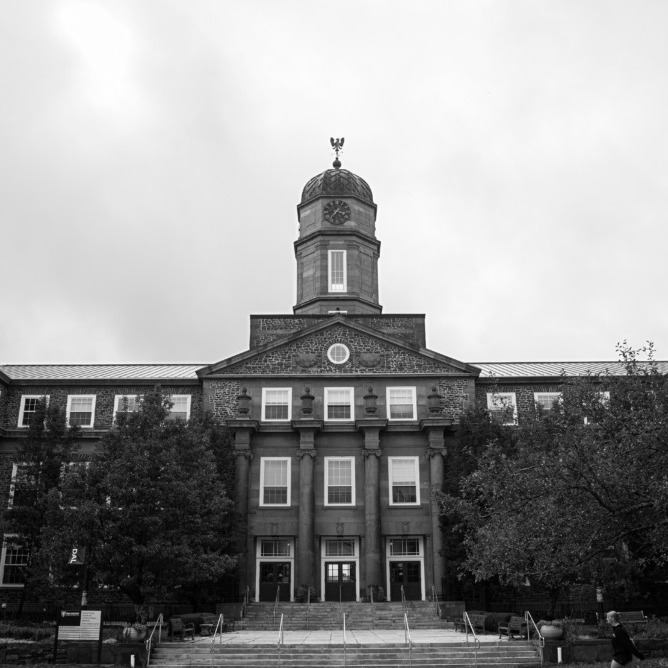
“The quality is already suffering:” Dal makes all faculties and units cut 6.3% of spending
Dal says cuts necessary to counteract increased wages from new union deals
October 22, 2026 / Charlotte Wood
Dalhousie University is making all faculties and units cut 6.3 per cent of their spending this year, a change professors say harms their work.
The cuts are part of Dal’s 2026-27 budget, where the university says that faculties and units are “required to absorb the cost” of $29.1 million of wage increases from multiple union agreements negotiated last year.
The faculties and units must find the cuts, or increase revenues equivalently, themselves. Dal’s faculty and units have a combined budget of $437 million.
Some faculty members say these cuts will — and are — negatively impacting their jobs and students’ education.
Jennifer Stamp, a psychology and neuroscience teaching fellow, has already begun to see the effects of a tightening budget, including the neuroscience program not renewing or replacing faculty.
“We’ve lost a lot of tech support,” she says. “We used to have a surgery technician, we used to have a histology technician, we used to have an electronics technician, and now we have none of those.”
“We’ve actually seen a drop in the number of majors, and I understand it,” says Stamp about the neuroscience program. “The quality is already suffering.”
Ajay Parasram, a professor of international development studies and history, also says the effects of these cuts have made it difficult to deliver a high-quality education to students. He says he’s seen class sizes grow as the number of available teaching assistants shrink.
“I think that a lot of these decisions are being made by people who do not teach or have not taught in a great number of years,” he says. “They don’t understand the importance of proper pedagogical design to achieve the high outcomes that we do.”
Dominic Silvio, Dalhousie Faculty Association president, points to larger class sizes being implemented within recent years and the effect that can have on a student’s education.
“What we hear is that now we have larger class sizes instead of smaller ones,” says Silvio. “Dalhousie used to pride itself on its small class sizes where students have that relationship with their instructors and professors.”
Dal signed a new collective agreement with the DFA, who represent almost 1,000 full-time faculty, last year, after locking the union off campus for four weeks during negotiations.
Dal also signed a new agreement with CUPE 3912, which represents part-time lecturers, TAs and markers. The university also renewed deals with two smaller unions representing administrative and technical support staff and grant-paid employees.
All of the unions got pay increases.
“The TAs won concessions on compensation and their last round of bargaining, and then the university met that by cutting their hours,” says Parasram. “It’s such a big deal because it has already fundamentally changed how we can teach our classes, and how we train our graduate students.”
In an introduction to the 2026-27 budget, then-provost and vice-president academic, Wanda Costen, did not sugarcoat Dal’s financial situation.
“Last year, for the first time in nearly 40 years, Dalhousie was unable to bring forward a balanced operating budget for Board approval,” she wrote, citing rising costs, limited government funding and cuts to international student visas.
“Bringing our operating revenues and expenditures back in alignment will take a multi-year effort, and we have seen Deans, Unit Leaders, and budget managers across the university grapple with difficult choices over the past year to move us forward on that path,” wrote Costen, who left the university in July.
The annual budget added $14.1 million of deficit, bringing the university’s total deficit to $34.6 million. Dal has pushed back its goal to rebalance the budget to 2028-29.

Read more from the gazette

Hundreds protest across Nova Scotia against Cape Breton AI data centre

Local university series fostered Jewish and Indigenous conversation and connections
Dal Student Life hosts not-so-haunted campus tour
Budgeting tips, from the provincial government
Hungover, Hungry and on a Budget