
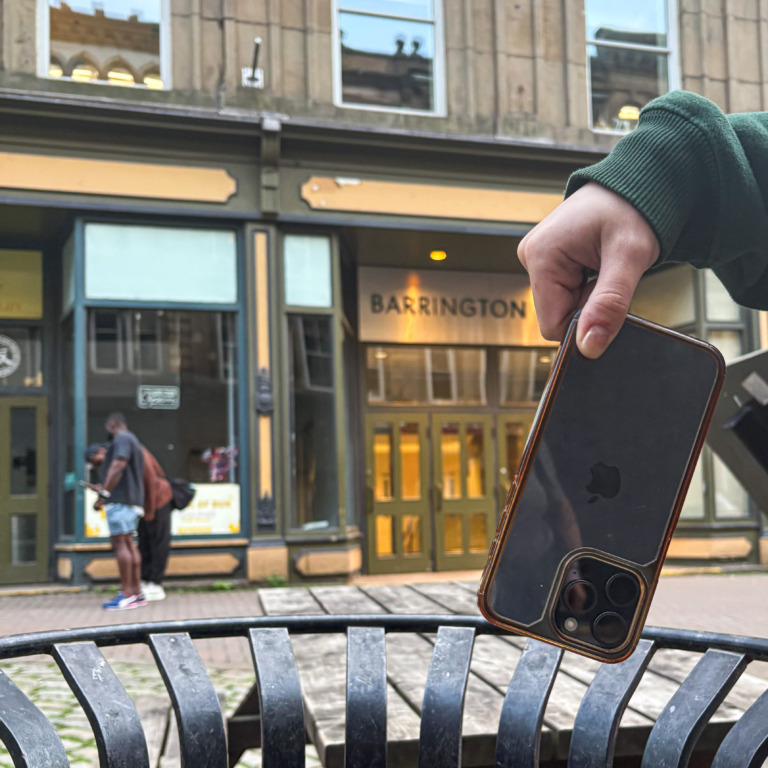
Please, don’t buy the new iPhone
Devices contribute to environmental and social impacts
October 22, 2026 / Mariana Luz
I remember how excited I was when I got my first phone — a pink flip phone that had belonged to my older sister.
I could call my mom, record about three seconds of poor-quality videos and play the snake game. That simplicity was enough for me.
Now, my phone can do pretty much anything. It holds years of memories in my camera roll, lets me contact anyone instantly, and it even lets me pay for my groceries. I don’t think I could survive without it.
Despite this, someone paying over $3,000 for the new iPhone Duo is absurd — especially if their current one still works perfectly fine.
I’ve had the same iPhone for almost five years, and my dad used it for three years before he gave it to me. Sure, it doesn’t have the best camera quality, and the battery life isn’t what it used to be, but I refuse to buy a new phone while mine still works.
When we are constantly bombarded with ads for new, shiny technology, it’s difficult to see our phones as something disposable.
Georgia Klein, the associate director of the college of sustainability at Dalhousie University, says the negative environmental impacts of smartphones begin before they even reach the hands of consumers.
She says a lot of these issues occur during resource extraction since smartphones contain metals and minerals from across the world.
“We hear about electric cars and how contentious the issue is with car batteries and resource extraction, but with the millions and billions of phones we are producing, it is actually the same problem.”
On Oct. 23, the iPhone Duo will be released as Apple’s first foldable phone. Some expect the company to sell around six million units in 2026. The iPhone Duo will be the 55th version of the iPhone released since the first was produced in 2007.
When one of the biggest tech companies releases a new phone every few months, it tells consumers their current phone is old and outdated. To sell and make a profit, they also sell the narrative that to fit in, you need the newest iPhone.
Truthfully, you don’t.
“Advertising is selling us that you are behind, you are poor, you are a complete loser if you don’t have the latest device,” says Klein. “We don’t really feel guilty about it because we think it will be recycled. But do you know where, or if, your iPhone is recycled?”
So how much of these rare earth metals actually go into producing the new one?
Although electronic recycling is a growing industry, only 17 per cent of consumers recycle their old phones, according to a 2026 Worldmetrics report.
For me, the problem isn’t owning something that will eventually end up in a landfill; it’s the constant, unnecessary replacement of products that still work and the disregard for proper disposal of those materials.
It’s almost impossible to live a completely sustainable life, especially on a student budget. Eventually, you will need to buy new clothes, groceries wrapped in plastic or even a new phone when yours stops working.
Sure, you can buy a product made with sustainability in mind or with recycled materials, but they’re usually more expensive than cheaply made in China.
This issue goes beyond environmental impacts. Resources used to build new phones may also be a product of child labour.
Children between the ages of five and 14 in the Democratic Republic of Congo face exhaustive labour conditions while mining coltan, a mineral used in cell phones and other electronic devices. Some have dropped out of school and now spend every day mining or carrying heavy loads of metal on foot, making as little as US$3 a day.
Not only do these kids have their childhood taken away from them, but there are also frequent deaths as a result of harsh and unregulated labour conditions in those mines.
By giving your money to companies that continue to exploit people and resources, you are directly contributing to the unjust treatment of those families and children.
Unfortunately, people will keep buying new phones they don’t need because their empathy will only go so far as their convenience. It’s easy to ignore others’ constant suffering when you have a shiny new phone in your hands.
For many, a gadget is more valuable than a life.
This isn’t to say you should throw away every Apple product you own or never buy an electronic device again — that’s unrealistic. Most people need a phone or computer to do work or school assignments.
Instead of buying a new iPhone every time it is released, consider keeping the one you already have or buying a phone second-hand. But know that if you read this and still want to buy the new iPhone, your conscience will carry the weight of a massive environmental footprint and could be linked to the daily suffering of thousands of people.

Read more from the gazette

The funding is lost, but the story goes on

Q&A with a member of the Gin and Jazz trio

“The quality is already suffering:” Dal makes all faculties and units cut 6.3% of spending
Could there be affordable housing hidden in Halifax? This group thinks so
Phoebe Bridgers wants you to be in the moment