The funding is lost, but the story goes on
Writers’ Federation of Nova Scotia hosts 5th Booktoberfest
October 22, 2026 / Ellie Garry-Jones
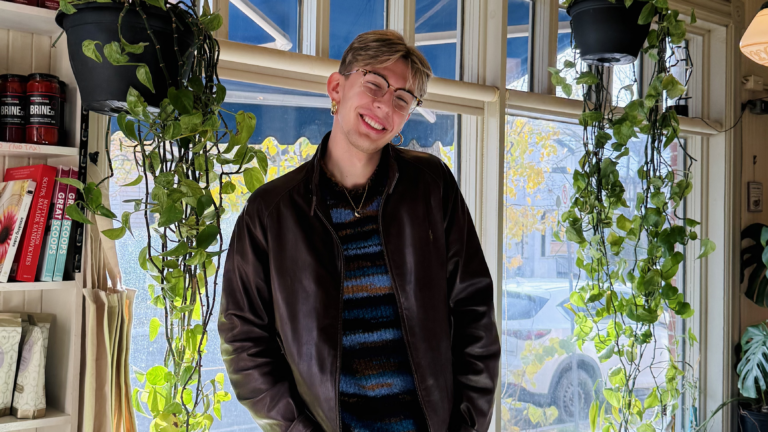
K.R. Byggdin always assumed stories were somewhere else: on the backroads of rural England, under the neon lights of New York City, on a Parisian terrace overlooking the Champs Élysées. Anywhere but here. The idea that a book could take place on Barrington Street or the Southern Shore was so foreign to them it took becoming an author to realize how powerful local storytelling can be.
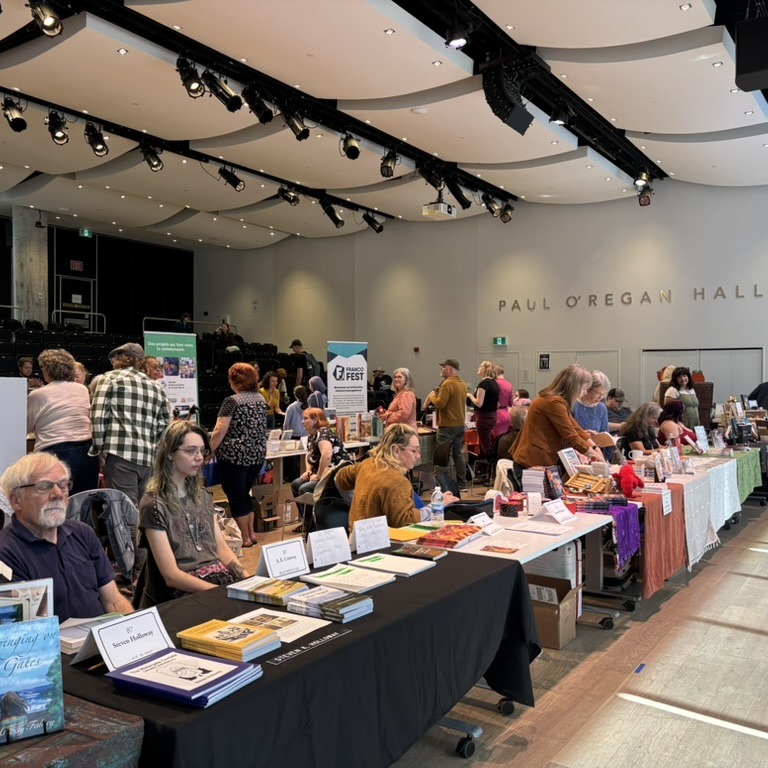
On Oct. 3, more than 50 Nova Scotian authors funnelled into the Halifax Central Library for Booktoberfest, the city’s largest literary showcase. Since 2022, the Writers’ Federation of Nova Scotia has brought together authors whose books were published in the previous year to give them something bookstores cannot always offer: an audience.
“It’s a time to say, ‘look at what we’ve accomplished,’” says Byggdin, Dalhousie University graduate and events coordinator for WFNS.
Booktoberfest was born during the pandemic, when books were published into silence.
“As these books were coming out, no one knew about them or had the chance to celebrate them,” Byggdin says. “Booktoberfest gave those authors the launch they never got.”
Now, it’s an annual showcase of the province’s robust creative industry. Around the room, there are mysteries set in small fishing towns, queer coming-of-age stories, children’s books about lighthouses and novels that grapple with climate change.
At Booktoberfest, authors of every genre get the chance to table, sell their work and talk to readers face to face. Throughout the day, literary diehards, curious passersby and everyone in between can drop in for readings and workshops — all free to attend.
This year, Booktoberfest hit closer to home.
“It’s harder than ever for local publishers and local writers,” says Carol Bruneau, an award-winning author from Spryfield, N.S. “The provincial government has assaulted the arts.”
In February 2026, the province axed the Publishers Assistance Fund, a $700,000 program that helped Nova Scotian books get published. The cut leaves Nova Scotia as the only province in Canada with no direct government support for publishers.
For Oriana Duinker, the executive director of the WFNS, the consequences reach beyond the publishing industry.
“It’s all an ecosystem that’s very well connected,” she says. In the publishing world, Duinker argues, the math is simple and unforgiving. Without funds, publishers are less willing to gamble on lesser-known or emerging local authors.
The result?
“Fewer Nova Scotian stories are going to be told,” she says.
Bruneau, who has based nearly all of her novels in Nova Scotia, knows the stakes firsthand. When she first started out, her publisher was in Toronto.
“I probably got more exposure there, even though I was based here,” she says. Getting her books to readers in the East Coast proved more difficult. “Books don’t travel to the rest of Canada as easily. Distribution is hard.”
Provided, when the books do arrive, readers are there to pick them up. “It’s unfortunate when people look outside the region for things they would consider excellent when we have a lot of excellence here,” says Bruneau
On Oct. 3, at least, Halifax knew where to look.
In the Paul O’Regan Hall, authors sit at their tables, years of hard work fanned around them. The smell of pages, fresh off the press, hangs in the air as readers drift from one author to the next. Whatever the provincial government has cut, it hasn’t cut this.
It begs the question: if the literary infrastructure is so precarious, what keeps Nova Scotian soil such fertile ground for writers? The answer is in the room. And, as the authors will say, in the ground beneath it.
“We live in a very scenic, creative environment and culture that evokes a lot of imagination,” says Sherri Aikenhead, author, former journalist and University of King’s College alum.
History and the tradition of storytelling are embedded in the province’s culture, Bruenau says. Set against an “undeniably beautiful” landscape, “All of those things working in combination makes for a really strong literature.”
But at Booktoberfest, the scenery is beside the point. What fills the room is the people who put Nova Scotia on the page, so readers can find themselves, and their own streets, in a book.
Bruneau has seen what that support does. “There is something about the scale of a place that lends itself to community. Stories are born out of community, but they also bring community together.”
The funding may be gone, but the stories certainly are not.
And this one is far from over.

Read more from the gazette
Hundreds protest against Cape Breton AI data centre in Halifax
Local university series fostered Jewish and Indigenous conversation and connections
Dal Student Life hosts not-so-haunted campus tour
Budgeting tips, from the provincial government
Hungover, Hungry and on a Budget