For one weekend only, Halifax’s (and Dartmouth’s) streets are buzzing and filled with art-lovers. On every street, people gather around eye-catching art installations to immerse themselves in the wonders of artistic creation.
Nocturne provides an accessible platform for artists in the city to come together and share their love for one thing: community.
At this year’s Nocturne, Gazette staff braced the freezing October air to report on the great art Halifax has to offer.
Francofest présente “Depuis ce temps là (contes et légendes du Québec)”
Par Jacqueline Graif, assistant arts and culture editor
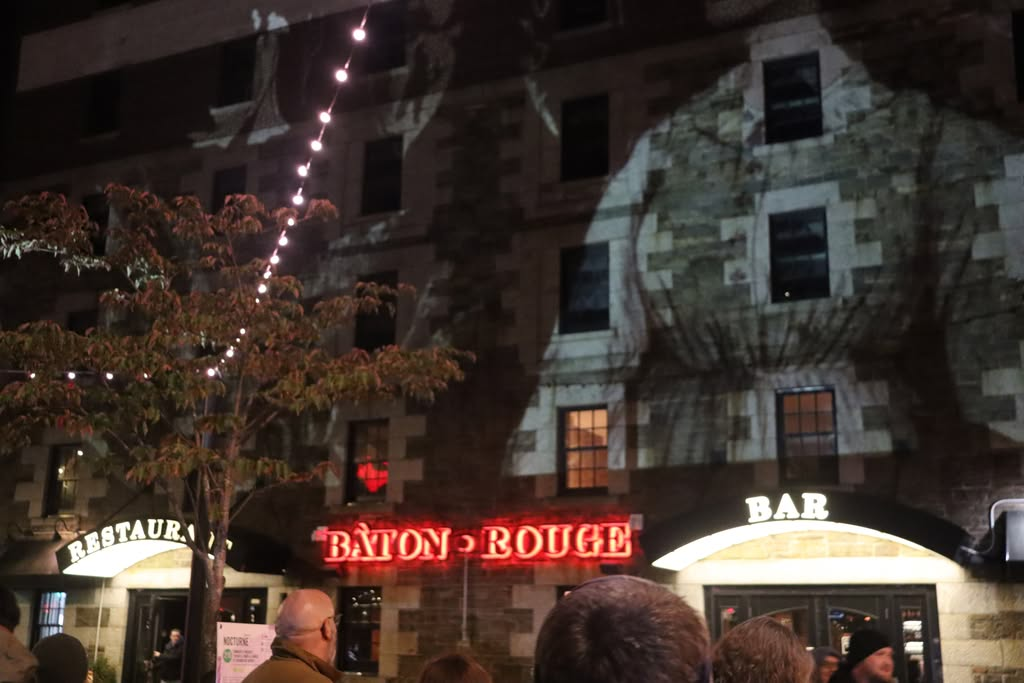
Dans un alcôve à côté du restaurant Bâton-Rouge Grillhouse et Bar, l’histoire du Québec est projetée sur un gros mur.
Samuel Charrois, un musicien et artiste visuel, utilise des mythes québécois pour illustrer l’histoire francophone à Halifax.
Pour «Depuis ce temps là (contes et légendes du Québec),» les mythes et légendes sont illustrés de façon humoristique et dramatisée. Les contes sont bruyants, et attirent l’attention des passants. Avec de belles couleurs, et de la musique captivante, c’est impossible de ne pas remarquer cette exposition.
Avec l’aide du Francofest, c’est un plaisir de découvrir la culture francophone à Halifax.
«Je partais pour faire un projet rassembleur pas juste pour le Québec, mais pour la francophonie en général,» explique Charrois.
Avec 12 à 15 contes différents, le spectacle visuel dure environ 55 minutes. Pour une partie de la soirée, Charrois suit les projections dynamiques avec de la musique en direct. Il accompagne au piano les histoires qui défilent à l’écran.
Avec une si belle représentation francophone, c’est une exposition à ne pas manquer.
ENGLISH TRANSLATION:
In an alcove next to downtown’s Bâton Rouge Grillhouse and Bar, the history of Quebec is projected on a large wall.
Samuel Charrois, a musician and visual artist, uses Quebecois myths to illustrate francophone history in Halifax.
In “Depuis ce temps-là (contes et légendes du Québec),” the myths and legends are illustrated in a comedic and dramatic fashion. The stories are loud and grab passersby attention. With beautiful colours and captivating music, it’s impossible to miss this exhibition.
With help from Francofest, it’s a pleasure to see francophone culture featured in Halifax.
“I set out to create a project that would bring people together—not just for Quebec, but for the French-speaking world as a whole,” says Charrois. (This quote has been translated from French)
With 12 to 15 stories, the show lasts around 55 minutes. For part of the evening, Charrois follows the vibrant projections with live music. As the stories unfold, Charrois’ music accompanies them seamlessly.
With such wonderful francophone representation, it is not an exhibit to miss.
“Suns in the Nightsky”
Jacqueline Graif, assistant arts and culture editor
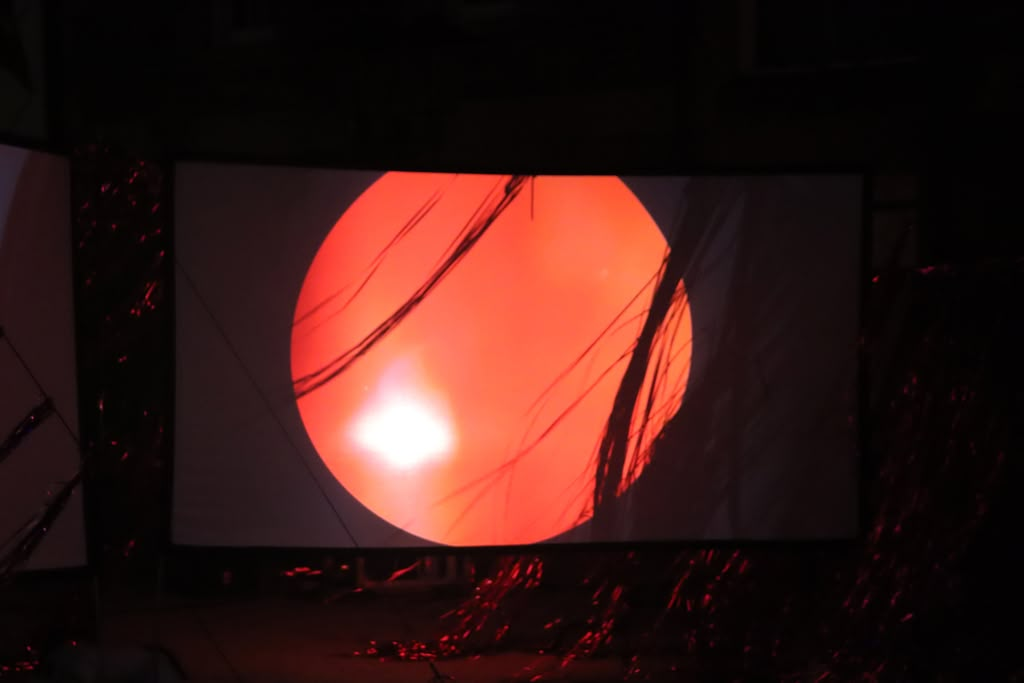
Next to the Halifax waterfront, a dark alleyway is lined with two large screens and pink tinsel flying in the wind.
Loud club music plays as passersby are immersed in Halifax’s queer nightlife. For “Suns in the Nightsky,” the goal was to turn a pocket of the city into an outdoor queerclub.
The videos on the screens are the star of the show. With various videography and photography from club nightlife, the visuals are intoxicating and feverish. The loud thump of the music and ever-changing videos and photos make viewers feel immersed in a vibrant club.
Two screens face the viewer, and without other people around, the scene feels bleak. If more people were attending the event, it would likely be more engaging. The location given to “Suns in the Nightsky” keeps people from finding this pocket of excitement.
“Suns in the Nightsky” turns a dark pocket of downtown into a vibrant LGBTQ+ club for just one weekend.
“Fit Check: Craft You Can Wear”
By Ellie Gary-Jones
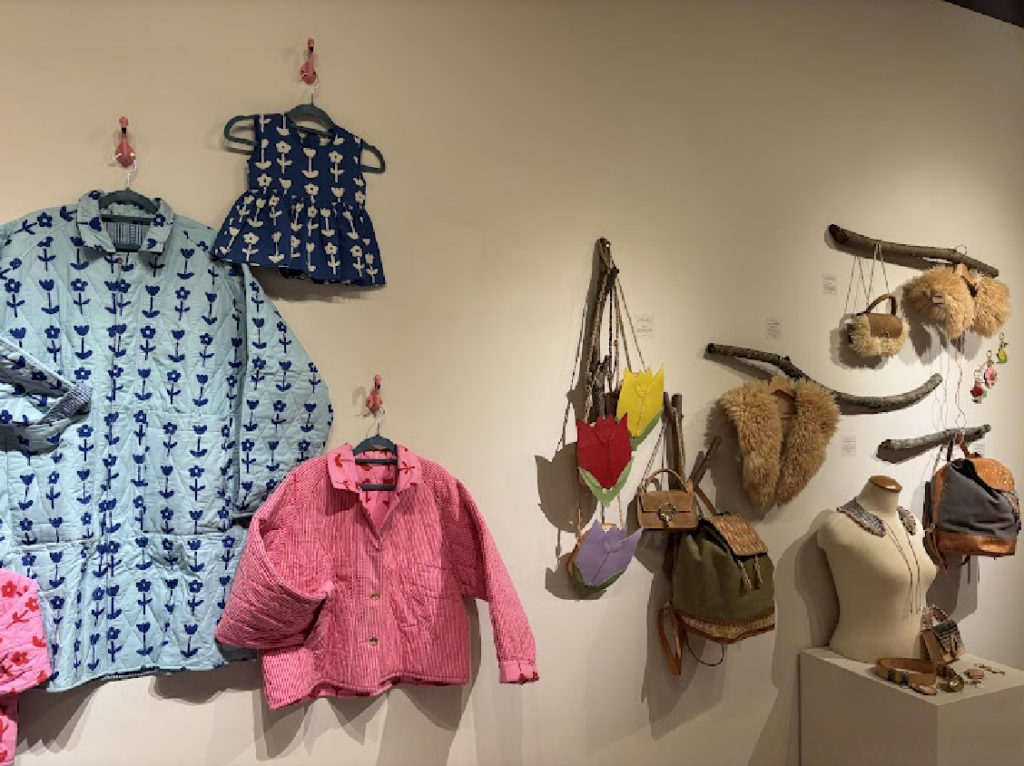
On Barrington Street, the handcrafted jewellery, textiles, and ceramics behind the glass of Verve Fine Craft Gallery serve as eye candy for passersby. On Nocturne Night, however, the gallery opened its doors for those who may identify as window-shoppers to not only touch, but try on hand-stitched leather, hand-painted scarves, or sheepskin collars. The exhibit, “Fit Check: Craft You Can Wear”, celebrates wearable art in an interactive and tactile experience.
“Sometimes it feels a little nerve-wracking to try something on if you know it’s not in your price budget, so the event makes a safer space to try things on,” says Hannah Craig, an artist at Verve.
Laura Hambleton (Skunks N’ Roses), Maggie MacCormick (Daytime People) and Pam Juarez, the artists who facilitated the items at the exhibit, believe that clothing is art. The exhibit urged Halifax to revel in that idea by experiencing the sensory joy that comes from wearing art and how it can transform the way we carry ourselves through the city.
“Music of the City; Embodied City”
By Ellie Gary-Jones
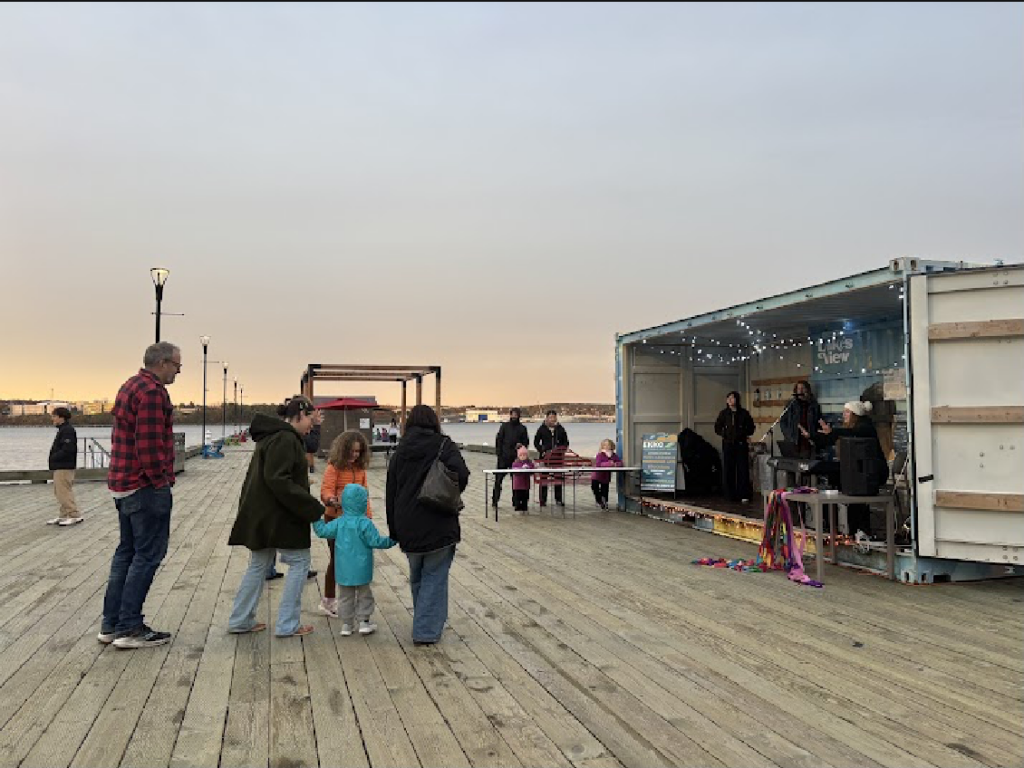
As the sun sets over the Halifax Waterfront, dance moves start to come out. A bounce in the knees, a sway of the hips, a tap of the foot — in no time, a crowd ranging in age from four to 74 dances in unison to a stranger’s chords. Each year, Ekko Performing Arts Society, a nonprofit music school, participates in Nocturne as a community group. This year they present “Music of the City; Embodied City”, an interactive experience that invites festivalgoers to experiment with instruments, listen to local talent, or join in a game of freeze-dance. The idea, according to Reagan Mae Kuzyk, Ekko’s Director of Community Engagement, is “public play.”
“Music brings people together. Even if you don’t speak the same language, you can still connect,” says Kuzyk. Through the exhibit, Ekko explores what happens when people are brought together in one space and given the opportunity to make music.
“Somebody you might not know might play for you, and you might sing for them. That’s the best part,” Kuzyk says.
“Butcher’s Block”
By Torrence Matheson
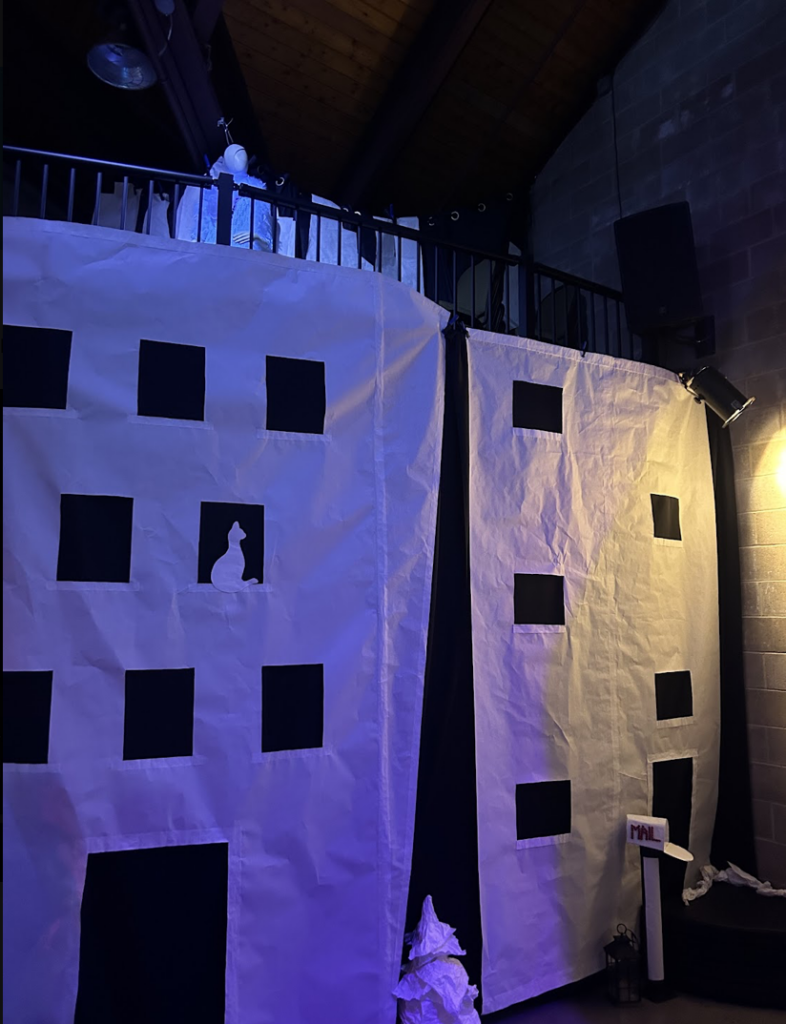
“Butcher’s Block” was a paper city art exhibit put on by Breaking Circus Collective. It’s an incredibly thought-provoking piece. The exhibit featured rotating events every thirty minutes, including breakdancing, aerial performances and more. After speaking with Dawn Shepherd, a co-founder of Breaking Circus Collective and performer during the exhibit, I learned the art illustrates the collapse of third spaces. The paper city was taken down after one night, representing how fragile current third spaces are and emphasizing how vital they are for human connection.
Butcher’s Block stresses the importance of social cohesion within the purple-lit paper city. “Butcher’s Block” became the embodiment of this social cohesion through its rotating events. The exhibit highlights the Turret Arts Space Society, historically a queer nightclub in Halifax and now an arts space. “Butcher’s Block” advocated for keeping the society’s space for community, as its area is currently at risk of being purchased by the city. Ultimately, the exhibit was a wonderful and immersive experience that captured the importance of maintaining these third spaces.
“Red Earth/Black Sea”
By Dylan Follett, news editor
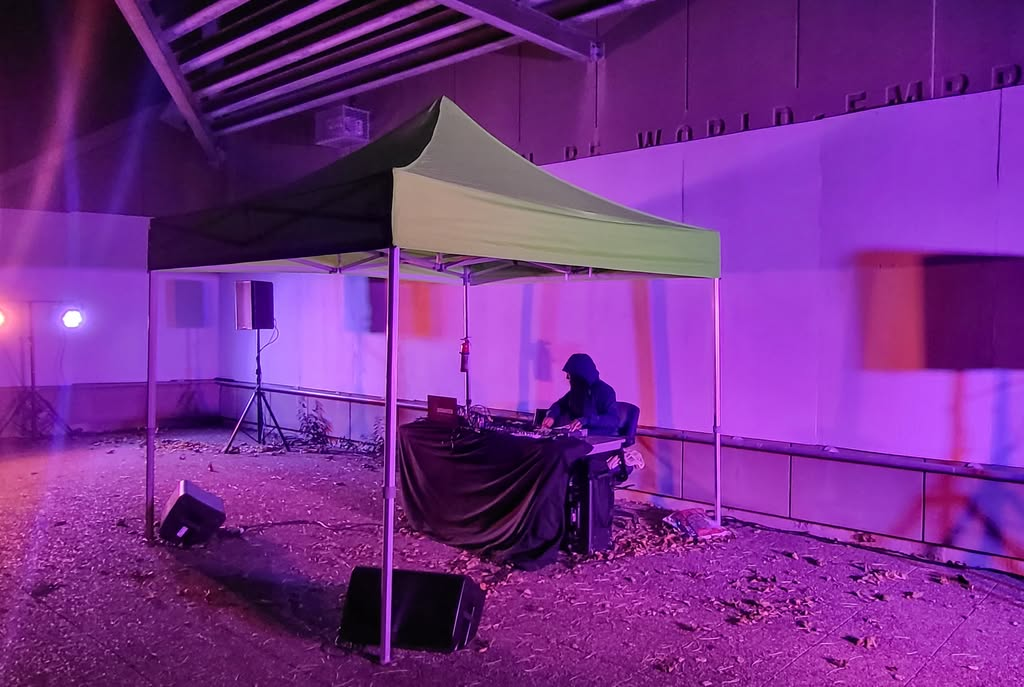
Nestled in the World Peace Pavilion, a trapezoidal concrete quazi-bunker on the Dartmouth waterfront, was “Red Earth/Black Sea,” the only audio anchor project at Nocturne.
The project, from artist Rena Anakwe, combined voice, found audio and looping synths to examine “connections, past and present, between African Nova Scotians, Black Canadians and the African diaspora.
The exhibit had a lot to overcome. It was visually unimpressive; a lime green canopy tent over a wrinkled tablecloth with messy wires. It was in Dartmouth. It was hard to tell if a constant whine over the speakers was art or a technical problem.
But if you sat and listened long enough, the crackling speakers faded away and you heard the interesting and intricate aural patterns Anakwe seemingly developed on the spot.
“Red Earth/Black Sea” forced you to be physically present, to stop wondering when the next ferry back to Halifax was, and if you could do that, you were invited into an unique art experience, which Anakwe says is inspired by the community of Africville.
An interesting and thought-provoking exhibit, but only if you have the time.
“Layers”
By Dylan Follett, news editor
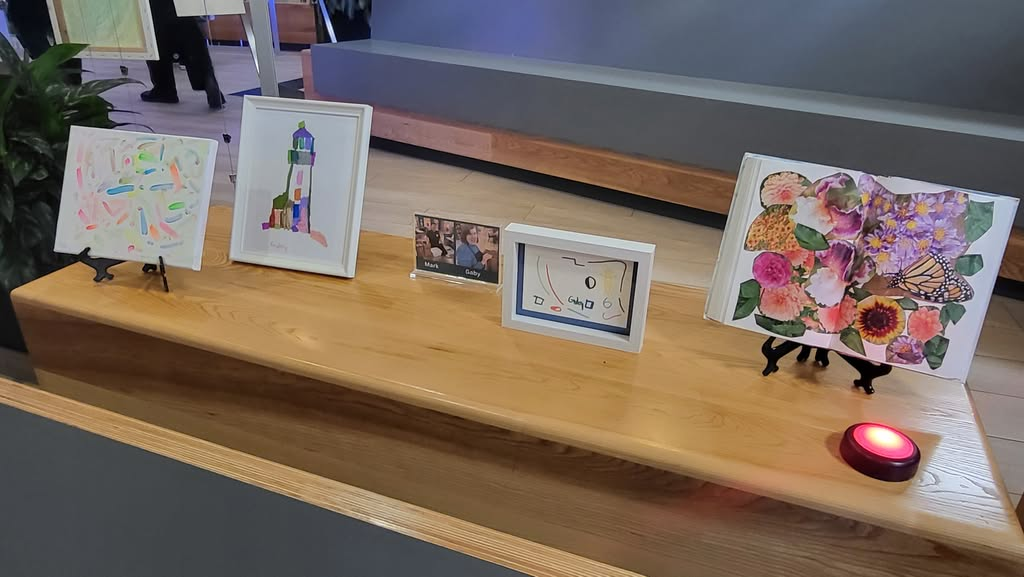
Inside Dartmouth’s Alderney Library, which borders the bus and ferry terminal, was “Layers,” a Nocturne exhibit by the Dartmouth Adult Services Centre Artists.
The centre serves people with intellectual disabilities or fragile health complex needs. Art from its members was displayed in the lobby, catching the eye of Nocturne-goers and passersby alike.
While “Layers” only had a small area for its exhibition, it was packed full with a huge quantity, and variety of work. Pieces ranged in style — from a painting of a Canadian Tire to abstract mixed media works incorporating text and pain — as well as medium — from canvas portraits to painted landline phones.
The gateway to five other exhibits all within two blocks, “Layers” was a robust, fun and interesting — if a little cramped — artistic experience to begin your Dartmouth Nocturne adventure.
“(Un)Seen City: Systems Between”
By Grace Kim, assistant opinions editor
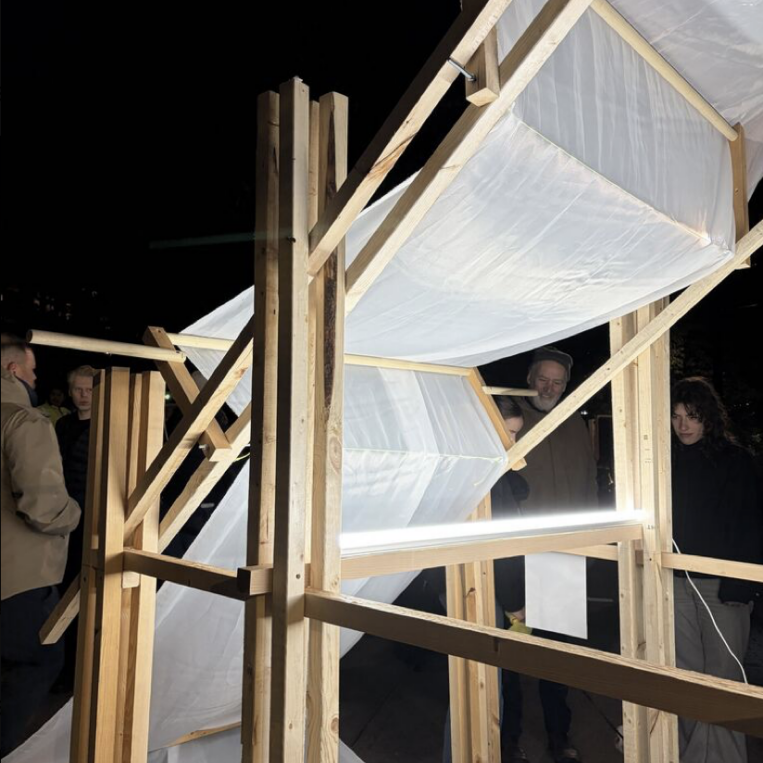
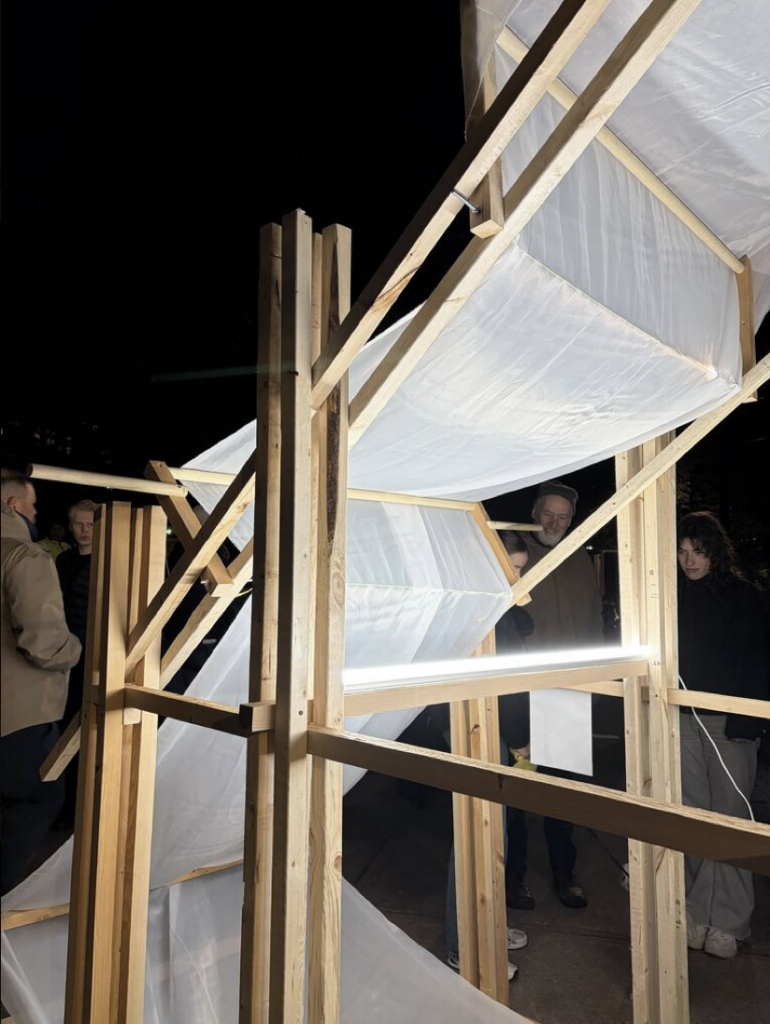
“(Un)Seen City: Systems Between” challenges viewers to consider how our lives are intertwined through a city’s physicality. The installation transforms a commonly crossed walkway into a jungle gym of interactive experiences. From giant wood walls to projections of a garbage can’s insides, the message of the inventions are conclusive: the overlooked systems of an urban area deserve our thought and attention.
Although the installation’s intention is compelling, the execution is unclear and poorly coordinated, which hinders the viewer’s experience. The layout is confusing, making it difficult to navigate where it starts and ends. The projections come in and out, causing some to miss key moments, and often the unique interactive aspects, such as the recreation of a sewer fall a little flat without explanation.
The installation’s strength lies in its ability to create a pocket of community over something simple, like neon strings representing the flow of electricity. The exhibit forces viewers to work together to create shapes and ties. Aside from that, the ambition of the pieces is too expansive to properly articulate the crux of its ideas and didn’t change the way I feel about dull entities.
Tiny Wooden Robots – Vol II
By Charlotte Wood
Artist LoHiFi, also known as Chris Little, hosted his second-ever Nocturne exhibit on Saturday.
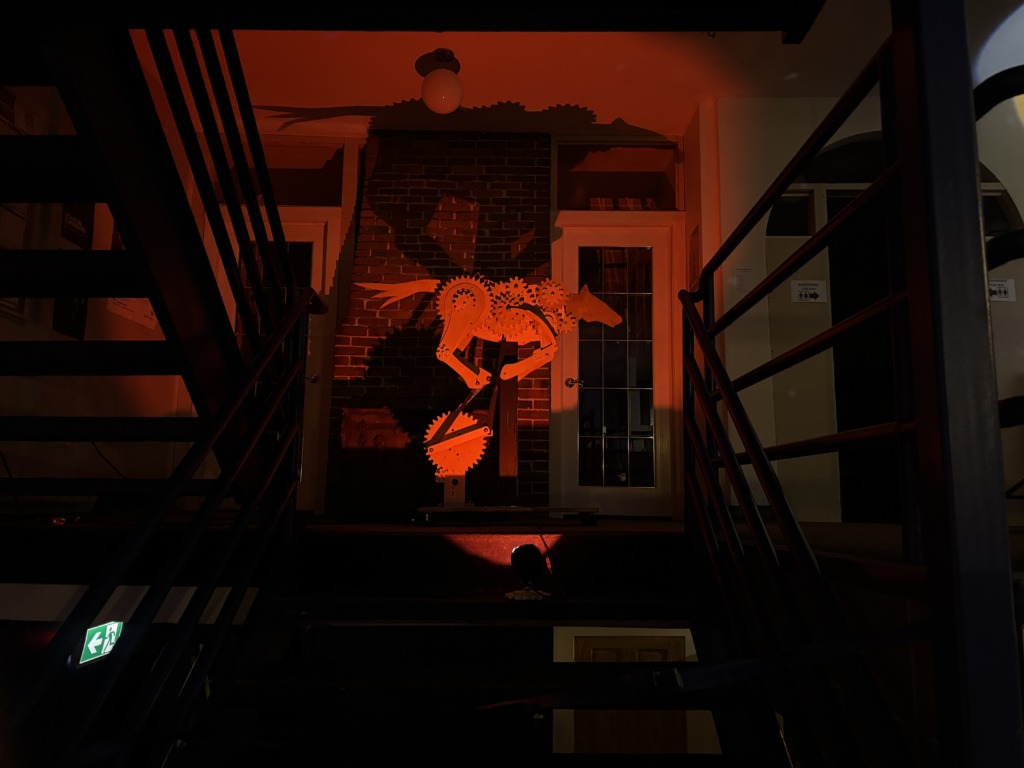
Little creates automatons — or automated puppets. Little’s exhibit, “Tiny Wooden Robots – Vol II,” was hosted in a tall building on Qunipool Road that used to be home to Video Difference.
When you enter the building, your eyes are met with blue and red lights. Amongst all of the automatons in the exhibit, what caught my eye were the wooden animals dispersed among the flight of stairs. The automaton animals were in constant motion.
Below the stairs were the rest of the automatons, each with a button for visitors to press. Once the button was pressed, each automaton carried out a different performance. One that stood out was a puppet sat at a desk wearing glasses and holding a quill pen. This puppet began to furiously write a letter after you pressed its button.
“Tiny Wooden Robots – Vol II” was a wonderful display of automata as art, while also demonstrating the level of work and engineering behind each automaton. The interaction one could have with each automaton made the exhibit unforgettable.
“City You Imagined”
By Ryan Bradbury, assistant sports editor
Tucked away on the outskirts of Nocturne lies “City You Imagined,” a vibrant depiction of an evolving city. Fake cornfields were erected, and a giant hollow fish was placed in the middle of the exhibit for people to walk through. The fish was a fan favourite, as kids raced through the fish with their friends. A fog machine provided an eerie atmosphere and appeared to be appreciated by those partaking in the event. People took photos in front of the cornfield, and everyone appeared to enjoy the overall experience. Those present slowly walked around trying to take it all in. “City You Imagined” is a clever take on how everyone can control a city, and it was certainly portrayed as such. The eclectic collection of corn and fish surrounded by fog was unique and demonstrated how a city can truly become whatever anyone wants it to be.
“Breaking Bread”
By Ryan Bradbury, assistant sports editor
Down by the Halifax Waterfront, a collection of art produced by local artist Kaashif Ghanie is on display. The exhibit is called “Breaking Bread” and consists of ceramic pottery influenced by Islamic heritage. Those meandering around can enjoy all there is to see, and no one stays in one place for very long. Despite having limited space, the room feels bigger with a plethora of blue and white pottery lining the walls. People stop to talk about the pottery’s intricacies, and many people stop in their tracks upon seeing the detailed creations in the middle of the room. The ceramics combine personal history with art and convey meaning through a wide variety of blue and white pieces. This leaves those present with the ability to interpret the art’s meaning in their own special way, which is exactly what “Breaking Bread” is designed for.
“The Art of Birding”
By Lukas Kohler, features editor
“The Art of Birding” brought together three artists, Suzanne Rent, Andy Stadnyk and Jessica Helson to showcase work revolving around their love for birds. Stadnyk says when organizing this exhibit, he hoped to create a space for birders to talk with others who share the interest. The exhibit displayed photography, paintings and feltings. It was obvious through the artwork’s detail that each artist cared about the natural world and its inhabitants. Stadnyk’s photography perfectly captures the essence of Nova Scotian wilderness through the lens of avian life. The exhibit was filled with individuals admiring the artwork occupying its walls and inspiring conversations among birders, fulfilling Stadnyk’s hope of creating a space for people who share his hobby.
“Places to Land”
By Hailey Jackson, assistant news editor
“Places to Land” challenges where we’re allowed to be vulnerable by turning a pedestrian thoroughfare into a comfortable space to relax. Set against the backdrop of the Halifax Central Library, the piece consists of large beanbag chairs on which the public is invited to sit. The beanbags were printed with images of rest using cyanotype, a process where a negative is placed on chemically treated paper and exposed to sunlight, creating a blue copy. As visitors came and went, the artist, Amber Helene Müller St. Thomas, moved silently between them, adding small cushions and banners which further extended the invitation to rest. The piece provokes thoughts about how spaces change when we’re permitted to pause, decompress or be silly. It interrupts the expectation that we should move efficiently through public spaces and that relaxation is vulnerable and therefore private. People took the opportunity to jump, lie down or sit and reflect on the chairs. Seeing each visitor’s different instincts added a welcome aspect of community-building to the experience. The piece is thoroughly engaging and successfully made me rethink what public spaces should feel like.
“The Acoustic World Of Whales”
By Noemi Ryan
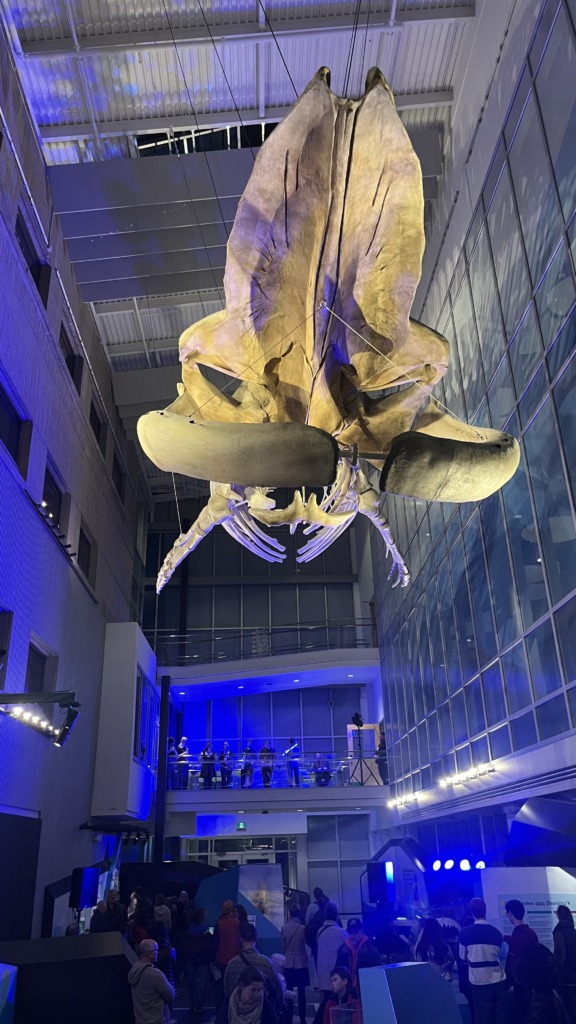
“The Acoustic World of Whales” takes you below the surface to explore whale sounds through underwater recordings, computer sound processing and musical composition.
Stop by for a minute or spend an hour listening to the movements composer Nashim Gargari put together. The atmosphere felt calm and serene at times, frantic and intense at others. But it was always beautiful and kept you involved.
Along with prerecorded and composed music and sound, there was an improvised, live performance by students from the Fountain School of Performing Arts. The result: a shaking drum mixed with whale noises and the sounds of various other instruments. The chatter of the audience mixed with the music gave the impression of a busy and flourishing ecosystem.
I enjoyed the relationship between animal communication and the presence of ship engines and sonar noises. The whole experience drove me to be more curious about how these relationships play out in real life.
“Cradling Peace in the Arms of Time: Turn back the Clock for Nuclear Disarmament”
By Hazel Somerville
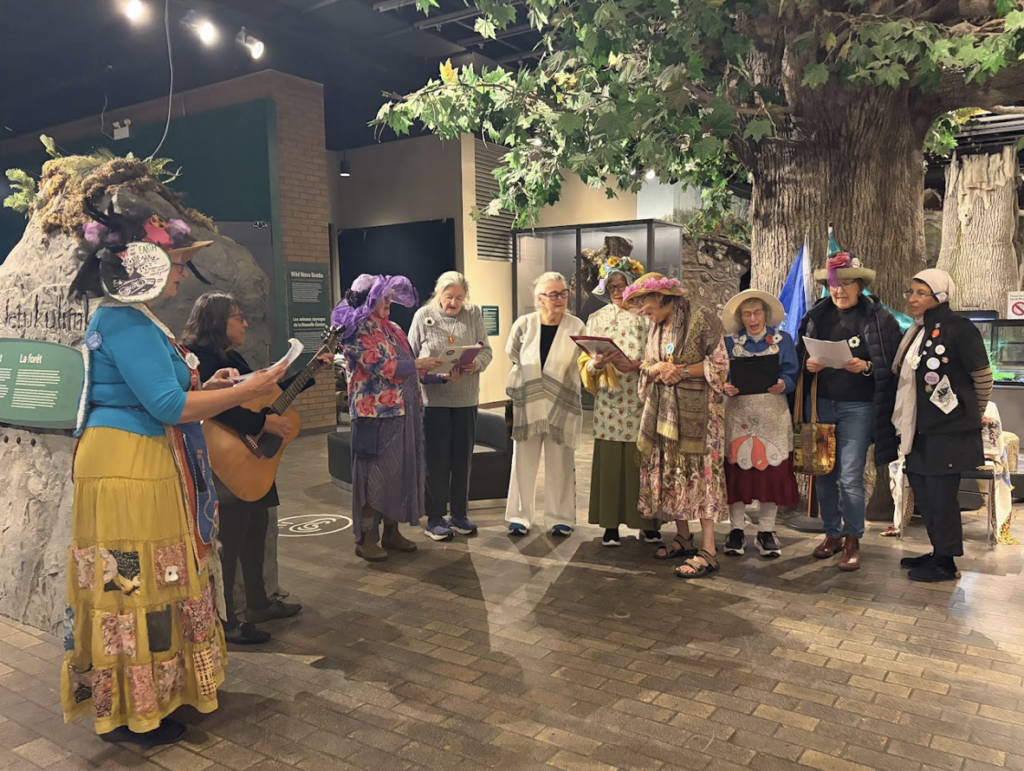
“Cradling Peace in the Arms of Time” was a powerful reminder that the possibility of peace rests in the hands of the community. Artist Kathrin Winkler uses The Bulletin of Atomic Scientists’s Doomsday Clock in her exhibition — a clock set at 85 seconds to midnight, representing our proximity to the catastrophe of climate change, nuclear arms and most recently, AI technology.
Winkler positions the Doomsday Clock around a dozen mini-clocks, each representing a different global crisis. The piece was made from paper plates and posterboard. The homemade quality rejects aesthetics in favour of mundanity and political protest. The exhibit, held in Halifax’s Natural History Museum, was surrounded by taxidermy wildlife: strange, but a reminder that our apathy has a cost.
Nova Scotia Voice of Women for Peace and the Raging Grannies supported the piece. Participants spun a colourful wheel and were instructed to support peace initiatives. Each participant flipped a number on a scoreboard. While the aesthetics and interactive component were slightly underwhelming, this made the piece’s meaning resonant: the fight for peace does not need to be flashy, and it is each person’s solidarity that will help turn the clock counterclockwise.
“The Embellishers Take Nocturne 2026”
By Alyssia Halvorsen
“The Embellishers” took participants’ everyday clothes and created tiny embroidery — done in a flash. Available styles included the popular Sullivan’s pond geese, a donair or a duck toller dog.
The exhibit was in the Downtown Business Commission’s office — a small but brightly lit room. Attendees filled out a form to request a specific embroidery and where they would like it. Popular songs played from a speaker, and tabletops were littered with tiny spools of colourful thread.
I dropped off a thrifted purple T-shirt and chose a grey rain boot to be embroidered on the bottom corner. My name and phone number were collected before I was off to see what else Nocturne had to offer.
An hour and a half after drop-off, I received a text that my item was ready for pickup. By 11 p.m., the once busy office was nearly empty. Hung on a back rack was my T-shirt, with a little boot stitched on.
“The Embellishers” created an exciting opportunity for people to take already loved clothing and make it a little more personal.
“Held (in) — Tension”
By Alyssia Halvorsen
Walking into “Held (in)—Tension” by Gabe Moore was, at first, a confusing experience. On the walls, a projector showed abstract black-and-white moving pieces. The back wall was a stretched canvas of black plastic, and behind it, microphones captured the sound of the plastic moving. Plastic bags of various shapes and sizes were scattered on the ground.
“The idea of the piece is based on giving people the chance to experiment and to play and try to find that sense of discovery,” says Moore.
At first, participants seemed nervous to play with sound, talking quietly into microphones or gently tapping the black plastic tarp at the back. As attendees gained confidence, the imagery on the screen changed in exciting new ways.
The interactive video showed particles of the room. Input from the microphones changed the way the particles moved.
Attendees sang high, drawn-out notes, or banged their hands against the plastic tarp, all the while watching the screen to see how their noise altered the visuals.
“I really wanted this to be a place where you can release,” says Moore.
“28th Annual Mosaic for Mental Health”
By Ryan Cleland
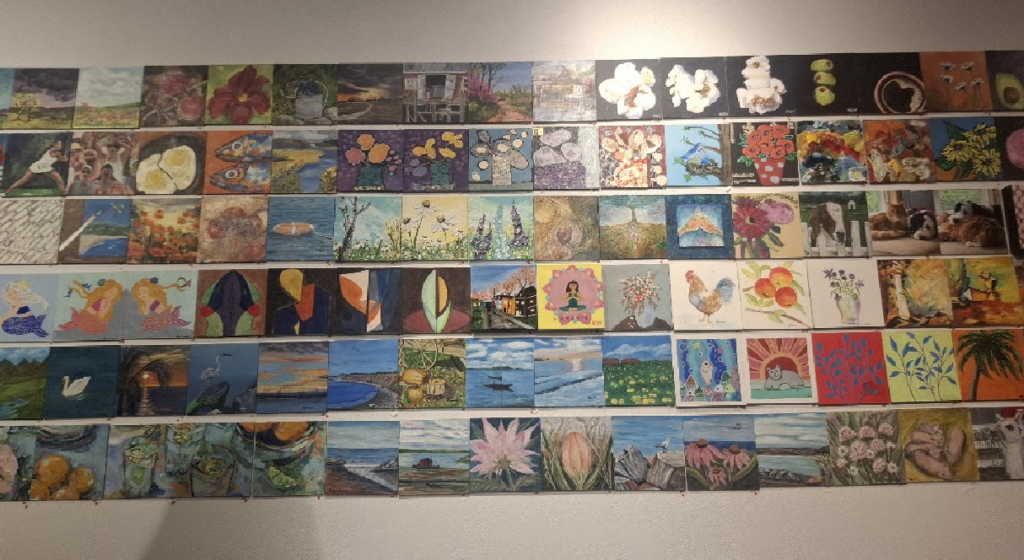
For the 28th year running, the Canadian Mental Health Association’s Dartmouth-Halifax branch ran its “Mosaic for Mental Health,” an initiative that sees hundreds of artists contribute over 1,000 six-by-six-inch tiles to create a beautifully intricate mosaic.
Housed at the Craig Gallery, a myriad of art styles were on display, from rug tufting to traditional paintings. With no direct theme or prompt, the artists stretched their creative muscle in whatever way they saw fit.
Some showcased photos of their pets and others delved further, using their art to focus on mental health.
Walking around the gallery, different shapes protruded from the wall as artists took liberty with the space provided. Some pieces used thicker wooden blocks, and there was a section displaying glass tiles.
For $35, you can even own a piece of the Mosaic, with every tile being available for purchase. Calendars and card reproductions were also available, as well as a silent auction for a select few tiles.
With contributions from artists from all around Nova Scotia, the work will be displayed until Oct. 27. And all proceeds will directly support the Branch’s Social Connection programs to support “adults in the community living with mental illness and mental health concerns”.
“Charcoal Art & Contra Dance”
By Laura Publicover
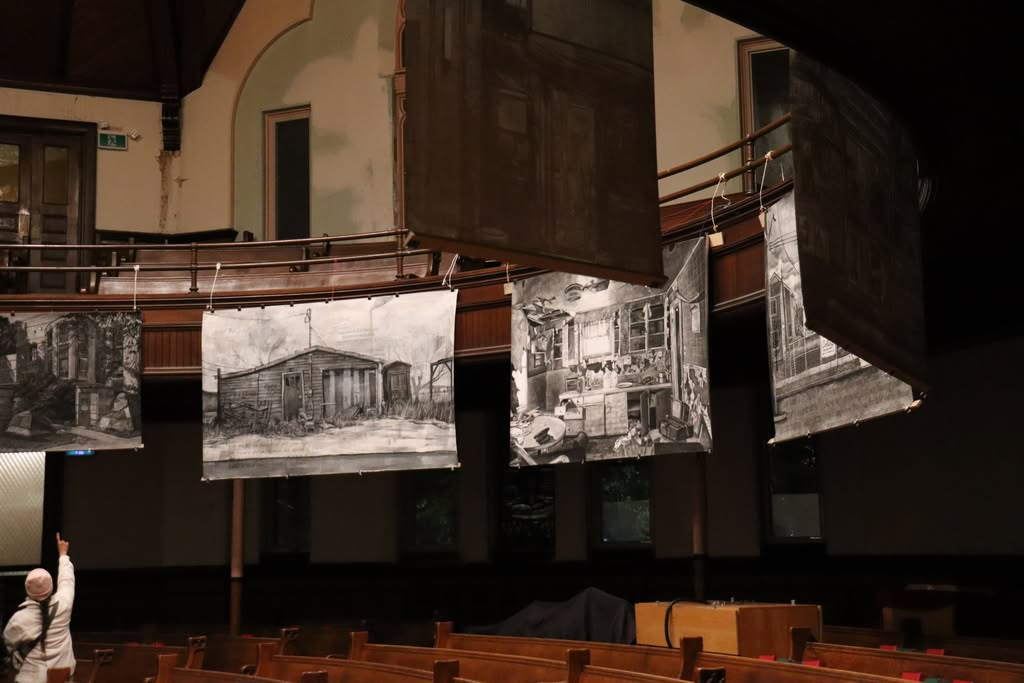
In the sanctuary of All Nations Church, Curtis Botham’s enormous charcoal drawings hung suspended over the rows of pews. The images — some as long as eight feet — depicted real scenes of poverty and the struggle for affordable housing in Nova Scotia. Several pieces had lines of text subtly etched into the foreground — quotes from articles calling out the Nova Scotia government’s lack of homelessness prevention strategies. After the slash to arts funding, Botham’s work reminds viewers of the danger of profit over quality of life.
One room over, a band played for a crowd of dancers. Halifax Contra Dances hosts monthly folk dances at the All Nations Church from September through May. This month, they joined Nocturne and hosted their event for free, bringing in newcomers and experienced dancers alike. People of all ages held hands and spun across the dance floor, switching partners and encouraging bystanders to join in. As the night went on, the dances got more advanced. Luckily for newcomers, an instructor was there to clap participants through every step. While no experience is required, it certainly helps to know right from left before joining.
“Ink, Paper, Imagination”:
By Maïa Dalla-Costa
In 2011, graphic designer Andrea Rahal1 opened Inkwell Modern Handmade, a boutique located right across from the Halifax Public Gardens. Rahal’s ocean-blue storefront is immediately eye-catching and invites you to explore a diverse range of handmade products from over 200 artists2 in a bright and colourful environment.
That same year, Rahal, alongside her partner Daniel Macdonald,3 opened Inkwell Original — a letterpress studio where they create greeting cards, prints and coasters4 inspired by their closeness to the sea.
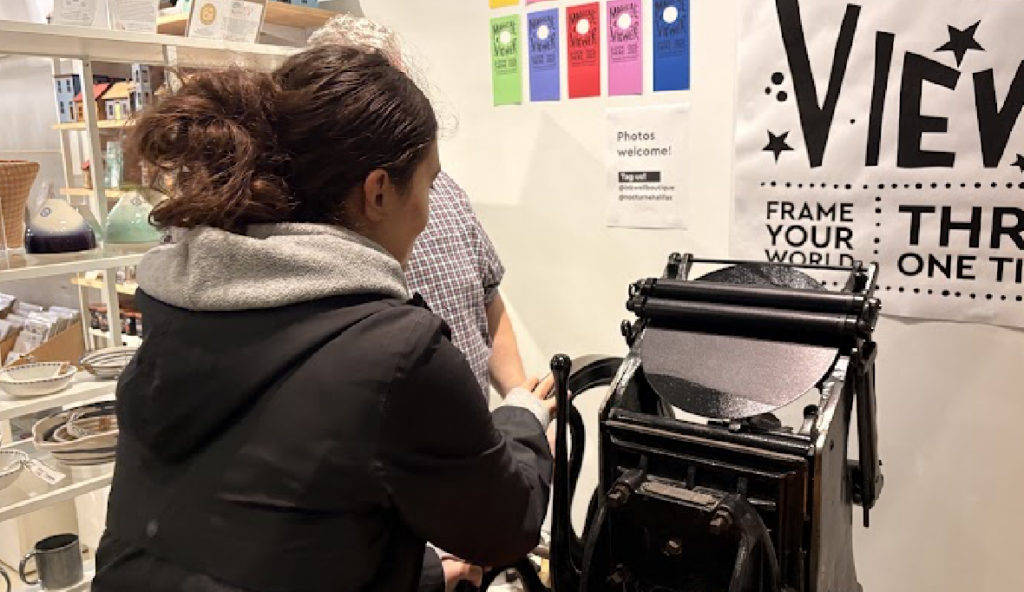
For the 16th year, Rahal opened her shop’s doors to Nocturne Festival goers5. With the help of their hand-powered press, attendees were invited to create their own “magical viewer” to explore the city through different eyes.
Macdonald guided participants by showing how to insert the paper into the press and spin the wheel until the ink seeps onto your paper.
Each year, Rahal reimagines a new “magic lens,” and judging by the line of people eagerly awaiting to collect each new design, Rahal’s tactile experience has visitors returning.

Read more from the gazette
“The quality is already suffering:” Dal makes all faculties and units cut 6.3% of spending
Could there be affordable housing hidden in Halifax? This group thinks so
Phoebe Bridgers wants you to be in the moment
Top recruit ready to make his mark for the Tigers
Ombudsperson’s report outlines areas Dalhousie can improve