
Budgeting tips, from the provincial government
How did years of spending and surplus turn into the province’s deepest-ever cuts?
November 5, 2026 / Dylan Follett
Affording life in Nova Scotia is getting harder — just ask Tim Houston.
The premier’s government cut more than $300 million in the 2026-27 budget, and also posted a record-breaking deficit — originally $1.2 billion, now projected at $1.44 billion.
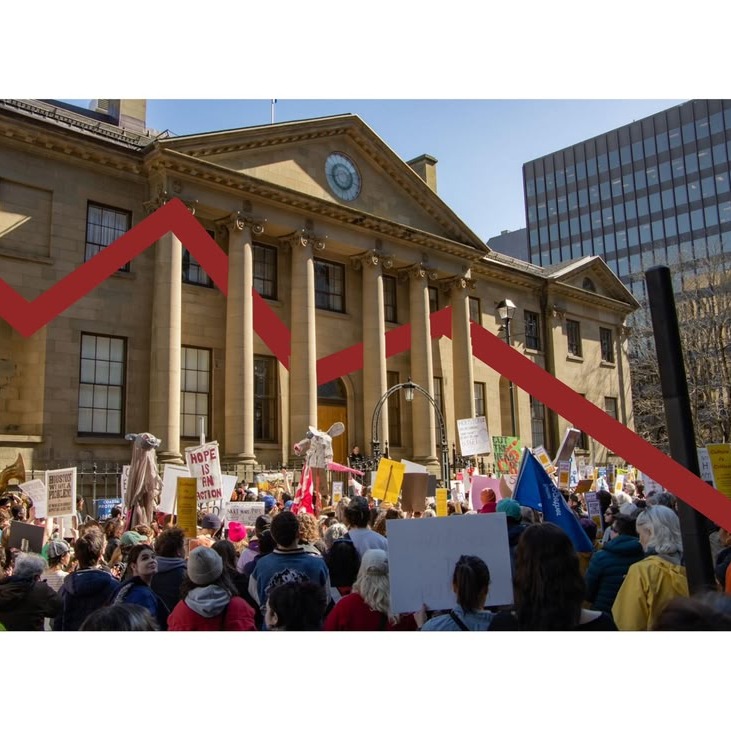
“We know that families are dealing with challenging times, so too is the government,” said Houston during protests in March against the cuts, some of which were later rolled back. “This is a difficult time right now.”
The budget also projects deepening cuts, with a total of $914 million over the next four years. These austerity measures would completely reverse recent years of increased spending and government surpluses.
“We went from a really difficult time, especially before the pandemic in terms of deficits … then we had a boom,” says Jerry Bannister, the director of Dalhousie University’s MacEachen Institute for Public Policy and Governance. “The boom lasted a couple years; then all of a sudden, we went bust.”
The first signs of a financial boom — one that would define the Houston government’s first three budgets — came a year after they took power in 2021. In September 2022, a projected $585-million deficit from the previous Liberal government became a $351-million surplus after a stronger-than-expected recovery from the COVID-19 pandemic.
From that surplus, the Progressive Conservatives increased spending for the next three fiscal years, notably on healthcare, and posted a surplus of over $100 million each year.
These surpluses allowed the government to justify tax cuts, including a one per cent HST cut Houston announced four days before calling a snap election in 2024, that resulted in a PC supermajority. The tax cut cost the province $260 million in annual revenue in the 2025-26 fiscal year.
But the PC budgets of surpluses and tax cuts don’t tell the whole story of the province’s financial state — partially because the budgets were never accurate. In every year of their first term, they projected deficits but delivered surpluses, underestimating the province’s bottom line by an average of about $600 million.
“It does seem opportunistic that every year they were getting $1 to $2 billion more revenue than they said they would, so by the end of the year they have this money they can play with,” says Nicholas Lawson, an economics professor at Dal.
“It’s hard to not look at that and think that wasn’t a realistic estimate,” says Lawson, who is also a research associate with the left-wing Canadian Centre for Policy Alternatives and the vice-president of the Nova Scotia NDP’s riding association for Halifax Citadel-Sable Island.
In the PC’s first term, government spending had increased by 43 per cent since they took office, and the provincial debt had grown by around a quarter to $20.7 billion. The PCs also averaged around $1.5 billion of unbudgeted spending each year.
“[There’s] really a lack of accountability and transparency for Nova Scotians,” says NDP MLA and finance critic Lisa Lachance. “The Houston government has broken the trust of Nova Scotians around budget issues.”
Bannister, a self-described moderate, also says the amount of unbudgeted spending is a problem.
“The situation is concerning regardless of your political stripe,” he says. “I would like to see proper procedure followed … nothing more, nothing less.”
“The onus is on people who want to spend the taxpayers’ dollars in a different way to explain why.”
After their 2024 landslide, the PCs kept spending even as post-pandemic growth and interprovincial migration slowed. With revenue down and spending up, their $900 million deficit projection ballooned to $1.4 billion in 2025-26.
Bannister says the size of Nova Scotia’s debt and deficit is a crisis, as the province’s annual debt repayments ticked past a billion dollars in the estimated budget for this year.
This year the province is spending more on debt repayment than on the Departments of Municipal Affairs, Community, Culture and Heritage, Energy, Agriculture, Natural Resources, Environment and Climate Change, Fisheries and Aquaculture, and Service Nova Scotia — combined.
Not all budget pressures are of Houston’s making. A Liberal-era public worker wage restraint scheme, which was ruled unconstitutional, could cost the province up to $300 million, while U.S. tariffs, interest rates and the national economy remain beyond provincial control.
Facing the record deficit, Houston’s government announced huge spending cuts for the 2026-27 budget. While not increasing any taxes, Nova Scotia still has one of the highest tax rates in the country.
“I wish we could do more … I truly do,” wrote Houston in a March statement when he rolled back $53.6 million of cuts to higher education support for African Nova Scotians and Indigenous students, seniors and people with disabilities.
In just the first three months of the fiscal year, the deficit was already $200 million over target, with another $250 million in unbudgeted spending.
The PCs are expected to table their 2027-28 budget early next year. They’ve already signalled it won’t cut more than five per cent from any department, will not cut healthcare (about a third of the budget), and will not raise taxes or increase the deficit.
The government’s plan requires a $318 million spending cut to the upcoming budget, just over the amount that led thousands to protest in the streets after this year’s budget.

Read more from the gazette

Hungover, Hungry and on a Budget

How has affording to be a Dalhousie student changed in the last 30 years?

Affordability means nothing in Halifax

The cost of having a vice

How a psychology and history student affords to live in Halifax