Out of tune with the budget: what it costs to record an album in Halifax
For emerging Nova Scotian musicians, finding the money to finish a record can be just as challenging as making one
November 19, 2026 / Ellie Garry-Jones
Despite Nova Scotia’s thriving music scene, the price tag of turning a collection of songs into a finished record can stop emerging artists in their tracks.
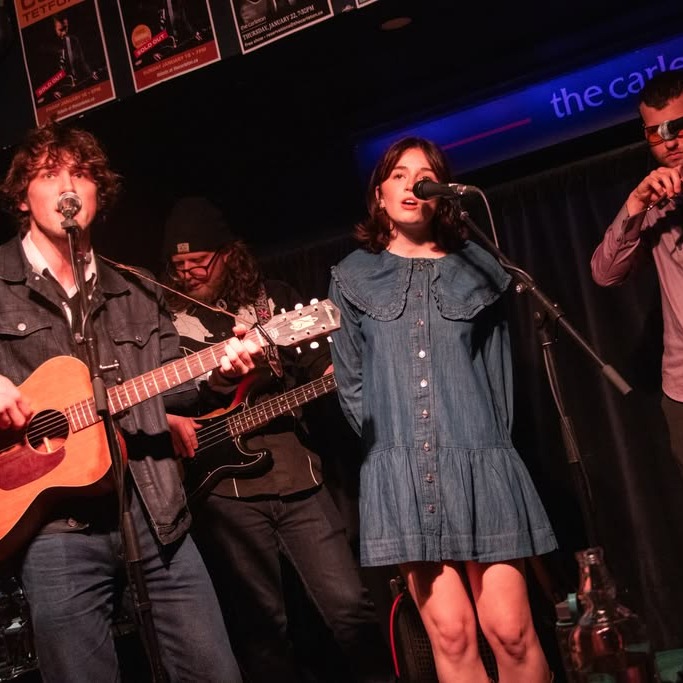
Manderville, a seven-piece folk band composed of current and former Dalhousie University students, began recording its first EP in March of 2026 after six months of playing together.
The band had eight songs ready to record when they headed to Fang Recording, a studio owned by Nova Scotian performer and producer Joel Plaskett.
Eight hours later, they walked out with two singles, a $600 bill for their time in the studio and no plan to record the rest.
“It’s way more expensive than they let on,” says Quinn LeBlanc, Manderville’s frontman.
Recording all eight tracks would have cost the band, at minimum, $4,000.
“When you get into a position of whether to buy groceries this week or master your single, it’s a tough battle,” LeBlanc says. “You have this vision for these songs you’ve written, and you have people who want to hear them, but you just can’t fork out a thousand dollars for the song.”
The process of recording
Vincent Baur, a Nova Scotian music producer and frontman for the Halifax-born indie project Gourmet Club, breaks down the process of making a record starting with the writing.
Once a demo is tangible, a producer is brought in to discuss the project, its budget and timeline.
The recording process is variable, he explains. Depending on the artist, it could take days, weeks, or even months. Traditionally, an artist would “flush out the beat” — recording basic sessions of rhythm, drums, guitar and vocals.
“If you have a drum kit, your kick drum would have a microphone or two, and then those two microphones get recorded individually,” Baur says. “An artist’s session could have 40 to 100 individual tracks.”
At the mixing stage, an engineer layers the individual tracks and boils them down to two channels, the left and right speakers. When passed on to the mastering engineer, they have control over one comprehensive track — a stereo file.
Mixing makes the track sound how the artist and producer want, while mastering makes it translate across any system, even vinyl, Baur explains.
At the end of the process, artists receive a finished song and an invoice for each step along the way.
How much does the whole process cost?
Lil Thomas owns the Sonic Temple Recording Studio. He says an artist could spend around $2,000 to record three songs over two days for a typical EP, if they are efficient with their time.
“A large degree of it depends on how prepared you are to go into the studio,” Thomas says. “More often than not, younger artists can be less experienced and lose ground by just trying to get the hang of how to perform in a studio.”
For a full-length album — 10 to 12 songs — a group could be looking at a bill of $10,000 to $15,000, taking two or three weeks in the studio. Ultimately, an album’s cost boils down to how much money you have, which he says often determines the quality level you can get.
Esdaile, a Dartmouth-based roots-rock band, found out what it takes — and what it costs — to make a record when it entered Sonic Temple to record its first EP in June 2025.
“An artist may find that halfway through their intended project, the funds dry up very quickly,” says Keegan Hammond, the band’s drummer.
At a studio rate of $100 an hour over two days, the band’s initial recordings for six songs came out to $1,800. They kept studio time to a minimum, recording live off the floor with only three takes of each song.
The band hired a producer to handle edits and overdubs for an additional $3,500. Before the band had even reached mixing and mastering, they had spent $5,300.
By the end of mixing, that figure had climbed to roughly $6,800, followed by another $513 for mastering the six-song EP. In total, recording, mixing and mastering cost Esdaile $7,370.
After marketing, promotion, photography and merchandise, the whole project came to $13,500.
“By no means would I say that’s an average spend for a six-song EP, but it’s nothing out of the ordinary for someone to spend that much,” says Hammond.
It’s easy for additional costs to rack up when musicians bring in outside help, whether that’s a recognized producer or a mixing or mastering engineer.
For those specialties, $50 an hour quickly adds up to $500 to $1,000 per day. Manderville swallowed that expense, paying $500 per song to have its tracks mastered by the same engineer who worked on one of American indie artist MJ Lenderman’s records.
How do artists acquire funding?
In Nova Scotia, the provincial government’s Department of Communities, Culture, Tourism and Heritage grants money to various clients. This includes Music Nova Scotia, a non-profit organization.
Music Nova Scotia provide three funding avenues for emerging artists: the Artist One recording program, the Artist Kickstarter program and the Artistic Creation Program. Each with tiers and varying investment amounts.
In 2026, the provincial government reduced grants for community organizations and programs by $130 million. With the CCTH department facing a $14.3 million cutback specifically, Music Nova Scotia’s $630,000 allocation was reduced to $504,000, a 20 per cent deficit.
While seemingly substantial, Darryl Smith, Music Nova Scotia’s education and investment program manager, says that, divided among the province’s vast number of applications, $500,000 doesn’t last long.
“It’s a constant challenge between funding a greater number of projects with less money behind them or fewer projects with more money behind them,” says Smith.
Outside Nova Scotia, other funding avenues include the Foundation Assisting Canadian Talent on Recordings, the Canada Council for the Arts and East Coast Music Association.
“These are extremely competitive,” Hammond says. “There are hundreds of applicants for every single one of these grants, and you need to invest a significant amount of time to put together even some sort of comprehensive application.”
When Manderville began preparing to record, the band quickly discovered that qualifying for grants required more groundwork than they had anticipated.
“We found out you need a website and links to music,” LeBlanc says.
“The first one’s on you,” LeBlanc has learned since his debut in the industry. “You’ve got to fork out and show them you mean business,” he says.
Even for artists who secure funding, the money doesn’t always come when it’s needed most.
“They all require an upfront spend and then a reimbursement,” says Hammond.
Timing is another catch. Music Nova Scotia only opens its recording funding applications twice a year, in March and September. If artists start recording outside those windows, they could end up paying out of pocket for work the grant will not cover.
Esdaile learned this the hard way. By the time they applied for funding to cover their recording costs nine months later, they discovered Music Nova Scotia does not honour any previously incurred expenses and only reimburses costs after the grant is approved.
Their $6,000 worth of recording expenses were denied on the basis of ineligibility.
“It creates a kind of funnel where artists are discouraged to start projects until March or September because that’s when funding deadlines are,” Hammond says.
Not only that, the demand for producers and audio engineers surges during those windows.
Government funding — when accessible — is enough to get artists into the recording studio for at least a few sessions, just not a full album, which can start as high as $3,500, according to Pierce Rogers, owner and operator of Audio Empire, another recording studio in Halifax.
“I don’t have a whole lot of faith in the province to be a financial aid,” says LeBlanc. “You gotta wonder how many people end up giving up or are driven away.”

Read more from the gazette
Can Halifax handle a basketball franchise?
EIA-bsent? Port Hawkesbury data centre campus to move forward without EIA
Fire chief requests $1M funding increase, 20 additional firefighters in HRM
StudentsNS calls for province to maintain campus sexualized violence prevention funding
Who will be the next leader of the N.S. Liberals?