Structurally sound: the Fiddle Sticks
The architects of Celtic fusion
October 22, 2026 / Ellie Garry-Jones
On Vernon Street, every house draws its curtains and packs it in for the night — except one, which is just waking up.
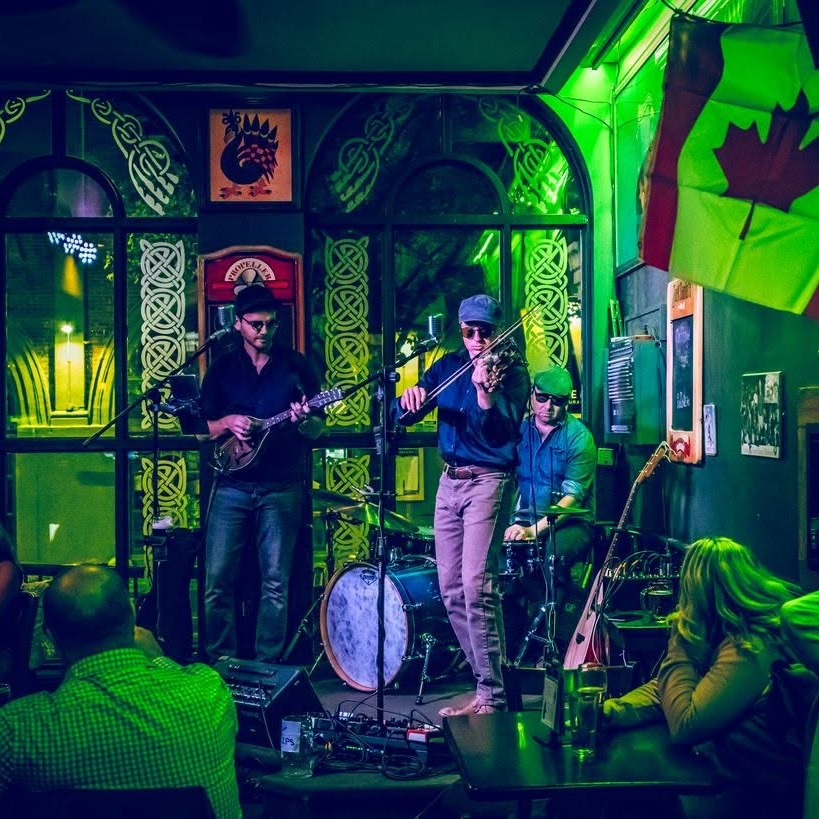
Its windows, propped open, inhale the evening breeze and let out a rousing breath. Through the fogged glass, figures cradle their instruments in one hand and beer bottles in the other. Their quick-footed, restless melodies ricochet off the walls before dancing out the door, singing the neighbourhood to sleep.
In the Maritimes, they call it a kitchen party. To The Fiddle Sticks, it’s just a Wednesday night.
The architects of this ruckus? Luke Norton mans the fiddle, Lucas Bondar keeps time on the drums and Duncan Armour multitasks on the mandolin and vocals. Their personal groupie, Tilly the beagle, oversees rehearsal from the couch.
The three met in architecture school at Dalhousie University, back when forming a band wasn’t in their blueprint. The trio — Norton from Prince Edward County, O.N., Bondar from Peterborough, O.N., and Armour from Ellershouse, N.S. — grew up with music, albeit different styles.
Two years after graduation, the three architects have discovered their own sound — what they call “Celtic fusion.”
“It started as a mix of a very folky sound from Duncan. Lucas had the classical upbringing and the percussion side. And me with more of a traditional Irish Celtic background,” says Norton. “We wouldn’t really consider ourselves maritime musicians. Though we do some maritime songs, we’re more traditional, folky and Celtic.”
For Norton, defining maritime music is less straightforward than describing what it does.
“It’s the storytelling aspect of the songs, the humour and high energy — that is maritime music. It gets people going and engaged,” he says.
“We feel a lot of that same energy in doing Celtic stuff,” Armour says.
After Norton graduated in May 2025, he took to his old cash grab — fiddling on the waterfront.
“It turned out to be pretty profitable and ended up opening lots of doors,” says Norton. Unbeknownst to him, one of those doors would be underneath the Celtic cross of the Old Triangle Irish Alehouse, where the band has now played for over a year.
Playing live shows regularly around Halifax, their repertoire has grown from three songs to three hours’ worth of foot-stomping.
Whether at the Old Triangle or the occasional gig at the Loose Cannon or the T-Room, the scene is much the same. A tap of the thigh travels to the foot as the fiddle’s sound climbs above the chatter. Pints are abandoned as the beat invites a clap. The space between tables fills as feet shuffle and hips loosen.
Just when it seems the night can’t get any louder, the Fiddle Sticks launch into “Seven Drunken Nights.” Norton’s bow flies across the strings, Bondar gives the crowd a rhythm to follow, and Armour’s mandolin fills the gaps as he delivers the tale of a man oblivious to his wife’s affair. By the chorus, the crowd has taken over, singing and laughing loud enough to rival the band.
To Armour, what they do “is opposite to the real professionalism of music, which you can see in a lot of bands who take things very seriously.”
“It’s not like having a band where you kind of make it or break it,” Armour says. “We’ve already made it because we’re just having fun.”
Norton agrees. “Those bands focus on one thing, and that’s music. You can see a regimen of technical skill,” he says. “It’s not that we don’t have technical skills. It’s just what people admire in maritime music is the personality and the ability to talk to a crowd.”
That fun takes different forms: writing together, playing together and leaving the door open for others to join in the mix.
Much like project-designing in their day jobs, writing music is rarely a one-man task. Yet the band’s songwriting process is less about working towards a finished product than seeing what happens when three heads collide.
“We’re not trying to write music to complete an album or finish any one song in particular,” says Armour. “We’re just experimenting around. It’s more felt.”
He’s coined the process “Ouija boarding.”
“We’ve all got our hands on the board saying, ‘Go that way! Oh, maybe not that way.’ It’s just feeling it out.”
During a weeknight rehearsal, it isn’t unusual for other musicians — fellow Dal grads among them — to find themselves swept up in a living room jam session.
Those impromptu gatherings sparked the idea for Fiddle Sticks and Friends, which takes the kitchen party’s swelling energy beyond the house and into public venues, where the music — and the chaos — can grow.
“People love to see a variety of musicians that are able to get along,” Norton says. “The fun can be shared with more people. That’s the strength of it.”
So for as long as the fun accompanies the music, the noise complaints on Vernon Street are here to stay.

Read more from the gazette

“The quality is already suffering:” Dal makes all faculties and units cut 6.3% of spending
Could there be affordable housing hidden in Halifax? This group thinks so

Phoebe Bridgers wants you to be in the moment
Top recruit ready to make his mark for the Tigers

Ombudsperson’s report outlines areas Dalhousie can improve