
Halifax is at the forefront of global marine CO2 removal
Haligonian company plans to remove 1 billion tonnes of carbon dioxide by 2035
September 10, 2026 / Lukas Kohler
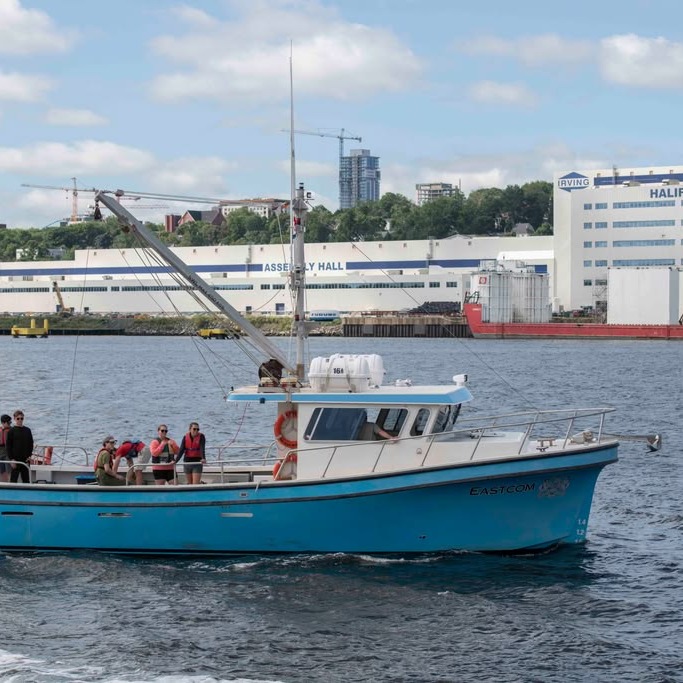
The waters of the Halifax Harbour have become a testing ground for new approaches to fighting climate change, as Haligonian researchers look for ways to remove carbon dioxide from the atmosphere and store it in the ocean.
Ocean Alk-Align is a project currently operating worldwide that aims to accurately measure how much CO2 is removed from the atmosphere and destroyed in the ocean.
The project often partners with Planetary Technologies Inc., a marine carbon dioxide removal company that works in the Halifax Harbour.
Alk-Align does not aim to prove or disprove Planetary’s marine carbon dioxide removal methods. It’s a collaborative, independent research entity from the company.
Planetary is restoring the Bedford Basin to normal alkalinity levels, using multiple alkali “feedstocks” — or the raw materials used to produce alkalis — as an “antacid,” according to Will Burt, vice-president of science and product at Planetary.
Burt says alkali neutralizes acid in the ocean, which in this case is carbon dioxide. When water has less carbon dioxide than in the air, additional carbon dioxide is driven into the ocean.
Among global attempts at accelerating the rate of carbon dioxide removal through the ocean, Planetary is the leading company attempting ocean alkalinity enhancement worldwide, according to CDR.fyi Inc., a carbon-removal industry database.
“The biggest ocean project in the world is in Halifax, and the most successful, and the most well-discussed [research] in the whole ocean science community is in [Halifax’s] backyard,” says Burt.
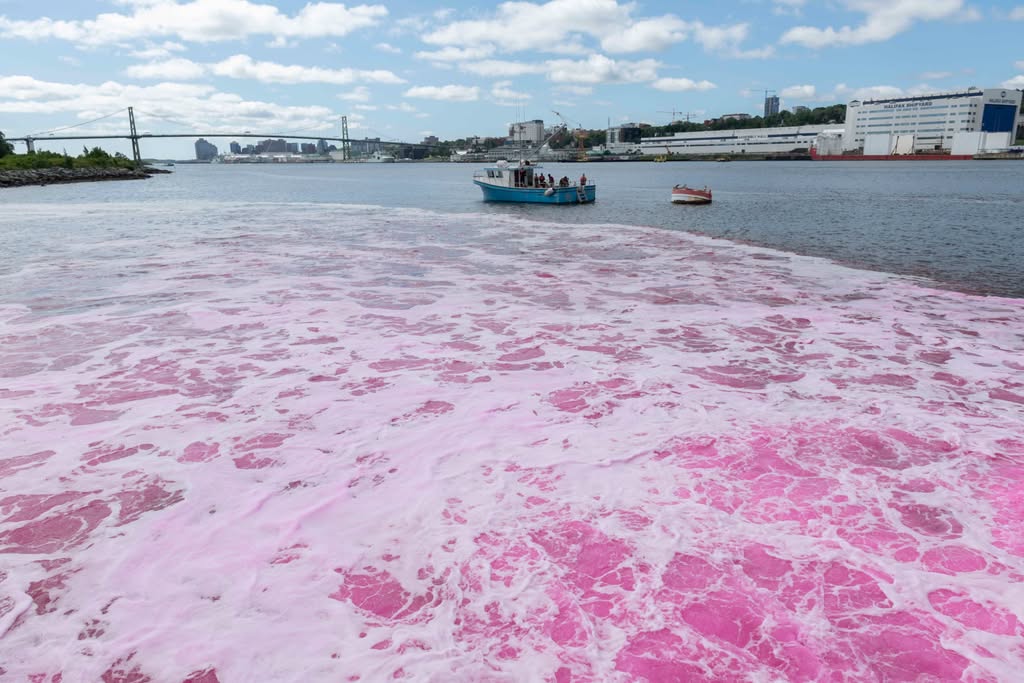
To date, Planetary has sold credits representing 130,000 tonnes of carbon dioxide removal from the atmosphere worldwide, according to the database. Planetary aims to remove one billion tonnes by 2035.
The ocean is the largest carbon sink for human-caused emissions, having absorbed roughly 40 per cent of carbon dioxide emissions since the beginning of the industrial era.
According to the Nova Scotia Legislature, a sink is any reservoir that absorbs more carbon than it releases.
Two kinds of sinks — natural and artificial — can remove carbon from the atmosphere.
Emile Weber, a recent Dalhousie University graduate, is working on the Alk-Align project.
“It’s been really interesting to see the public’s engagement and interest with [the project],” says Weber. “It’s also been really great to see them put such effort into having community outreach projects and to have people engaged and interested in it.”
Should we be concerned?
Christopher Algar is a Dalhousie professor researching sediment and the impacts ocean alkalinity enhancement might have on the sea floor. His main concern about alkalinity enhancement is the risk of increased sediment on the bottom of the sea, which may affect mineral compositions.
“As [feedstocks] settle on the sea floor, they could change the grain size and the permeability of the bottom,” Algar says. “That could affect the organisms that live there.”
Katja Fennel, Alk-Align’s lead principal investigator and Dalhousie University professor and researcher, says that a significant fraction of the feedstock, Planetary’s alkalinity addition to the ocean, settled out and accumulated in the depths of the Bedford Basin in 2023.
“That led Planetary to reevaluate the type of feedstock,” she says. “So they now use feedstock that’s much more soluble, and we don’t think the feedstock they use now settles in the cumulus in Bedford Basin.”
Julie LaRoche, a Dalhousie professor in the department of biology who researches the ecological effects of research done in the Bedford Basin, says her team has not seen anything troubling.
“We’re doing microcosm experiments, taking the Bedford Basin water, bringing it into the lab, and then doing some treatments on it,” says LaRoche. “We add what Planetary is adding, and then we look at the plankton.”
She said the treatments have not shown major effects on biology, but she still isn’t certain that there are no ecological effects.
Some of the other approaches to carbon dioxide removal
Another company in the Halifax Harbour, pHathom Industries, is using a different approach to carbon removal.
Ricardo Arruda is a post-doctoral researcher at Dalhousie and a senior scientist at pHathom who focuses on ocean measurements of temperature, salinity, pH and alkalinity. He says the main difference between pHathom and Planetary is the process for storing carbon.
For pHathom, carbon removal happens inside a reactor and is later stored in the ocean. While at Planetary, the removal is done directly in the ocean.
The method used at pHathom is a point-source carbon dioxide removal system, meaning the actual removal happens outside of the ocean through the accelerated weathering of limestone inside a weathering reactor.
Once pHathom’s system converts atmospheric carbon to a stable solution, the bicarbonate is stored back in the ocean.
This is just two of numerous approaches to alkalinity enhancement, which is only one of the many methods of carbon capture and removal.
How could this be applied worldwide?
Burt says ocean alkalinity enhancement is widely considered to be the most scalable method, but the solution to carbon dioxide removal will be a combined portfolio of many techniques.

He also says alkalinity enhancement must be more cost-effective to facilitate scaling.
According to CDR.fyi, over $12.4 billion has been spent to remove 49 million tonnes of CO2 from the ocean and sold as carbon credits.
“The reality is that in order for people to take up and buy this carbon, as they do with forestry credits, [carbon credits] just need to be cheaper,” he says.
Fennel says scaling Planetary’s method requires implementing the alkalinity solution in more locations. To do this, she says, Planetary would need to build locations to deploy enhancement and source feedstock effectively.
Why Halifax?
Burt, who was the first oceanographer with Planetary, says the project started in Halifax because of the city’s extensive ocean expertise. The company’s initial tests were through Dalhousie.
Planetary currently deploys alkaline feedstock through Tufts Cove Generating Station’s turbine cooling system, which pulls harbour water into a cooling loop that returns to the ocean.
Alk-Align used a tracer dye in 2023 to model the dispersion of solutes through the basin and the flow through the harbour due to tides, winds and currents before applying alkalinity to the ocean.
“Just before [the water] goes back out into Halifax Harbour, that’s when either the dye or the mineral feedstock is being added,” says Fennel. “That’s where it dissolves and dilutes, and that’s what we’re simulating. Then, in the model we can also simulate other locations.”

Read more from the gazette

Q&A with DSU Faculty of Architecture and Planning representative candidate Nermine Mokdad
Q&A with DSU Faculty of Arts and Social Science Representative Candidate Rory Laing-Gatehouse
Q&A with DSU Disabled Students Community Representative candidate Kenzy Bezeau

Only three candidates running across nine empty positions in DSU by-election
Ella Mowbray Chriske acclaimed as KSU president in by-election