
What you can see in You Can See Everything
New documentary explores the limits of communication
November 19, 2026 / Theodore Boyce
You Can See Everything, Nathan Fielder and Lance Oppenheim’s new documentary, is about getting to know people, both in front of and through the camera.
The nearly three-hour film shows an intimate portrait of Elizabeth Holmes — the founder of Theranos, a health technology company — who was convicted of fraud and ordered to pay nearly half a billion dollars in restitution. The film follows her in the days leading up to her 11-year prison sentence.
Most of the movie explores her belief that she is innocent. A claim that swings between believable and far-fetched many times throughout the film.
The title is obviously a little ironic. Most of the movie underlines the fact that nobody gets any meaningful insight into who Holmes is or what she believes, despite the complete access given by Holmes and her partner.
As the film progresses, the truth gets muddier until it’s permanently out of reach.
But although the movie is about Holmes’s deception, the sleight of hand Fielder and Oppenheim are obsessed with is their own.
Fielder’s breakout series, Nathan for You, is a comedy in which he poses as a fixer-upper reality TV host who convinces ailing small businesses to try out ridiculous marketing strategies.
The people on the show truly believe him and do what he suggests purely on the basis that he looks like a professional with a television crew. The cameras in the show are pointed at people like weapons; they transform the behaviour of the people in front of them.
Similarly, in You Can See Everything, the camera acts as a device that shows a world subtly distorted by it, instead of the world as it is.
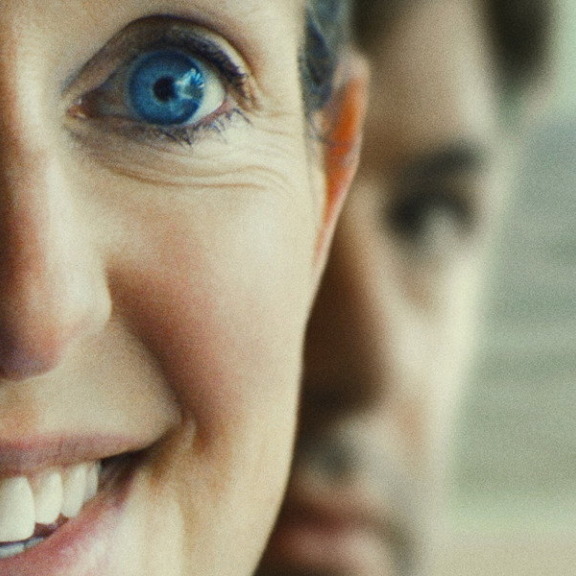
The other director — Oppenheim, who recently directed Primetime — lends his signature visual maximalism to You Can See Everything. Every single pore, eyeball vein and piece of dead skin is visible.
Counterintuitively, this only puts more distance between the subjects and the audience. The movie plays with the idea that the audience can play the mind games between the people on screen, but it always comes up short on its promise. The directors make it as if you can always look through their movie when they really only ever let you look at it.
Fielder forces the audience to confront his subjects with him. The movie is shot in a way that makes us feel like we take up space. Like him, we are obstructed because we’re seeing people who are conscious of being seen — not just by Fielder, but by us too. The intrusive effect makes us feel less like observers and more like participants. Although it shows Holmes and her partner in their most private moments, it only shows them when they know they’re on camera.
While Fielder stars as “himself,” he too is an unreliable narrator. Like everyone else in the movie, he puts on a performance with his own interests in mind — the interests of his film.
Fielder does not behave as people would expect a documentarian to behave, even though he plays and pretends to be one. He shows the world to his audience less like a journalist and more like a magician.
Implicit narrative — the story we create in our heads when we don’t have all the facts — is the device through which the movie thrives. It edits around tantalizing absences, withholds crucial information until dramatically relevant moments and re-enacts true events.
As the mystery gets more complex, Fielder brings in another confidant to discuss the evidence. They act as an audience member who speculates and guesses at what the truth might be. Like the audience, they replace what the camera can’t (or chooses not to) capture with more colourful, satisfying details and with what they want to see — while letting Fielder keep his naive, unassuming persona.
It utilizes every trick in the book, tricks that one might associate more with a dubious History Channel documentary than in a so-called serious movie. They’re so beautifully hidden beneath its hyper-real surface they’re almost unnoticeable — which is, in a way, the whole point.
The core truth that You Can See Everything expresses is that it’s incapable of revealing any truth about someone or something. It’s a constant struggle for a clear line of communication that always comes up against new interference. It’s gorgeous, funny and, most of all, absolutely terrifying. I don’t know if anything like it has ever been produced.

Read more from the gazette
Paul Wozney wants Nova Scotians to get angry

The Dal review: La bola negra and All About My Mother

Friendship is dead

My complicated relationship with the idea of motherhood

From other countries to Dalhousie athletics