If you don’t want the new East of Eden adaptation, you might be sexist
Female characters deserve nuance
October 8, 2026 / Amelia Penney-Crocker
Editor’s note: This article contains mention of sexual assault and spoilers for East of Eden.
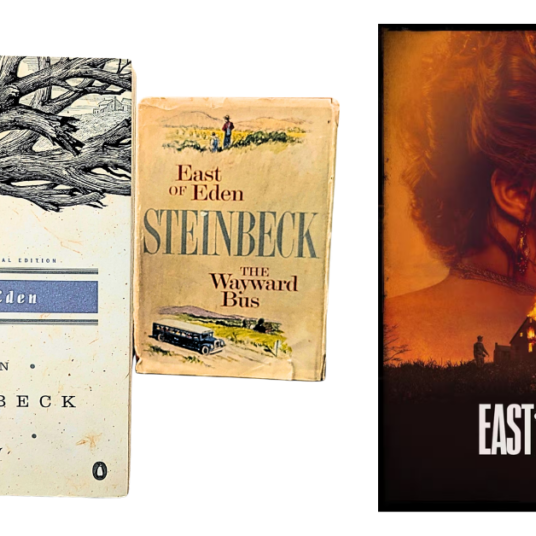
Netflix’s adaptation of East of Eden, created by Zoe Kazan and starring Florence Pugh, was released on Oct. 1, and it’s already controversial.
Judging by the trailer, Kazan has chosen to place Cathy Ames, the novel’s primary antagonist, at the centre of this iteration. In an interview for Netflix’s Tudum, Kazan said she wanted to make sure Cathy was a person and not an archetype.
But some people don’t want to see this.
“Cathy is a sociopath who ruins the lives of everyone around her. She is not the main character, and to make her ‘misunderstood’ or sympathetic is against everything Steinbeck wrote,” proclaimed one user in the YouTube comment section of the teaser for the series.
In the same comment section, another user was worried the series will be “girlbossing the villain.”
What’s odd is these comments were left under a trailer that nowhere implies a positive characterization of Cathy. In fact, the teaser only reveals that Cathy will be the lead.
Liza Libes, who posts about books on social media, said in an Instagram video that the only reason Kazan — who she calls “this chick” — was allowed to adapt East of Eden was because her grandfather made the 1955 film adaptation of the novel. She went on to call the new series, which hadn’t even dropped yet, “an atrocious assault on classic literature.”
The idea that approaching the novel from Cathy’s perspective would ruin it is unfounded, and using the word “chick” to describe Kazan reeks of misogyny.
The entire discussion is reactionary backlash against any change to a classic. Especially change that promotes a more charitable understanding of the female characters.
Too often film adaptations are bar-for-bar copies of their books. While a certain amount of respect for the source material is due, filmmakers who tie themselves too firmly to the views of long-dead authors curse themselves to mediocrity.
Especially when the author’s perspective is worth questioning.
From the moment she’s introduced, John Steinbeck asserts that Cathy is evil, leaving no room for nuance.
The first evil thing Cathy does is frame two boys for sexual assault. Steinbeck strongly implies that Cathy lured the boys and manipulated them into hurting her.
I find it questionable that Steinbeck uses the premise of lying about sexual assault as a way to show Cathy is evil, especially because she’s a prepubescent child in the scene.
When I read this part, a shiver ran down my neck. I immediately saw parallels to the real world, where women and girls are made to feel responsible for the violence against them.
Many book fans argue that Cathy is supposed to represent pure evil, but her virtuous foil, Adam, is not pure good.
Cathy kills three people, including her own parents, but Adam also kills many people in war and acts horribly toward people, including his own children.
When Cathy manipulates a man for money, he responds by physically attacking her with the intent to kill. She is portrayed as pure evil for this, while the man’s violent outburst is given context through the story’s narrative.
Male characters are allowed grey areas and context. Cathy is not.
Kazan vows to unfold Cathy’s character rather than reinventing her; a task worthwhile in the context of women’s historical marginalization both in the present time and in the story’s setting.
It’s also a task which can be taken on without changing a single element of the plot.
While I can’t promise the new series will be good, as I haven’t watched it yet, I believe women should be portrayed in media as conniving, flawed and villainous, without losing their humanity.
It doesn’t ruin the story if Cathy is less Satan and more human, and maybe Bookstagram should just calm down and give this female-led story (behind and in front of the camera) a shot.

Read more from the gazette

The AUS to ACAA pipeline
Chartwells manages half of SUB food vendors after Abstract takeover

Africville tribute on display at Nocturne

Tigers defeat Moncton 3-2 in a dramatic overtime finish

The Gleeboot could save lives