Arts and social sciences classrooms go screen-free
Dalhousie professors discourage screens following U of T laptop ban
October 8, 2026 / Lily Van Beek
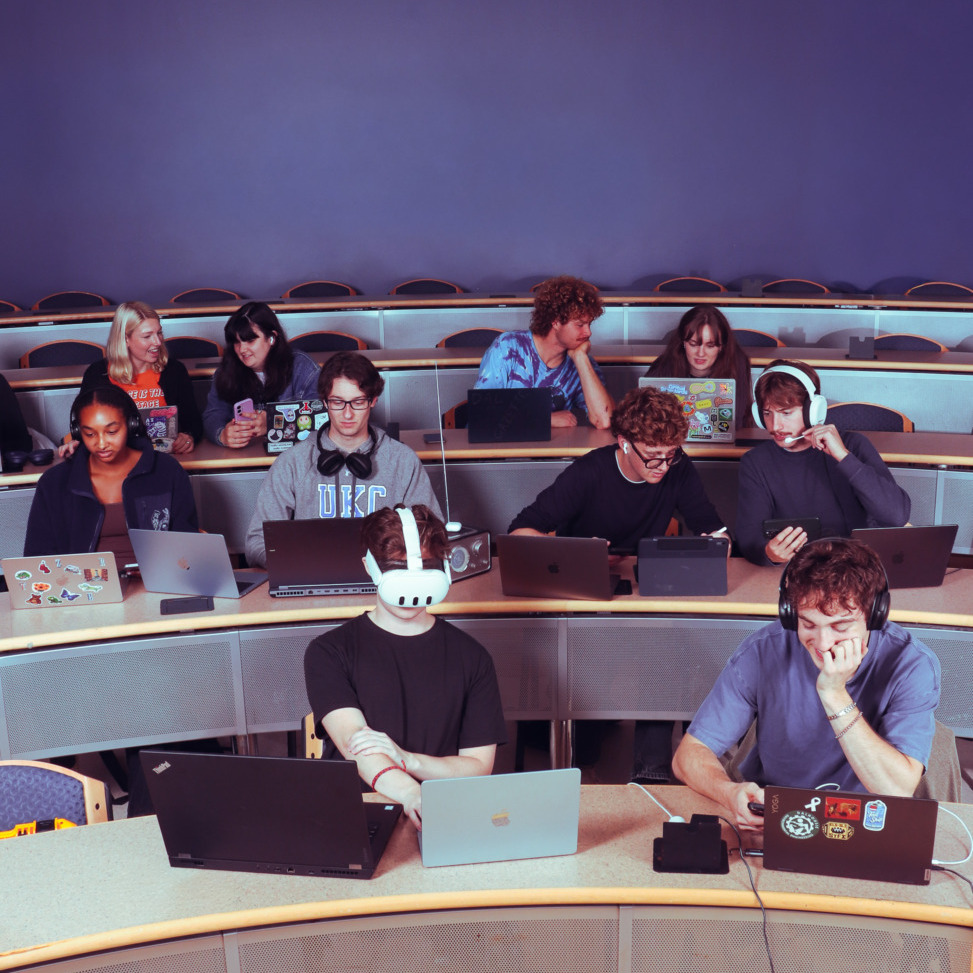
This semester, Dalhousie University students are digging out their notebooks and pens.
Following a laptop ban at the University of Toronto, some arts and humanities professors are designing new technology policies for their classrooms.
Alice Brittan, an associate professor in the department of English at Dalhousie, says she heavily discourages technology use in her classroom after years of observing disengaged students.
“I was shocked and dispirited by the fact that most people in the room were on their screens most of the time,” she says. “I was looking out at a group of people who were physically present but were not mentally present.”
In August 2026, U of T’s faculty of law announced a set of guidelines to help professors ban laptop use in their classrooms.
In a statement to the Dalhousie Gazette, Christopher Essert, dean of U of T’s faculty of law, said the faculty is introducing this policy to give structure to the laptop bans already occurring in some classrooms.
“Following widespread conversations with faculty members, we have adopted a framework that faculty will need to follow should they decide their classroom would benefit from being laptop-free,” he said.
The policy, which only prohibits devices with keyboards, will supplement students’ handwritten notes with summaries or recordings provided by the professor.
“Students can take notes by hand with paper and pen or on a tablet with a stylus,” said Essert. “Faculty will provide either AI-generated notes, notes captured by student note-takers or class slides, speaker notes, annotated case list or a similar record of material covered in the class.”
While there is not a department-wide policy at Dalhousie, Brittan says she has seen improved learning in classes where screens are discouraged.
“Two years ago, I team-taught a first-year creative writing class with my colleague Dr. Heather Jessup … and Heather decided that we would have a totally screen-free policy in the lectures,” says Brittan. “I was impressed by how well this worked.”
Since collaborating with Jessup, Brittan has experimented with ways of discouraging technology use in her own classroom.
“I am thinking of making it more formal in the future,” she says. “Since [working with Jessup], I’ve talked about it in all my classes, and I always say … ‘unless you feel a strong need to have a laptop open to take notes, I would ask you not to.’”
Critical thinking in jeopardy
In an email to students, Richard Stacey, associate dean in the U of T faculty of law, said he was concerned by the lack of critical engagement from students in lectures.
“The very act of type-writing comprehensive notes during class does not allow students to think deeply about the class material or to engage in discussion and argument,” said Stacey. “There is a wealth of educational research that supports the conclusion that type-writing notes in class limits higher-order analytical thinking.”
Brittan agrees, saying she notices that students using laptops transcribe lectures instead of analyzing the material.
“They are not doing the crucial work of filtering out the most important ideas from the less important,” she says.
Charlie Baker, a fourth-year honours student in English and creative writing, has taken several classes with Brittan. Baker says learning to take analog notes has improved his focus and comprehension.
“[I have] more focus on the discussion and the content of learning,” says Baker. “When I’m taking notes, I try to think less about copying down the exact words, or taking notes on exactly what the slides say, and more on focus[ing] and process[ing] my own thinking throughout this lecture.”
Baker says reduced focus and engagement are ingrained in the design of modern technology.
“It’s baked into the purpose of technology to make things more convenient for us,” he says. “But that’s almost the antithesis to what learning is often about, which is doing the work to expand … our capacity to learn things.”
Brittan says students concerned with writing down every fact are missing the point of attending a lecture.
“In this discipline, I would say you don’t need a verbatim transcript. You need the key ideas, and you need to be able to think,” she says.
Screens have also eroded students’ abilities to engage with longer and more complex material, says Brittan.
“We [used to expect] students to read 200 to 300 pages a week [per course],” she says. “I would not do that now. The shortening of attention spans means that…would be impossible for most people.”
Impoverished learning, impoverished self
For Baker, the loss of engagement within classrooms translates to a broader loss of identity.
“We’re so inundated with access to entertainment and media, we no longer have to spend time just sitting in ourselves [doing] active self-analysis and self-reflection,” Baker says. “We’re off-loading time that we can spend [on] reflection to the consumption of passive entertainment.”
Brittan says technological distractions prevent students from developing creative and analytical skills that are important for their well-being beyond the classroom.
“It is very clear that when we are constantly distracted and occupying our minds with things, we are alienated from ourselves,” she says. “The chronic distraction makes engaging in sustained work difficult. It’s an alienation from your own interiority, and it is your own interiority that you are using to think, interpret, create.”
According to Brittan, the presence of screens in the classroom also inhibits social engagement.
“The screen’s an escape, a hiding place. It’s not just that [students] aren’t interacting with me in the same way, they’re also not interacting with their own peers,” she says.
While it might be difficult for students to break from their technology habits, Brittan says, it is essential for their learning and social development.
“We’re asking [students] to change their mode of social interaction and their whole working theory of themselves as social beings,” says Brittan. “All of that’s at stake here. This isn’t just about note-taking and learning. This is existential.”

Read more from the gazette

Purple door, orange door: the classic Halifax homes

The Emmys are still #SoWhite

Ed Sheeran is seriously out of touch

If you don’t want the new East of Eden adaptation, you might be sexist
The conditions for a culture