The AUS to ACAA pipeline
Collegiate athletes transfer between divisions for more playing time
October 8, 2026 / Lily Van Beek, Ryan Bradbury
The landscape of collegiate sports is changing in Canada. Tempted by the allure of a fresh start with a new team, students are beginning to enter the transfer portal more regularly.
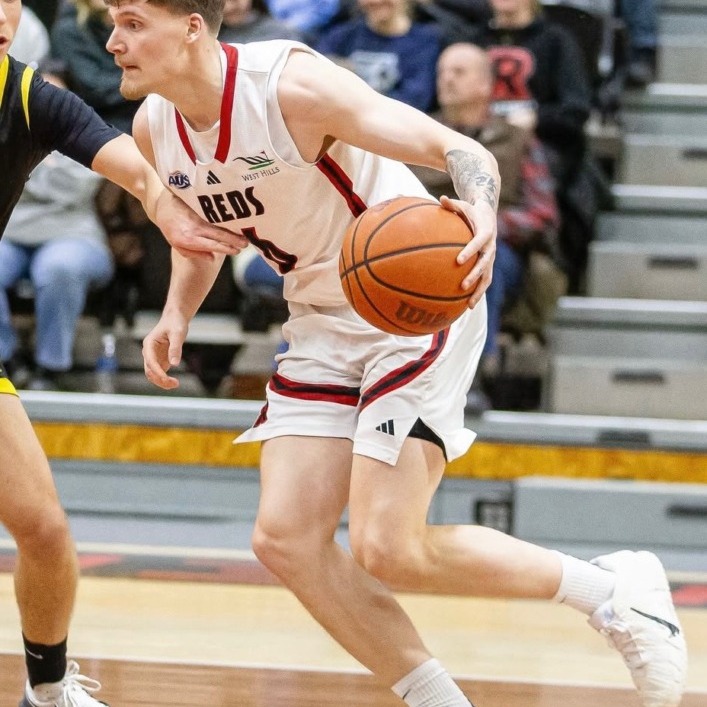
Athletes like Ben Power, a basketball player at the University of New Brunswick, have been temporarily transferring from Atlantic University Sport for opportunities in the Atlantic Collegiate Athletic Association.
AUS is the Atlantic division of U Sports, the highest-level Canadian collegiate athletics league. Similarly, the ACAA is the Atlantic division of the Canadian Collegiate Athletic Association, a league for smaller universities and colleges. For example, Dalhousie University athletics play in the AUS, while teams from the University of King’s College are in the ACAA.
Power kicked off his career playing one year for Saint Mary’s University in the AUS. He then transferred to UNB’s Saint John campus for a year of ACAA basketball before returning to AUS at UNB in Fredericton.
“My plan the whole time was to play for a year, do as best as I can, and then find another spot to play U Sports,” says Power.
Power says dropping down to the ACAA was beneficial for his development as a player.
“A lot of people frown upon dropping down a level,” he says. “If you’re not getting the playtime or role you think you should be getting at U Sports, [transferring] is a great option to test your skills and see where you really fall.”
The transfer of college athletes between teams and divisions was popularized by the United States, with the implementation of NIL rules (name, image and likeness) that allow players to capitalize on their likenesses. On Sept. 29, the U.S. Senate passed a bill restricting athletes’ ability to transfer between teams. If the bill becomes law, athletes will be limited to one transfer without penalty during their college career.
Power is one of many Canadian athletes taking inspiration from American counterparts south of the border.
While the ACAA has helped many athletes on their journey to higher levels, Liam Pelletier, a volleyball player at UNBF, says the league is extremely competitive on its own.
“It’s belittling to say that [the ACAA] is a training ground for U Sports,” says Pelletier. “Top ACAA teams will compete against U Sports-level teams. It’s not necessarily a B league and A league.”
Pelletier transferred to UNB after spending a combined four years playing on teams in Québec’s CEGEP program and for Université Sainte-Anne in Nova Scotia. He is a two-time ACAA Most Valuable Player and holds the ACAA records for most points and offensive plays leading to points in a single season.
What about direct U Sports transfers?
U Sports is relaxing its regulations on transfers in 2026-27 to allow athletes to transfer between U Sports programs without having to sit out for a season.
In a statement to the Globe and Mail, Tara Hahto, the chief operating officer for U Sports, said there has been no significant increase in athletes in their first two years of eligibility transferring between U Sports teams despite the rule change.
“It would be concerning if we were looking at half of [the athletes], but we’re looking at less than 3 per cent,” said Hahto. “We’re pretty pleased with that number.”
If the rule change went into effect before his transfer to UNBSJ, Power would have tried to transfer directly into another U Sports program. He chose to transfer to the ACAA to avoid sitting out for a season.
Power says his year in the ACAA reduced some of the risks of transferring to a new program.
“You [can] work on your game, work on the things you need to do to get back to U Sports and show coaches what you can do,” Power says. “Without having to risk going to a different U Sports program and not playing.”
Is the ACAA just for stat padding?
Some players benefit from the ACAA’s smaller size, taking advantage of greater playing time and individual statistics.
“I see [the ACAA] as a feeder program,” he says. “I know a lot of guys go to the CCAA to try to work back up to U Sports.”
Power averaged 11.0 points per game in 18 games for the UNBSJ Seawolves. At SMU, he averaged 1.2 points per game in nine games.
Ryan Clutterbuck, an associate professor of sport management at Brock University, says players transfer between leagues for several reasons based on individual needs.
“It’s not so much about inflating [individual] stats as what you have access to at a given time,” he says. “More often than not, if a football player is not entering [AUS], it’s either because they aren’t eligible academically or they’ve made the decision that they want to work full-time … there’s lots of variation.”
Clutterbuck says it’s common for athletes to transfer in all sports, and transfers are a natural part of player development.
“If you’re involved in sports for long enough, you’re going to see players that come and go,” he says.
Matthew Bartley, athletics director at the University of King’s College, said in a statement to the Dalhousie Gazette that the ACAA is uniquely positioned to support the wide-ranging needs of student-athletes.
“The ACAA can support athletes with a range of goals,” said Bartley, “Whether that means pursuing higher levels of sport or having an excellent university sport experience while contributing to their university community.”
How does athlete turnover affect competition in the ACAA?
Sydney Flora-Kirsch, a third-year player on the women’s basketball team at King’s, says she has watched many AUS athletes come and go during her time in the program.
Previous King’s athletes Arek Akeg and Lindsay Black left the program to play in U Sports at Carleton University and the University of Prince Edward Island, respectively. In Black’s case, she came to King’s after playing for the Dalhousie Tigers.
Kai Raphael, who also played for the Tigers, transferred to King’s in 2025-26.
Last season, Flora-Kirsch’s team had just three returning players. She says it can be difficult to compete when playing each season with a fresh roster.
“When you’re a team full of rookies, it’s definitely harder to compete, even if you have the skill,” she says.
Bartley said roster turnover can affect team competitiveness and chemistry from season to season.
“This makes strong culture, clear systems, consistent expectations, and developing new leaders particularly important to maintaining continuity as teams evolve,” he said.
Both Bartley and Flora-Kirsch note that the challenge of roster turnover is worth the opportunities it offers athletes.
“Ultimately, our role [in the ACAA] is to support and guide students through this stage of their lives and help them pursue the path that is right for them,” Bartley said.
Flora-Kirsch says that although it can be sad to lose a teammate, she is proud to see her friends progressing in their careers.
“It’s good to support your teammates to reach their goals and their dreams.”

Read more from the gazette

Chartwells manages half of SUB food vendors after Abstract takeover

Africville tribute on display at Nocturne

Tigers defeat Moncton 3-2 in a dramatic overtime finish

The Gleeboot could save lives

Dal’s MacEachen Institute restarts talk series with talk on energy future