Kent Monkman breaks Eurocentric waves at the largest art museum in Atlantic Canada
New exhibition reimagines Western-European art through Indigenous perspective
September 24, 2026 / Jacqueline Graif
“Kent Monkman: Breaking Waves” invites viewers to watch as European and Indigenous cultures collide in Monkman’s largest artistic works at the ongoing exhibition in Halifax. Monkman is a Cree visual artist and a member of the Fisher River Cree Nation in Treaty 5 Territory, Man.
The exhibit showcases some integral pieces of Monkman’s work, including pieces donated to the permanent collection of the Art Gallery of Nova Scotia.
Halifax-based Fabiyino Germain-Bajowa, a graduate of the fine arts in criticism and curatorial practice program at the Ontario College of Art and Design, curated the exhibition. Germain-Bajowa is the Art Gallery of Nova Scotia’s first TD curatorial fellow.
Germain-Bajowa says the return of Miss Chief’s Wet Dream inspired her to curate the exhibition. “I knew I wanted to obviously rehang it on its home wall, but I thought it would be nice to also broaden the context of its reintroduction to the community and place it in conversation with some other works,” she says.
Monkman’s Miss Chief’s Wet Dream is part of the permanent collection at the Art Gallery of Nova Scotia, but had toured for Monkman’s exhibition “History is Painted by the Victors.”
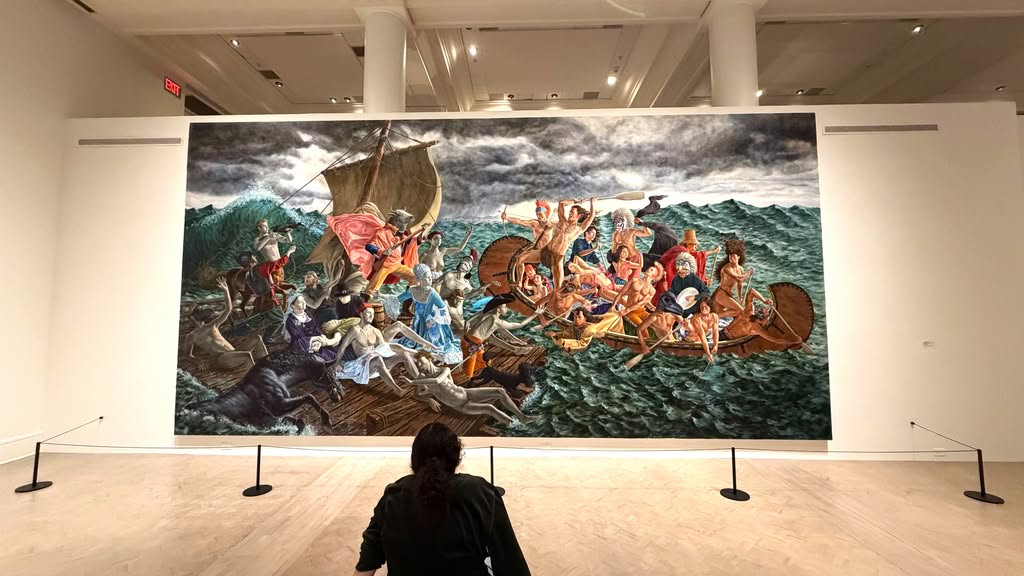
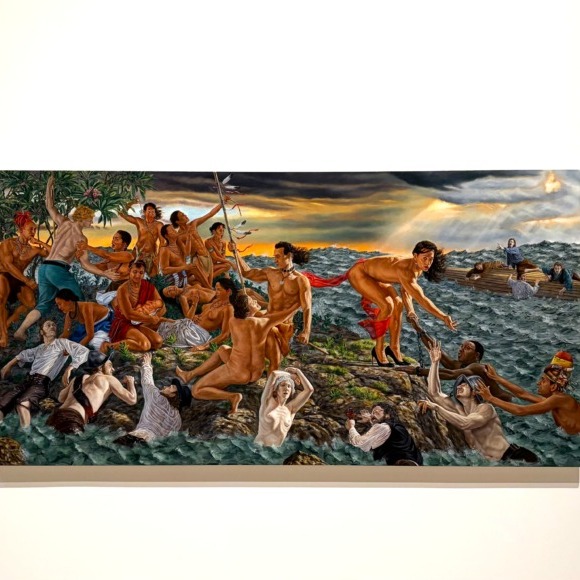
The painting retells the 1613 Treaty of Teioháte Kaswenta (Kanien’kéha), or the Two Row Wampum Treaty in English, according to the AGNS. The treaty was about the co-existence of the Dutch and the Haudenosaunee, more specifically the Kanien’kehá:ka people, according to the Canadian Museum of Human Rights.
Miss Chief’s Wet Dream is the first of Monkman’s works to have a maritime theme, says Germain-Bajowa. Being in a coastal community, Germain-Bajowa says she was glad she was able to incorporate works featuring water within the exhibition.
She says the water-based theme of the exhibition explores the impacts of migration.
“We’re absolutely in a time where conversations around migration and natural resources are at a peak,” she says.
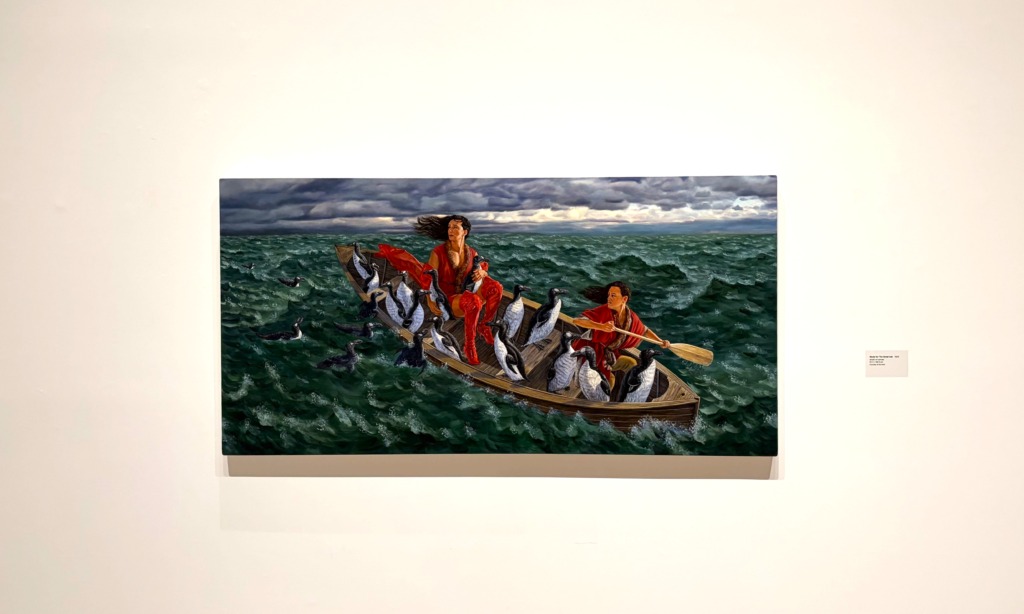
These themes tie together explicitly in Miss Chief’s Wet Dream, as well as Monkman’s Study for the mistikôsiwak (Wooden Boat People).
In Monkman’s Study for the mistikôsiwak (Wooden Boat People), Miss Chief, Monkman’s queer alter-ego, leads migrants of different backgrounds into a new land, says Germain-Bajowa.
On the wall of the exhibit, it says the water backdrop in both images serves as a “participant in our history. It is a force of life that has sustained and narrated the journeys of Indigenous nations, settlers, enslaved peoples and refugees alike.”
“I thought it would be nice to look at the social aspects of migration, but also the ecological impacts and pathways that we are experiencing now, and that others have experienced in the past,” says Germain-Bajowa.
Monkman references European artwork
Dalhousie University associate professor of history, Lisa Binkley, says Monkman’s work uses a similar technique to the high-art practices of large-scale historical paintings.
“[Monkman] uses a workshop very similar to what the high artists would have used in Europe, where he has apprentices underneath him who do a lot of the painting,” says Binkley.
Monkman came up with the concept for Miss Chief’s Wet Dream and used apprentices to help bring the almost 12-foot-tall painting to life. This is an approach used by masters such as Rembrandt, a Dutch artist of the 17th century.
The painting reminds Binkley of Théodore Géricault’s The Raft of the Medusa.
While Monkman’s work is inspired by Géricault’s pieces, it also bears many similarities to paintings from the French Revolution period.
Historically, paintings were used to educate the lower class and functioned as a form of communication, which is why they were so “epic and big,” says Binkley.
Monkman uses a similar technique, as Miss Chief’s Wet Dream is about 24 feet wide and 12 feet tall.
Binkley says that by doing this, Monkman is “reworking these history paintings and making his own history.”
“I think it’s incredibly beautiful to see these realities, past and present, be reinserted into the larger [artistic] canon,” says Binkley.

Read more from the gazette

Halifax’s thedottedline is here to finish what Kendrick Lamar started

The AUS to ACAA pipeline
Chartwells manages half of SUB food vendors after Abstract takeover
Africville tribute on display at Nocturne

Tigers defeat Moncton 3-2 in a dramatic overtime finish