I have to move my car (again)
Students risk parking tickets instead of buying permits
September 24, 2026 / Lily Van Beek
By 8 a.m., parking lots at Dalhousie University are usually crammed end to end with cars.
In response, students like Taylor Caissie, a fourth-year history student at the University of King’s College and Dal, are choosing to park their vehicles illegally, both on streets and in private lots.
Caissie, who lives on campus, says she often exceeds street parking time limits to avoid paying for a student parking pass.
“I usually park in two-hour parking spots, and I’m good to leave my car there all day,” says Caissie. “Right now I have [my car] on the street somewhere … but I’ve never parked there before, so there could be a ticket on my car as we speak.”
Ryan Wilson, a third-year computer engineering student, takes a similar approach.
“These days I’m parking at a park on Jubilee,” he says. “There’s nothing closer, and I don’t want to pay for a parking pass anyway.”
Why not pay for a parking pass?
It may seem irresponsible to risk parking tickets instead of coughing up the cost of an official pass, but for some students, illicit parking is the best option.
An annual general parking permit from Dal, which allows students to park in limited lots on campus and does not guarantee parking, is $408.92. The cost for a reserved spot can be up to $2,266.42.
For Wilson, general passes cost too much since spaces are not guaranteed.
“[A parking pass] is massively expensive,” he says. “There’s not much point [in buying one] if you know you’re going to be fighting with a dozen other people for a spot.”
According to Dalhousie’s 2026-27 parking rates webpage, a waitlist for several of the school’s reserved outdoor lots has more than 200 people, and it will be several years before spots become available.
What are the alternative options?
Resident parking permits can also be difficult to obtain, as the Halifax Regional Municipality’s policies make individuals living in large apartment buildings ineligible for residential parking.
According to HRM policy, a residential permit is available to anyone who resides in their designated zone in a property of no more than four dwelling units.
For students with cars living in larger apartment buildings, the only other option is to rent a parking space from their landlord, with prices varying between buildings and property managers.
Some property management companies like Killam Apartment REIT also struggle with illegal parking in their private lots.
In a statement to the Dalhousie Gazette, Lauren Sinclair, director of communications and marketing for Killam, said the company sometimes struggles with individuals parking illegally in high-traffic areas.
“We occasionally experience challenges with unauthorized parking at some of our downtown properties in high-demand areas,” she said. “[Although] we would not characterize it as a student issue specifically.”
Students who commute might also compete for HRM monthly commuter permits, which allows drivers to park on designated streets depending on which zone the permit is issued for. The permits are sold in limited quantities every month and do not guarantee parking or renewal.
Street parking within walking distance of Dalhousie campus is difficult to come by, says Caissie.
“If I don’t park before 8 a.m., I’m basically screwed,” she says. “I won’t get parking. I either try not to leave in the middle of the day, or I try to park at 8 p.m. to make sure that I get a spot [for the next day].”
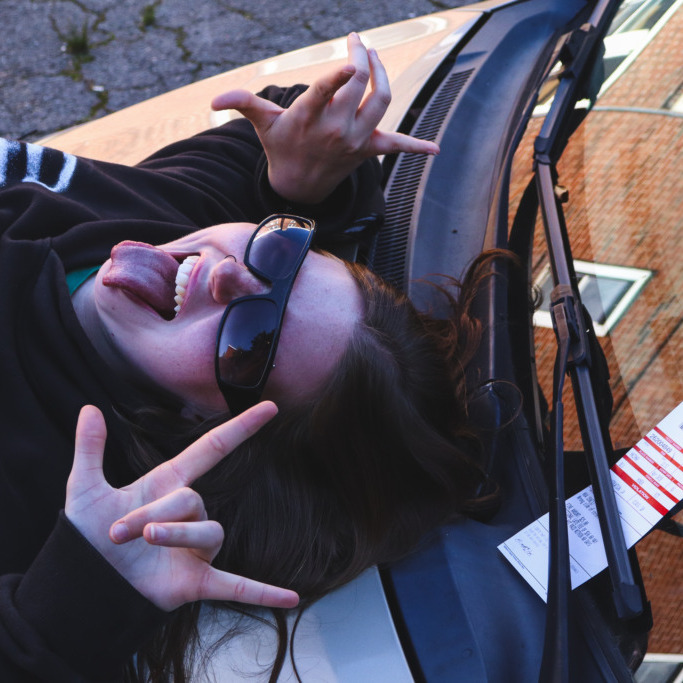
Caissie says it’s less expensive to pay the occasional parking ticket than to purchase a student parking pass. Last year, she paid $300 in parking tickets.
A question of accessibility
In a statement to the Gazette, Mike Fleury, the senior manager of strategic communications at Dalhousie, said the university prioritizes other transit methods.
“Dalhousie recognizes that reliable transportation is important to students, faculty and staff and therefore provides a range of supports,” he said.
Fleury referenced Dalhousie’s support for busing, cycling and ridesharing infrastructure.
“The university’s approach is to manage its existing parking capacity while investing in and supporting a range of transportation options that give community members alternatives to driving alone,” Fleury said.
However, students like Wilson and Caissie have specific needs that are not met by the Halifax public transit system.
Wilson, who lives outside Halifax, says he lacks reliable access to the bus system.
“I’m too far out to take the buses,” he says. “I’ve got two buses that go by my house [per] day, and one’s at 6:30 a.m. The buses aren’t particularly an option.”
In a follow-up statement to the Gazette, Caissie said having specific accessibility needs precludes other transportation options.
“Being a student with autism makes it hard to take the bus,” she said. “I have related medical appointments I need to get to, and there was nothing [Dalhousie or King’s] could do for me.”
What can Dalhousie do?
In his statement, Fleury said that adding parking infrastructure would be too costly for the university.
“Parking is a uniquely challenging issue because Dalhousie’s Halifax campuses are situated in areas where available land is limited and expensive,” said Fleury. “By necessity, Dalhousie uses a combination of measures to manage parking demand.”
Despite these challenges, students are offering potential solutions to improve parking.
Wilson suggests implementing a system similar to Nova Scotia Community College’s satellite lot.
“NSCC’s [Ivany Campus] has a satellite lot with a shuttle,” he says, “Which is one way you could add another parking lot if there’s not space nearby.”
Regardless of whether Dalhousie constructs new lots, Wilson says it is unfair for the university to oversell parking permits.
“If you’re paying that much for a parking pass, you should get a guaranteed spot,” says Wilson.

Read more from the gazette
Halifax’s thedottedline is here to finish what Kendrick Lamar started
The AUS to ACAA pipeline

Chartwells manages half of SUB food vendors after Abstract takeover
Africville tribute on display at Nocturne

Tigers defeat Moncton 3-2 in a dramatic overtime finish