
Tony turns Provincetown into Hollywood
How this biopic overwrites Provincetown’s legacy
September 10, 2026 / Mia Phillips
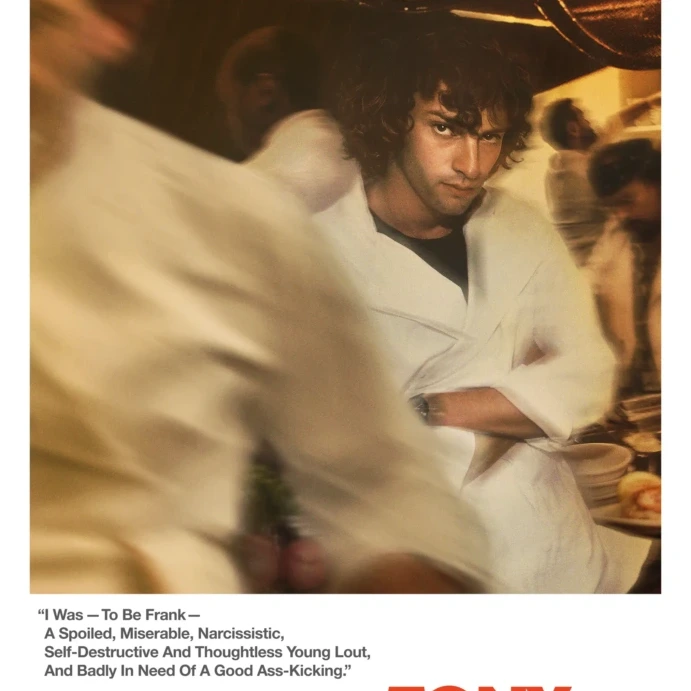
The Anthony Bourdain biopic Tony (2026) is a perfectly fine movie. The plot is formulaic, the story heartwarming, and the movie-going experience is overall satisfactory. The only catch: the story isn’t actually Bourdain’s.
Directed by Matt Johnson, Tony follows 19-year-old Bourdain (Dominic Sessa) on a life-changing pilgrimage to Provincetown, Mass. There, he experiences a classic hero’s journey transformation: he spirals out of control, is taken in by a local chef (Antonio Banderas), finds his sense of purpose in the kitchen, then accidentally burns the kitchen down, later saving the day by organizing a clam-bake fundraiser. By the film’s conclusion, every loose string is neatly tied up with a big bow.
Johnson dramatizes Bourdain’s life until the scenes gleam with a picture-perfect, Hollywoodified sheen in the pursuit of a polished plot.
In reality, Bourdain was brought to Provincetown by his then-girlfriend, Nancy Putkoski, and their friends. He spent his time high on the beach, revelling in the directionlessness of his life. He had wild, shoulder-length black hair and no ambition apart from hanging out. That is, until his roommates had had enough of him not contributing and made him get a job as a dishwasher at a local restaurant, the Flagship.
Provincetown, as Bourdain found out, was a place to both be yourself and find yourself; a place that ran free with authenticity. Bourdain once described the town as “a wonderland of tolerance with a longtime tradition of accepting artists, writers, the badly behaved, the gay, the different. It was paradise.”
There are glimpses of truth within the film; the scenes of Tony and Sal (Leo Woodall) on the pier are straight out of a vintage postcard. Woodall’s performance is truly transportive. I have never heard a better Boston accent in a film. It’s like they plucked someone right off a lobster boat and put him in front of the camera. Those realistic moments shine through the rest of the movie’s eye-roll moments.
Sessa’s performance, on the other hand, is less than convincing. I expected great things after his generational performance as Angus Tully in The Holdovers. But Sessa’s Tony felt like the same performance he gave three years ago — brooding, anti-social, and brash — a far cry from the Bourdain Provincetown remembers. When Sessa told Vanity Fair that he didn’t attempt to embody Bourdain, I believe him.
Johnson admittedly spent only two months in Provincetown the winter before filming began, and it shows. Tony is obviously the work of someone with limited exposure to town lore.
Last year, the Boston Globe reported on the ongoing gentrification of Provincetown. Private corporations have bought up the commercial land and driven prices through the roof. Recently, Provincetown was named the most expensive town on Cape Cod — the famously unaffordable peninsula in Massachusetts.
As a fourth-generation Provincetown resident, the changes are hard to admit, and harder to deny. Every year, more kitschy T-shirt shops crop up on Commercial Street and another iconic landmark is lost to luxury condo developers. Even the Flagship, the first restaurant Bourdain worked in, is now a private residence.Unaffordability drives out those artists, writers, etc. who make Provincetown so special.
A big-budget film made for mass appeal exists in direct conflict with the lifestyle this edge-of-the-world sandbar facilitates. Now that Provincetown’s land has been developed, Johnson has commercialized its legacy too.

Read more from the gazette
BREAKING: Ella Mowbray Chriske acclaimed as KSU president in by-election
Over 100 people protest against AI data centre at legislature
Halifax’s thedottedline is here to finish what Kendrick Lamar started

The AUS to ACAA pipeline
Chartwells manages half of SUB food vendors after Abstract takeover