
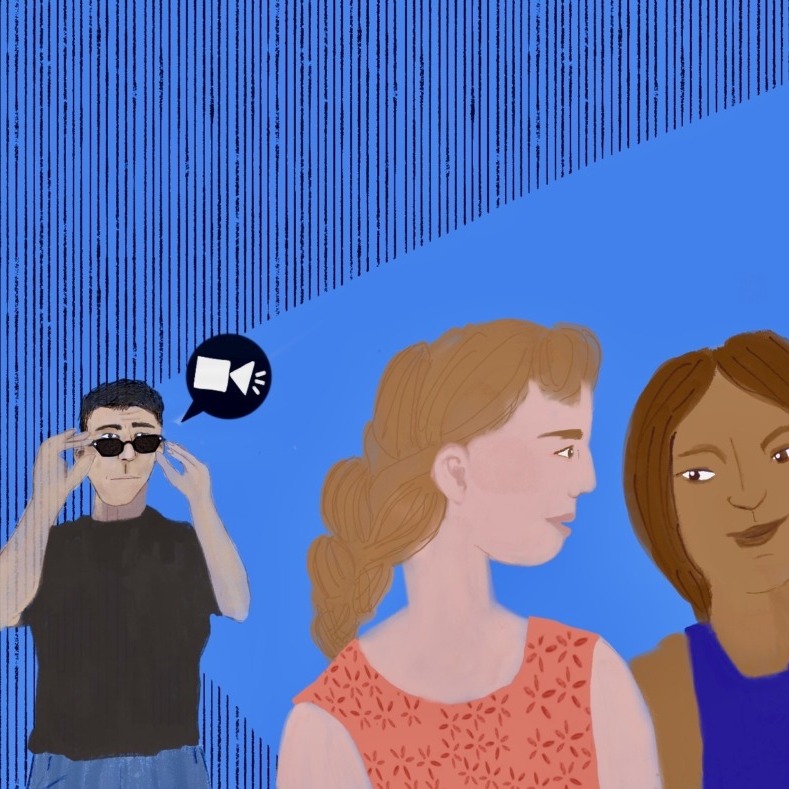
Meta’s AI glasses are for perverts
Technology shouldn’t be used to break consent
September 10, 2026 / Mariana Luz
When I was in high school, I read 1984 by George Orwell for the first time. That book made me realize I was terrified of living in a world of mass surveillance.
The idea that millions of people are now wearing glasses with hidden cameras makes me question if we are getting closer to the book’s reality.
Meta’s AI glasses are marketed as technology that allows users to be more effortlessly connected. In reality, they are being used to film others without consent.
Theoretically, Meta’s AI glasses seem like a great invention — allowing people to be online without constantly reaching for their phones. In reality, it simply doesn’t work.
In a world where some still don’t accept no for an answer, there is no ethical way these glasses can exist.
Filming people without consent didn’t start with smart glasses. People have used cellphones or security cameras to film others without permission for years.
The biggest difference is that you can tell when a cellphone camera is being shoved in your face. In most cases, there is no way to tell if you are being filmed with smart glasses, or to give explicit consent to be filmed.
As a safety feature, Meta’s AI glasses have a capture LED, a small white light that blinks when the glasses are filming. This is a flawed safety feature because it requires the person being filmed — on a device that looks like a regular pair of glasses — to recognize it.
The light is also not always reliable, considering it can be easily hidden. A quick internet search showed me multiple YouTube tutorials on how to disable it, some of them less than two minutes long.
In a recent privacy update, Meta claims that the camera will be automatically disabled if the device detects that the light has been tampered with. They also claim that the company will take legal action against people who are selling services and devices that disable the capture LED.
This sounds like a great solution, but I’m skeptical about how they are detecting people who are tampering with the light when there are so many different ways to deactivate it, including many gadgets sold online that cover the light without disabling the camera.
Nowhere on the Meta website does it say how they are able to detect it or how accurate their detection is.
Videos filmed using smart glasses are often shared online, and in many cases, women are being harassed not only by the person filming, but also in the comments section.
A recent study by the University of Sydney in Australia analyzed 350 public Instagram videos posted by pick-up artists worldwide between 2023 and 2026. The videos were identified by hashtags including “rizz” and “POV.”
Out of the videos with those keywords, approximately 60 per cent were classified as potential harassment. In around 43 per cent of the videos, the victims were exposed to online abuse, with some even having their personal information leaked.
The study was prompted by a BBC article about two separate women who were filmed with smart glasses without their consent. The videos were then posted to TikTok and gathered millions of views. By the time the victims were made aware of the videos on social media, the comment sections were flooded with many derogatory comments — and one video had even revealed where one of the women lived.
Adam Mosseri, the head of Instagram, recently said in a story post that the platform is working to take down the videos of people being harassed. But even if the videos are deleted, or the accounts are taken down, the damage is already done.
Looking through the hashtag “raybanmeta” on Instagram, I was able to find multiple videos and accounts dedicated to posting harassment content that still haven’t been taken down.
Personally, I don’t want to be scared that I will stumble upon an Instagram video of me that someone filmed without my consent.
Currently, Canada doesn’t have any laws restricting the use of smart glasses in public spaces. This type of content will not stop as long as the people posting it face no real consequences for their actions.
Until then, many people — mostly women and minimum-wage workers — will continue to be harassed for Instagram likes.

Read more from the gazette

BREAKING: Ella Mowbray Chriske acclaimed as KSU president in by-election

Over 100 people protest against AI data centre at legislature
Halifax’s thedottedline is here to finish what Kendrick Lamar started
The AUS to ACAA pipeline

Chartwells manages half of SUB food vendors after Abstract takeover