“We’re all complicit in genocide”: Dalhousie’s investments impact everyone
Ignorance allows others to follow, and the consequences are devastating
September 24, 2026 / Alyssia Halvorsen
Much of my days are spent thinking about Palestine.
I think about the women and children being bombed in refugee camps, simply because they exist.
I think about the callous response to the tragedies we have seen so casually on Instagram, and about people I considered friends who demonstrate no concern.
I think about the journalists who were targeted, the journalists who were killed and the stories that were buried with their bodies.
It’s a lot to think about every day, but it’s nothing compared to the people living through it or the people whose families, friends and colleagues have been impacted.
My thoughts are quieted, and I’m brought hope when I encounter my fellow students in Halifax who fight so completely for Palestine. Protests, encampments, calls for divestment, fliers stapled to telephone poles — all of these are reminders of the people who have put so much on the line, who care and are fighting for change.
It is baffling to watch my university and other schools ignore these voices.
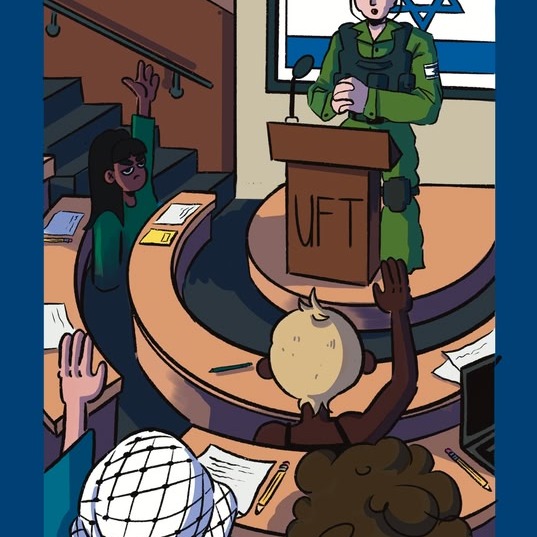
In July, the University of Toronto announced a fall semester class taught by visiting professor David Lagziel, special topics in economics: Israeli economy. His usual post is in the economics department at Ben-Gurion University of the Negev in Israel. He is also an ex-Israeli Defence Forces soldier.
The Varsity, U of T’s student newspaper, highlights a now-missing section of his resumé that describes his time as an Armoured Corps Lieutenant in the IDF from 2002-06. They highlight how military service is compulsory for most Israeli citizens. However, Lagziel’s rank would have had him surpass the mandatory minimum.
Outrage has, of course, followed.
After the backlash, the course has been pushed to the winter semester. Lagziel responded to an email campaign calling for his removal on Sept. 2, posting on X, “There are some people who just need a hug. To the head. With a bat.” The original post was in Hebrew, and this is the English translation.
His account has since been made private. The comment is being called a threat of violence and has renewed calls for his removal.
On Sept. 18, it was announced that Lagziel was removed from his position at U of T, and his classes have been cancelled. The university has not made a statement at the time of writing. Lagziel has also been removed from the microeconomic theory course he was going to teach.
The Dalhousie Gazette reached out to Lagziel for comment but did not receive a response before publication.
I spoke with Owen Skeen, the chairperson for the Nova Scotia branch of the Canadian Federation of Students.
The federation represents individual university and college student unions across Canada, and their activism takes many different forms. They campaign for free and universal access to post-secondary education and offer services such as a healthcare plan and international student cards.
Skeen describes how the group “has been very active in its role of supporting grassroots organizing and grassroots efforts to push for divestment.”
This included support for the pro-Palestine student encampment that took place on Dalhousie grounds in the summer of 2024, as well as statements supporting Divest Dalhousie.
Leah Walter, the Dalhousie lead for Nova Scotia Student Strike, perfectly worded the importance of divestment.
“[Dalhousie’s investments] make all of us here complicit. All the students, all the teachers, we’re all complicit in genocide,” says Walter.
Dal, like many other institutions, invests money in a variety of endeavours, including companies that invest in weapons manufacturing and connecting students with businesses in Israel.
Universities’ unwillingness to divest, as well as hiring ex-IDF soldiers, forces a complicity that I do not want to be a part of.
Why are we all forced to live with this knowledge, this guilt, when we know divestment is possible?
There has been a long history of academic institutions telling their students that divestment, in a variety of ways, is impossible.
“Palestine is not the first area in which students have been very vocal about the need for divestment, and it probably won’t be the last,” says Skeen.
In 1986, Dal was a part of “a historic push” for divestment from apartheid in South Africa. Ultimately, Dal was one of the earliest universities in Canada to divest.
The argument for the “impossible” divestment is blamed on the managers of financial assets, who universities say don’t have the capacity to meet their demands, even if the university wanted it.
Last March, following the Nova Scotia student strike, Nova Scotia College of Art and Design finally made steps toward divesting from Israel, after three years of refusal and claims that it was impossible, says Skeen.
Only months after the student strike ended, NSCAD disclosed all of their investments, and created an avenue for divestment on the condition that they could find a new investment-management firm.
It’s these examples that show us schools could divest, if they truly believed it was worth it. Instead, we take steps backward.
Skeen highlights how it is not only the financial aspect that makes divestment so important. Universities including Dal “carry so much weight socially and morally in terms of setting a tone for the kinds of discourses that are acceptable.”
“It’s despicable the way in which these universities and these institutions do serve the function of normalizing,” says Skeen.
It’s easy to feel nervous in this current climate, knowing protesters are being watched and the potential of being targeted for activism.
Walter isn’t letting it get to her.
“If I’m not going to speak out in a place of privilege, who is going to speak out?” asked Walter.
Anjali Seshadri, president of the Dalhousie Student Union, had a similarly hopeful outlook.
“I’m glad that students have conviction. It’s great to see,” she says.
It’s difficult to watch such conviction being ignored by U of T. It’s difficult to imagine Palestinian students attending an institution that shows so little care for genocide.
I look back on the student strike last March and Dal’s complete ignorance of student action. It stands to me, more than anything else, as permission.

Read more from the gazette
Halifax’s thedottedline is here to finish what Kendrick Lamar started

The AUS to ACAA pipeline

Chartwells manages half of SUB food vendors after Abstract takeover
Africville tribute on display at Nocturne

Tigers defeat Moncton 3-2 in a dramatic overtime finish