
Dal Faculty union agreement revealed 10 months after lockout ends
Agreement contains pay increases, increased faculty leave
September 10, 2026 / Jonas May
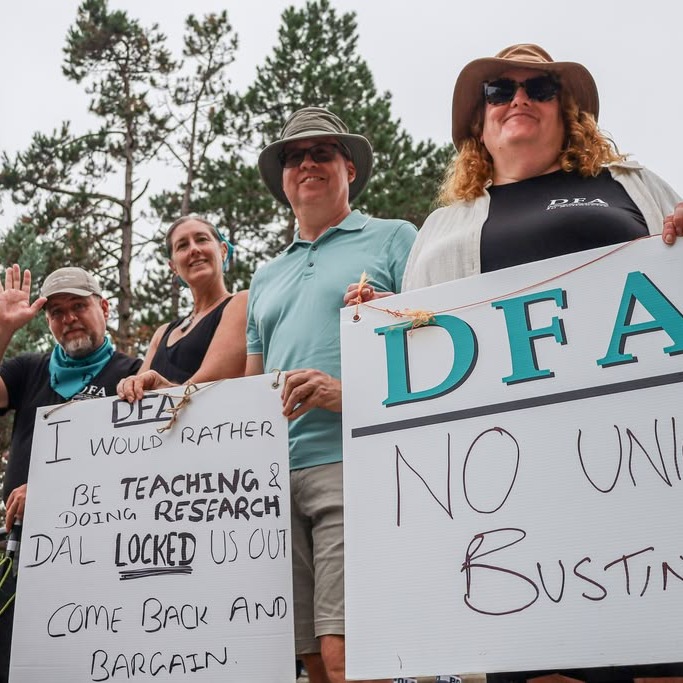
The new agreement between Dalhousie University and its faculty union was revealed in July, over 10 months after the labour agreement was ratified, ending a four-week lockout that delayed the start of the fall semester last year.
The deal sets the work terms for the Dalhousie Faculty Association’s nearly 1,000 members for the next three years. The collective agreement’s details were the source of intense negotiation between the DFA and Dalhousie, culminating in a four-week lockout.
When the agreement was ratified on Sept. 17 of last year, a statement from Dalhousie said the full agreement would be released “in the coming weeks.” The agreement wasn’t signed until July 23 and was posted to the DFA and Dalhousie’s websites shortly after.
David Westwood, who was the president of the DFA last year, said there “isn’t any real drama” behind the delay in signing the new agreement.
Higher annual salary increases, reduced academic work for the DFA president, and better parental and childcare options for union members were among the terms that led to the lockout. The final agreed-upon pay increases ended up slightly closer to Dal’s earlier offers than the DFA’s demands.
The university did not respond to multiple requests for comment from the Dalhousie Gazette to speak with a member of university administration on the details of the collective agreement.
The DFA, which represents full-time professors, librarians, counsellors, and instructors, was locked out by Dalhousie’s board of governors from Aug. 20, 2025, to Sept. 17, 2025, after negotiations on the collective agreement collapsed. At least 90 per cent of Dalhousie’s courses were suspended until Sept. 23, 2025.
DFA members were locked out of their offices, classrooms and emails. The lockout was the first of its kind at a leading research university in Canada.
New salary increase structure
The DFA announced a 3.25 per cent salary increase for all union members for the first two years of the agreement, increasing to 3.5 per cent in the third year. The deal was ratified last year and will end in 2028.
After Dalhousie sent an offer including a 2 per cent salary increase for each of the collective agreement’s three years, the DFA’s counteroffer was for a 3.75, 4.75, and 5.75 per cent salary increase split. This financial disagreement was the leading factor for the lockout.
The previous deal guaranteed union members a 3 per cent increase in the initial year of the agreement, followed by two years with a 2.5 per cent increase.
Westwood, who is now the DFA’s president-elect, says the change to annual splits increasing, rather than decreasing, over the course of the agreement is due to Dalhousie’s ongoing monetary struggles.
“[The board] imagines the finances will get better over time,” says Westwood. “Let’s hope they do … we still are laser focused on [salary increases] as we look to the next round of bargaining.”
Related: Dalhousie projects $13.1 million deficit for 2026-27 academic year
The DFA president will now be entitled to a full workload reduction, meaning they don’t need to perform any of their usual duties, including teaching, research or doing admin. The president-elect can now reduce their workload by up to 50 per cent. In the previous agreement, the DFA president could reduce their workload by the equivalent of one full class. The president-elect previously did not receive a reduced workload.
Dominic Silvio, the current DFA president, was the union’s president-elect and served as the acting head of the science and management divisions, as well as the arts and social science division of Dalhousie’s library services last year.
“We needed more time to focus on what’s going on with the DFA,” says Silvio. He confirmed that he’ll be taking the full workload reduction, and the library will hire someone to do his work during his one year as president.
Childcare was, and will continue to be, contested by the union
Increasing the quality and quantity of childcare was the main point of contention throughout the collective bargaining aside from salary increases, Westwood says.
Silvio says Dal’s board of governors were “reluctant” to negotiate on childcare, and that the topic will be a point of emphasis the next time the DFA negotiates a new collective agreement in 2028.
The new agreement replaces the term “daycare” with “childcare,” including a non-binding letter of understanding stating the board of governors and the DFA will share responsibility for finding 20 additional childcare spots for union members over the course of the agreement. The DFA was hoping for a higher increase of childcare spaces from the university.
“We pushed hard; we kept it on the table as long as we could during conciliation,” says Westwood. “We think Dal can, and needs to, do better.”
The union and university also negotiated an increase in parental leave payments. Members who go on pregnancy and parental leave will now receive 52 weeks of additional payments from the university compared to the previous agreement’s 31 weeks.
Additionally, the agreement includes a new Indigenous leave clause that gives members five available days of paid leave for days of cultural importance per calendar year.
Updated wording will make it easier for union members to take bereavement leave, while also adding a new provision to account for Indigenous understandings of family and community.
Silvio and Westwood are both looking forward to a return to normalcy this year. Despite this, Westwood says that the impacts of the lockout will be felt at Dalhousie for years to come.
“Last year was so unusual and chaotic that it was just such a low point in so many people’s lives and careers,” he says. “I can’t believe we had to go through that. Never again; we can’t let that happen.”

Other Posts in this category
Make-A-Wish partner society founded at Dalhousie
DSU rehires same security contractor for DalFest after alleged assaults last year, adds new safety measures

Tony turns Provincetown into Hollywood
Meta’s AI glasses are for perverts
MacLeod is out of tune with Nova Scotians