
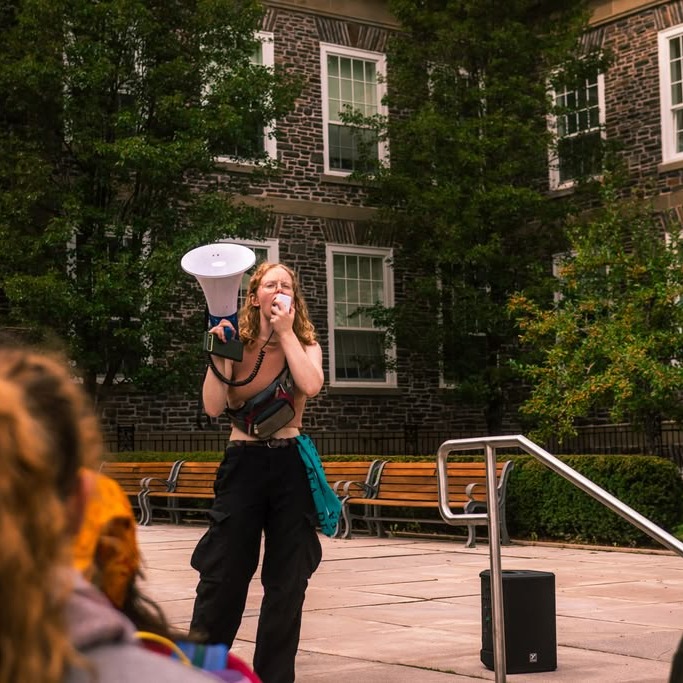
Kim Brooks never responded to my emails
Beyond personal moral failures, the Dalhousie administration systemically de-prioritizes student decision-making
September 10, 2026 / Maren Mealey
During my year as the Dalhousie Student Union president, I only received one direct email from Dalhousie University president, Kim Brooks:
“Maren,
Just forwarding something nice to see for your inbox.
Kim
–
‘Others might have already discovered this, but the new Abstract Cafe (in the old Grawood Pub space, DSU building) has fantastic croissants that are worth the detour. Like, really good.
Happy Thursday.”
As tempting as it may be to write a hit piece against Brooks, this is not that article. My deep belief is that the systemic rot at this university goes far beyond individual moral failures.
Holding the highest level of office in the student union confirmed to me what many of us already know: the university administration fundamentally and consistently prevents students from exercising decision-making power.
Last year was not an easy one for Dal students. We started the fall semester in the middle of an admin-initiated lockout of our faculty’s union. The new year brought a devastating series of province-initiated budget cuts that continue to threaten post-secondary education and pose an existential threat to funding for African Nova Scotian and Indigenous students. In March, our student body voted in favour of a first-of-its-kind motion to carry out a one-week student strike.
At each of these turns, I reached out to Kim to meet, voice student concerns and negotiate. Consistently, I received no reply from her.
Instead, I got replies from various other administration members tasked with “student affairs.”
After spending the better part of a year not being able to track down Kim, at the end of February I finally secured a meeting with her, along with the provost and the vice-provost of student affairs.
My excitement about this long-awaited meeting was short-lived when I learned second-hand that Kim was in India with Mark Carney and couldn’t make it.
Instead, the vice-provost of student affairs, the provost and academic vice-president Wanda Costen and I sat down for an admittedly tense and largely unproductive meeting with Kim’s absence looming large.
During our conversation, Wanda admitted she didn’t know when reading week was and trivialized the legitimacy of students exercising their right to protest in academic contexts.
To be clear, I understand that university administrators have busy schedules that may shift suddenly. As disappointing as it was, I don’t hold it against Kim that she was called away and couldn’t make the meeting.
What I do, however, find largely inexcusable was that she didn’t notify any student union executive of her absence or make any attempt to reschedule when she was back. Once again, crickets.
This points towards the larger concern of students not being taken seriously by university administrators.
In my experience, often Dal administrators weren’t often openly hostile to students, but they didn’t prioritize them and refused to meaningfully share decision-making power.
Throughout my time, I had frequent meetings with the vice-provost of student affairs, who seemed genuine and was often helpful. However, they held limited control over broader decision-making in the institution.
When conversations around divestment, student protests or the lockout emerged, meetings with the student affairs office could only take the concerns so far. This entire institution is built upon the base of students, and that should be reflected in the structure of decision-making instead of relegating student issues to one department or a single designated administrative representative.
Circumstances where the institution implements student positions within the university’s ecosystem — committees, boards and other decision-making bodies — represent an often tokenistic effort. In nearly all of these university committees, the number of students is proportionally limited, making it incredibly difficult for students to influence the university’s direction.
For instance, when it comes time to vote on tuition increases at the Dalhousie board of governors, student representatives hold only three seats in contrast to the 21 other board members who consistently vote in favour of tuition increases year after year.
In forums where some of the most significant decisions on student issues take place, often we aren’t even represented tokenistically at the table. When I raised a motion on divestment to the board of governors, I was initially largely ignored. It was not permitted to be added to the agenda ahead of time, and when I attempted to move it on the floor of a board meeting, I was told it was “bad governance” for it not to come through a subcommittee first. However, the finance, audit, investment, and risk committee has zero student representatives.
These decisions are simply not happening in ways that are accessible to students. As a reader, do you know how the two student positions are appointed on the budget advisory committee? To be perfectly honest, neither do I anymore.
Administrators are, whether intentionally or not, expecting students to meet them on the institution’s playing field, one mired in a lack of transparency and obstacles, instead of meeting us where we are. Students aren’t being heard, and this isn’t because they aren’t voicing their opinion loudly.
The past few years have seen a surge in student protest and organizing. Merely allowing a handful of “recognized” student representatives to be accepted into limited and performative decision-making positions serves to delegitimize and disregard student voices when they assert themselves outside of these recognized channels.
In the most recently publicly available report from Dal’s Ombudsperson, Jessica Chubb, they outline a lack of “student-centred decision-making” from the university. While I wholeheartedly agree with the analysis and concern about the lack of transparency and disregard for students, I think we need to go beyond a “student-centred” model and instead build a “student-decided” model.
Students need to be placed meaningfully and representationally in the centre of decision-making. While an administration that makes calls with “student well-being” in mind is lovely and all, it will always be more out of touch with student needs than an actual student.
My year in the student office led me to believe that Dal’s administration isn’t mean-spirited; they just don’t care about us enough to loosen their control over the institution.
As the student body, we can’t wait for administrative figures to show us benevolence, but we need to continually work to build a university that serves us and the broader community.
We got a taste of this in the summer of 2024, when students worked together to build the Al Zeitoun University encampment. Through it, a parallel academic institution was built, with solidarity and education at the core of its mandate, with no tuition, free food for all, faculty-student coalitions and teaching open to anyone in the community.
As we continue to advocate for our principles, this sort of audacious and creative intervention into university business-as-usual should continue to guide us towards systemic and student-driven reinventions of the university. To be honest, I’m not exactly sure what those solutions are, just that they must come from us and not by continuing to play by the university’s rules.

Other Posts in this category
Make-A-Wish partner society founded at Dalhousie

DSU rehires same security contractor for DalFest after alleged assaults last year, adds new safety measures

Tony turns Provincetown into Hollywood

Meta’s AI glasses are for perverts

MacLeod is out of tune with Nova Scotians