
Hungover, Hungry and on a Budget
Where the coffee flows and the prices stay low
November 5, 2026 / Ellie Garry-Jones
It’s 1982. You walk into a diner and order a plate piled high with eggs, sausage, ham, bacon, hash browns and toast. A cup of joe on the side, and the bill comes to less than eight dollars.
It’s 2026, and despite decades of inflation, little has changed at the Ardmore Tea Room. The time machine appears to be broken.
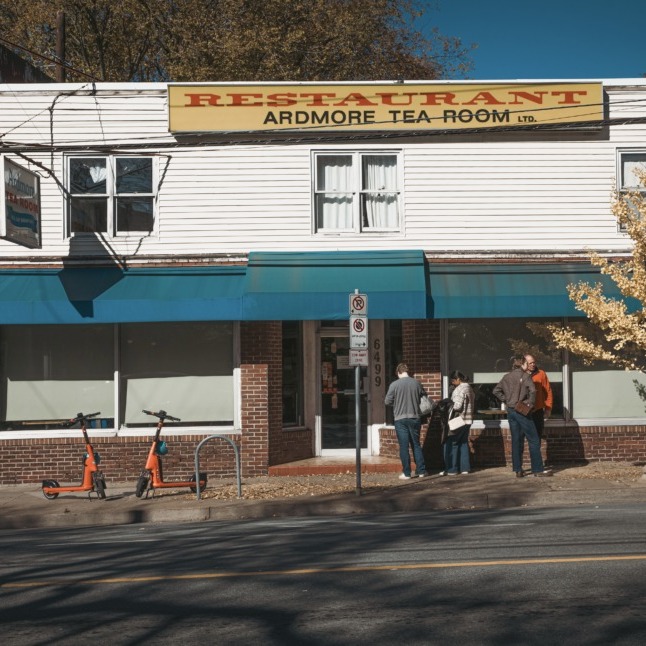
On Quinpool Road, a line wraps around the building of this Halifax greasy spoon that provides a Sunday service of its own religion. Here, the hungover come to repent.
The congregation arrives dressed in their best attire: sweatshirts and sunglasses in a desperate bid to keep the hangxiety at bay. In its vinyl pews, university students sit nursing their coffees and piecing together the sins of Saturday night.
Nowadays, when one sit-down meal can blow the weekly budget, the diner offers a rare form of student salvation: a full stomach without the financial hangover.
In a world overflowing with cafés and bistros, to owner Mike Cormier, the Ardmore might just be “one of the only diners left.”
The business Cormier is running isn’t fundamentally different from other restaurants or greasy spoons. What sets the Ardmore apart is its refusal to let inflation become a catch-all justification for charging customers more.
“Yeah, inflation is there, but people take advantage of that and spin the narrative so they can put their prices up more than they need to,” he says.
Once a small chain, the Ardmore opened in 1952. Its name originated from the district now considered the border between the west and north ends. The Quinpool location opened its doors in 1958 and has since been the only one to keep them open. Seven decades later, nothing has changed significantly — not the unpretentious decor, the menu prices and definitely not the demand.
In the 15 years since Cormier became owner, he’s seen increased food prices cause the menu to inch its prices up. When he first began, the most popular item on the menu, the lumberjack breakfast, went for $7.99; now, it sells for $11.25.
“But that’s not a huge price increase,” he says. “Which is a large part of why there’s always a lineup. It’s good food. It’s affordable. It’s reasonable.”
On the list of business priorities, Cormier says affordability ranks high.The most expensive item on the menu, steak and eggs, costs $15.50.
Bells and whistles aren’t the restaurant’s forte. “We’re volume. That’s how we make money,” he says. “We’re not making it on every single plate. It’s about turnover.”
Yet the golden question remains, how does the Ardmore defy the typical restaurant price gouging amidst inflation? The answer is not some secret omelette recipe, but through a series of decisions about what a restaurant needs and what it can do without.
A smaller restaurant, first of all, equates to less rent. More importantly, Cormier says menu engineering is critical to keep costs and ticket times down. On the breakfast menu, the Ardmore offers 14 items to choose from, a small quantity compared to breakfast-joint competitors like Cora’s or Pur & Simple. The seven additional items listed under the burger and sandwiches section bring the total number of main items to 21.
According to the Statistics Canada annual survey of service industries, food costs make up 35 per cent of all expenses for full service restaurants.
Cormier says the engineered menu not only means fewer ingredients to buy, but also less food waste.
“We throw zero food in the garbage,” he says. “It’s only when something falls on the floors, that’it gets thrown out. But that’s it, because everything is used in multiple dishes.”
Staffing is another major expense, and one the Ardmore keeps lean. The diner employs only 10 people. The small team does big numbers, with little room for the operation to slow down. Each shift, three to four cooks work the line, churning out eggs benny and french toast, while another two to three servers shuttle orders between tables and kitchen. This keeps plates moving from 8 a.m. to 2 p.m.
It’s a system capable of, on a busy day, feeding 50 mouths at a time, built around making the most of what’s already there. Fewer ingredients mean fewer menu items, which means less waste, less prep, fewer hands in the kitchen and ultimately, fewer costs. Each decision feeds into the next, and the savings add up.
All the other stuff? That comes down to the difference between need and want.
The Instagram crowd may lament the lack of matcha lattes, avocado toast arranged with Michelin-star precision or a sprawling list of alternative milks and gluten-free substitutions. But those are precisely the kinds of extras that would steer the Ardmore away from its decidedly unglamorous attitude.
“We keep it simple. We don’t try to be all things,” says Cormier. “When you lose your focus, your costs start to creep up. You bring in oat milk, but you’re not really selling that much oat milk, so you’re then throwing it out and losing money.”
Aesthetically, the temptation to spruce things up and keep with the times is always there.
“Would I like to have all new flooring, new booths, and new tables? Of course I would,” he says. “But it’s more important to stay in the cheap lane.”
Is feng shui really worth the cost if that cost eventually lands on the customer’s plate?
“You see people that come here for the first time, and it’s like, ‘Where have I been dropped?’” says Cormier. At a higher price point comes the expectation of something more, but that’s not what the Ardmore is trying to offer. “What you see is what you get,” says Cormier, who knows exactly what it is that does matter most to his customers.
“I think people are fine with the way it is as long as their breakfast is $10,” he says. “But you put the breakfast to $17.50, then you need to be Pur & Simple, have nice stuff, fancier this and that. Then suddenly, your breakfast is not 10 dollars.”
So while other restaurants keep playing within the growing margins, the Ardmore sticks to the practice it preaches best: “pumping it out.” Maybe the time machine isn’t broken after all; maybe the diner just holds faith in the simplicity of a greasy breakfast and those who need it to pull themselves back together before Monday.
No customer is asking for luxury. Because on a Sunday, real luxury is not having to check your bank balance before ordering another piece of toast or a waffle on the side, and ideally, being able to afford it again next week.
To that, the hungover gospel of Halifax says amen.

Read more from the gazette
Budgeting tips, from the provincial government
How has affording to be a Dalhousie student changed in the last 30 years?

Affordability means nothing in Halifax

The cost of having a vice

How a psychology and history student affords to live in Halifax