
Local university series fostered Jewish and Indigenous conversation and connections
Series explored shared histories, cultural preservation and revitalization
November 6, 2026 / Ryan Cleland
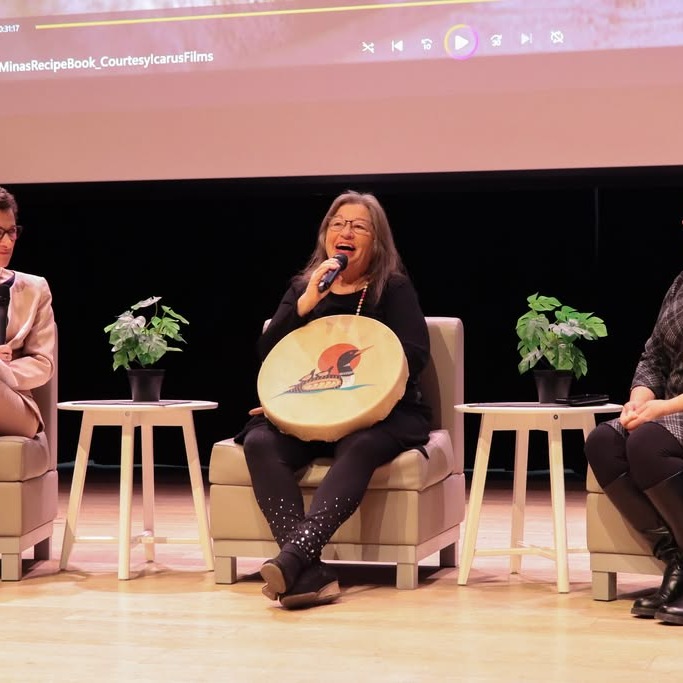
Three Halifax universities came together for an event series connecting Jewish and Indigenous voices in Mi’kma’ki.
The Fostering Indigenous-Jewish Dialogue in Mi’kma’ki: A Two-Eyed Seeing/Etuaptmumk Approach conference ran six workshops and four events in Halifax from Oct. 25 to 27. Dorota Glowaka, a professor at the University of King’s College, led the series, alongside Dalhousie University’s Centre for Jewish Studies and Mount Saint Vincent University’s Two-Eyed Seeing Program.
The three-day gathering aimed to create opportunities for meaningful dialogue between Indigenous and Jewish communities. Public events included an art gallery opening, concert, film screenings and a panel discussion.
“We were not just running parallel histories,” says Glowacka. “You really don’t learn very much about yourself, your own culture and your own difficult history until you see it in a different perspective.”
The gathering emphasized the use of the Mi’kmaw approach of Two-Eyed Seeing — or Etuaptmumk.
Etuaptmumk is a way to see the world with one eye attuned to Indigenous perspectives and the other to European, or Western perspectives.
Virginia Hector, fourth-year King’s student and Glowacka’s research assistant, who helped to organize the event., says “The important thing is that you’re using both eyes at the same time so that you have a much more full view of the world. .
There were three workshops for faculty, and three for students. Each explored a different aspect of Indigenous or Jewish cultural preservation and revitalization, including the return of ancestral belongings and cultural objects, language and linguicide, and the role of material culture.
The workshops brought together scholars from across Canada, including Caleb Sher and Jacob Hermant, King’s alum and current PhD students at the University of Toronto, and Wade Paul, a PhD student at Concordia University who presented a workshop on material culture.
Sher and Hermant brought a Jewish perspective through Yiddish literature, speaking on the history of the language and the material history of its printed books.
Paul, who is a member of the Sitansisk Wolastoqey (St. Mary’s First Nation) in New Brunswick, focused on treaty objects — such as Indigenous drums and treaty medals — to help emphasize how physical objects are tied to our history.
“I got to see a lot more shared experience between Indigenous people and Jewish people,” Paul says. “It’s been pretty eye-opening.”
The three scholars all emphasized how the discussions highlighted the similarities and differences between the experiences of Indigenous and Jewish people.
“These are not just cultures of loss but also cultures of creativity and continued life,” says Sher.
Glowacka says the response from both students and the public was encouraging, and described the engagement as something she had rarely experienced in her teaching career.
“It’s important to acknowledge that not everyone supports those kinds of initiatives, and I did have critical voices and had to adjust things accordingly,” says Glowacka. “So I had these moments when I was like, ‘No, I will never do it again. It’s not worth it.’”
But after receiving positive feedback from students, participants and faculty, she says she wants to continue hosting similar events.
Read more from the gazette
Dal Student Life hosts not-so-haunted campus tour
Budgeting tips, from the provincial government
Hungover, Hungry and on a Budget
How has affording to be a Dalhousie student changed in the last 30 years?
Affordability means nothing in Halifax