
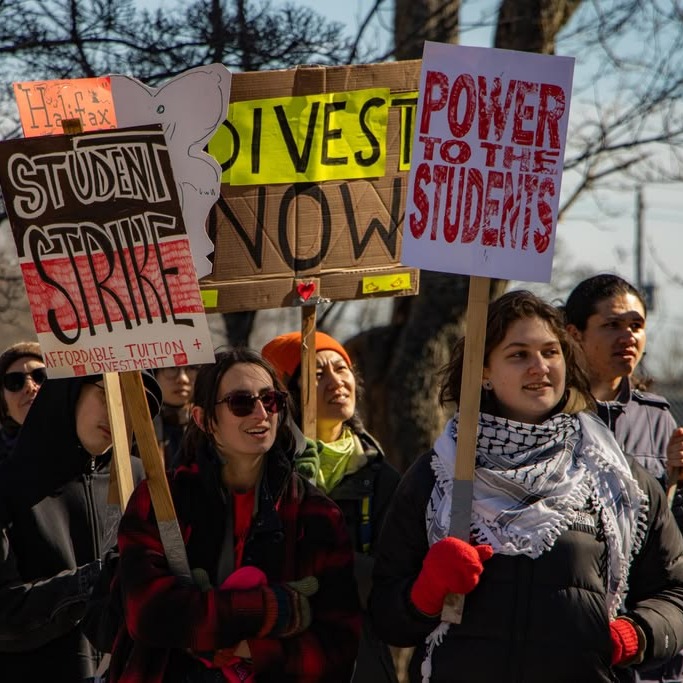
Student Strike organizers push for two-week strike in March
Group is also planning alternative O-Week events to grow into its second year
September 10, 2026 / Dylan Follett
Nova Scotia Student Strike is planning events in September and a two-week strike in March as the group tries to grow in its second year.
NSSS organized the province’s first-ever student strike, including Dalhousie University, last year from March 15 to 21. The dates for this year’s March strike have not been set, but the group is hoping to get another strike mandate from the Dalhousie Student Union like last year.
The grassroots student group is advocating for cheaper tuition through increased federal funding, and for universities to divest from entities involved with weapons manufacturing, fossil fuel extraction, genocide or the exploitation of sovereign Indigenous land.
They are planning alternative events to Dal’s official O-Week from Sept. 14 to 21.
The strike group’s “Disorientation Week” events — including bringing in kittens to compete with O-Week’s puppies — are to promote the group and protest a co-op Dal offers with Elbit Systems, an Israeli weapons manufacturer.
Other events include a teach-in on Sept. 15, a multicultural food festival on Sept. 16 and “Zine and Zyn” on Sept. 17 — an event to make zine booklets and “zyn it up.” The events will be held on Dal’s Studley Quad.
They are also hosting a community soccer tournament to raise funds for community members in need on Sept. 20 at the Halifax Commons.
This year, they’re trying to increase student engagement, especially at Dal, to grow their national student strike coalition and build toward their goal of an indefinite strike in 2028.
They also hope to get faculty-specific societies and associations to join the strike this year — a technique popular with Quebec student strikes.
No student union or group can make a student strike, but a mandate means the organization will support them if they choose to.
The group has undergone internal changes since the last strike, including establishing a written constitution. Over the summer, they held elections to give lead organizers official roles and responsibilities, something they were previously unwilling to do.
They’re also expanding their focus to more accessibility issues and more international crises beyond the genocide in Palestine — like Sudan and the Congo.
Leah Walter, NSSS’s newly elected Dal lead organizer, says the Nova Scotia group worked with counterparts in British Columbia, Ontario, Quebec and New Brunswick over the summer to build ties and national momentum. Students in Ontario and Quebec have also planned strikes for this year.
Other than trying to organize at a departmental level, NSSS isn’t planning to change their strategies or goals this year, according to Walter.
Participation in the strike varied across the striking schools — Dal, the University of King’s College, Nova Scotia College of Art and Design University and Acadia University — but was especially lacklustre at Dal.
Walter says growing the strike movement at Dal doesn’t require changing tactics, just building more student engagement.
“[The] majority of people believe in these causes, the majority of people aren’t going to argue against divestment, or affordable tuition, or extra ramps and accessibility,” says Walter. “We just need to build up some more momentum and get the word out there.”
Last year’s strike was the first province-wide student strike outside of Quebec. It was also the first successful strike vote at the DSU, passing with 62.4 per cent in favour, out of 226 students who voted.
Walter says the group feels confident about the goal of the indefinite strike in 2028.
“Slow and steady wins the race, right? We’re learning from last time, and we’re slowly building it up, and we’ll learn from this time and do it again.”

Read more from the gazette
Q&A with DSU Faculty of Architecture and Planning representative candidate Nermine Mokdad
Q&A with DSU Faculty of Arts and Social Science Representative Candidate Rory Laing-Gatehouse
Q&A with DSU Disabled Students Community Representative candidate Kenzy Bezeau
Only three candidates running across nine empty positions in DSU by-election
Ella Mowbray Chriske acclaimed as KSU president in by-election