
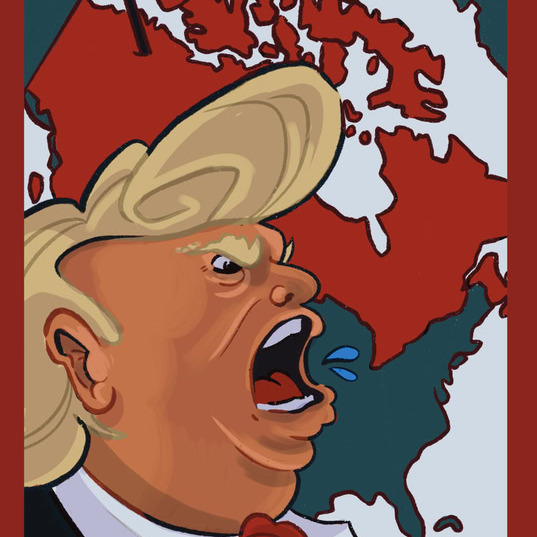
Canada’s premiers aren’t fighting Trump. They’re fighting you
Aligning with the government against the U.S. shouldn’t mean letting them off the hook at home
September 24, 2026 / Dylan Follett
As the United States and Canada’s trade war continues to take jobs on both sides of the border, one brave group of entrepreneurial Canadians are using it to procure their own job security: our premiers.
Before the trade war’s recent escalations, the job prospects for Canada’s batch of premiers looked dire. A June poll found five premiers’approval ratings at a historic low. Only one, Wab Kinew in Manitoba, had the support of more than half of his province.
So since the deeply disliked premiers got the opportunity to position themselves next to one of the only politicians less popular than themselves, they’ve been tripping over each other to do so.
When Donald Trump said he was changing the name of Lake Ontario to Lake America, Ontario Premier Doug Ford shelled out $25,000 of taxpayers’ money for an oversized Lake Ontario, Now and Always sign. Among other premiers, Nova Scotia’s Tim Houston weighed in as well, saying, “We’re into some real foolishness now. It’s Lake Ontario, buddy,” on social media.
David Eby, British Columbia’s premier, didn’t wait for a name change before announcing new signs at the U.S. border proclaiming British Columbia “will NEVER be the 51st state. Sorry!”
The premiers have thrown themselves wholeheartedly into the “Team Canada” coalition of elected officials to fight the trade war. They are also doing it mainly through tweets and signs.
If that strategy — or finding yourself on a team with your premier — feels off, it’s because the premiers’ chest-beating isn’t just part of Canada’s fight with Trump. They’re also using it for their battle with their own constituents.
There’s a reason Ford, Eby and Houston in particular spend so much time on nationalist posturing: they’re the three least popular premiers.
The premiers want to be seen as the opposite of Trump, hoping being the lesser of two evils will get their constituents back on their side while they pass deeply unpopular legislation at home.
Houston knows a light scolding won’t change Trump’s mind, but he also knows that wrapping himself in the Canadian flag is the only way to make people forget he’s still Tim Houston, as he dismantles Nova Scotia to sell for parts.
Now that Canada is at (economic) war, we need to figure out a new relationship with our elected leaders. As a testament to how thoroughly the trade war has scrambled Canadian life, the perfect model for that new relationship is Pierre Poilievre.
During a recent U.S. media appearance, the federal Opposition and Conservative leader refused to criticize Mark Carney’s handling of U.S. relations, saying “politics end at the border.”
Canadians should take a page out of Poilievre’s book. He isn’t setting aside his rancorous opposition-leader self; he’s just focusing it on domestic issues where Canadian infighting helps the country, not hurts it.
The situation with the United States is dire, and Canadians should be a united front against it. But Nova Scotia’s budget cuts are also dire, as are Ontario’s housing and British Columbia’s fentanyl crises. Premiers don’t get to ignore those issues just because the stakes are so high south of the border.
Canadians are in two different battles right now: one where they’re on one side with the premiers against the threat of foreign annexation, and one fighting those same premiers for better conditions at home.
Team Canada needs to be like every sports team — we have to spend more time practicing, competing and fighting with each other domestically than we do squaring up with foreign opponents.
Canada is facing a crisis, one that can’t be solved along partisan lines and will require sacrifice (like playing alongside Houston for a couple of shifts). But if we forget the crises of Canada’s provinces and let the premiers off the hook, we’ll get out of this trade war to find we gave away everything that made Canada worth fighting for.

Read more from the gazette

Forget Cupid. Find Archer Valentine

I have to move my car (again)

Dalhousie football club looks for redemption at homecoming

Twenty landlords own 43% of Halifax’s rental housing units, report shows

King’s has invested $2.76 million in entities they say are unethical. Why won’t they divest?