Dal’s MacEachen Institute restarts talk series with talk on energy future
Sept. 18 talk was the first of five scheduled on key public issues
October 8, 2026 / Ryan Cleland
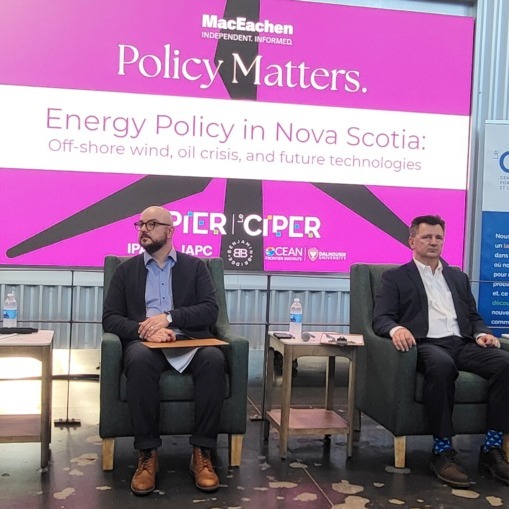
Dalhousie University’s MacEachen Institute of Public Policy and Governance held its first Policy Matters panel in four years on Sept. 18, with experts discussing the uncertainty of energy in Nova Scotia.
The talk, titled Energy Policy in Nova Scotia: Offshore wind, oil crisis, and future technologies, took place at the Pier, a harbourfront venue in Halifax.
Panellists discussed the need for greater provincial energy literacy and affordability, the role of government regulation and the province’s reliance on energy from outside the region and the United States.
“The real core theory [of the institute] is that solid democracy depends on hearing a variety of opinions,” says Hilary Doda, the project coordinator at the MacEachen Institut. “It is built on constructive, open discussion and debate.”
Around 50 people attended the talk, the first of five Policy Matters events the institute has scheduled between Sept.18 and Nov. 27 as part of a new effort to revitalize the institute and grow its community engagement.
The MacEachen Institute began in 2015 as a public policy research institute at Dal, running Policy Matters talks since 2016. The talks are organized to encourage public engagement on policy issues and foster “conversations about our democratic institutions”
The talks stopped during the COVID-19 pandemic, and the institute has only held limited-scale events in 2021 and 2022 until this year.
The talk’s panel included Christine Bonnell-Eisnor, CEO of the Nova Scotia-Canada Offshore Energy Regulator; Larry Hughes, a research fellow at the MacEachen Institute; Dragan Pecurica, director of energy and risk management at Nova Scotia Power; and Sven Scholtysik, research director of Net Zero Atlantic.
The panel also discussed projects including the offshore wind farm Nova East Wind, offshore oil and gas and whether Nova Scotia Power has the capacity for the province’s changing energy needs.
“[Energy is] the foundation of how people live their lives. It’s the foundation of future economic development.” Scholtysik says.
“It is a really important topic, but it’s really difficult for some people that are in an affordability crisis to really care about it, because other things take priority. But fundamentally, energy is the foundation of everything.”
The talks stopped during the COVID-19 pandemic, and the institute has only held limited-scale events in 2021 and 2022 until this year.
Doda, says the talks are an important part of the institute’s goal of encouraging public debate in the community.
Part of the institute’s attempt to revitalize itself and build public trust is to make all its events free and easily accessible. The institute also launched The MacEachen Paper Series this year, which is open for submission to everyone.
“The idea is to get material in front of policymakers and to get policymakers to start writing about what they want to learn and what they want to see,” she says.
The talk began with a foreword by the MacEachen Institute’s director, Jerry Bannister, who announced “tonight is just the start of a longer conversation.”
The talk began with questions from Bannister to the panel, followed by an audience Q-and-A.
Following the talk, attendees had an opportunity to meet the presenters. Panel members said the talk went well, but the time was too short for the scale of the topic.
“The event was fantastic,” says Pecurica, the Nova Scotia Power director. “The audience was quite engaged, and they had some really good questions.”
During the Q-and-A, audience members brought up the potential for nuclear energy in Nova Scotia and the provincial government’s efforts to lift the province’s fracking ban, both of which hadn’t been addressed by the panellists before.
The next talk, titled Data Sovereignty and Low-Earth Orbit Satellites: Unexpected costs of the space race, will take place at the Irving Oil Auditorium on Dal’s Sexton Campus on Oct. 16.

Read more from the gazette

KSU finance VP steps in as interim president, won’t run in fall by-election

DSU to spend $250K renovating first-floor SUB room

Dal Mawio’mi celebrates Mi’kmaw and Indigenous culture on campus

Magnetic World attendees report long lines, safety concerns

What are the DSU’s goals for the year?