News paywalls exclude too many
The corporatization of journalism is becoming a problem
October 22, 2026 / Celia Fournier
You are reading your last free article this month. Subscribe to continue reading!
I have a confession: I don’t pay for news outlets. Despite their best efforts, I’ve never been persuaded into a subscription. Instead, I groan and leave the site.
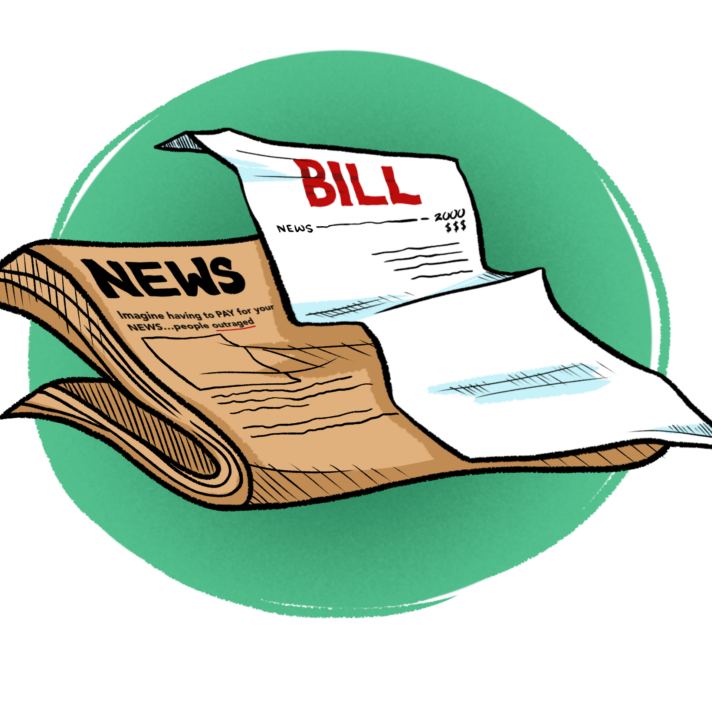
I consider myself a fairly well-informed person. I stay up to date on current events, I recognize the importance of information from reliable sources, and I strongly believe journalists deserve to be paid. But how well-informed am I if my only way to access reliable information is hidden behind a strict paywall?
A not-so-comforting phrase I’ve heard a lot recently is “Journalism is a dying industry.” But as grim as it sounds, it’s not without reason. News organizations are nuking their workforces, and local papers are either shutting down completely or are bought by corporations who only run stories in their own best interest.
Private capital and corporate sponsorship do not make for unbiased reporting, and neither does a politically funded news organization. Independent journalism ensures the people in power are held accountable.
At least some news outlets asking for money believe as much. The Atlantic tells me my support “ensures a bright future for independent journalism.” The Globe and Mail assures me that a subscription would help me “understand the forces shaping [my] world.”
I don’t want to feel resentful of this. Journalists deserve to be paid, but if it means coughing up $240 a year for the family all-access subscription to the New York Times, then I can’t be the one to do it.
There’s something about the accusatory or guilt-inducing wording that puts my hackles up. As if by not subscribing, I’m not only okay with condemning journalists to eat Mr. Noodles for the rest of their days but also condemning myself to be misinformed and uneducated.
Honestly, I simply can’t afford to break that wall down. My friends, who are probably more informed than I am, get their information in ways that don’t factor into their monthly budget spreadsheets.
My friend Leah Haines, a recent Dalhousie University grad, says that if she sees an article behind a paywall, she’ll simply search for a similar article somewhere that won’t charge her.
“I’m more willing to do that than pay,” she says. “I just don’t make that kind of money.”
Unfortunately, not everyone is that determined. In America at least, 32 per cent of people who run into a paywall give up on accessing the information completely.
The irony lies in how many paywalls I was hit with while researching this article alone. It’s no wonder some people get burnt out from searching. But this problem is more than a frustration; it can easily become dangerous.
When certain privileges come with a hefty price tag, we need to be mindful of who is being left out. Especially when that privilege determines staying informed about events that personally affect you.
Those most likely to pay for online news have medium-high income and are highly educated. This inaccessibility doesn’t just affect broke college students. The issue is systemic.
Racialized Canadians experience higher rates of poverty than white Canadians. Excluding a large group of potential readers from reliable information is deeply troubling — especially in a society that benefits greatly from an informed electorate.
And when news outlets aren’t available to us, where do we turn? The worst possible place for reliable sources: social media.
TikTok, Instagram and Facebook have become the most widely used way of accessing online news. Now, we have AI to worry about too. Only four per cent of people who find their news on AI search engines always/often click through to the original source.
When we rely on social media for our news, we open ourselves up to rampant misinformation. Even the content our algorithms put in front of us isn’t accidental or neutral. Big tech corporations choose what to push through our algorithms, what content is viewed most, and what content is practically blacklisted.
When media companies prioritize profit over public service, the readers suffer. The quality of the news itself is brought into question, and many readers feel alienated. We’re turned into consumers, instead of active participants in the news cycle.
Unfortunately, it all comes down to capitalism and treating news as a product to sell. Nothing comes for free. Even the Dalhousie Gazette is funded by money taken out of Dalhousie students’ tuition. So even students who don’t read the paper are paying for it.
Is that fairer than a subscription? It’s at least more democratic.
In this era of confusion and restrictions, unbiased reporting is essential. We should be able to access reliable sources without a paywall blocking us. I’m tired of second-guessing whether what I’m reading is true.
I’d even take articles covered with ads if it means everyone can access the content. Pop-up ads are annoying, sure, but at least then I can still read the news.

Read more from the gazette
The funding is lost, but the story goes on

Q&A with a member of the Gin and Jazz trio
“The quality is already suffering:” Dal makes all faculties and units cut 6.3% of spending
Could there be affordable housing hidden in Halifax? This group thinks so
Phoebe Bridgers wants you to be in the moment