How not to eat garbage
My incisors barely miss the sticker on the pear.
September 14, 2012 / Dalhousie Gazette Staff

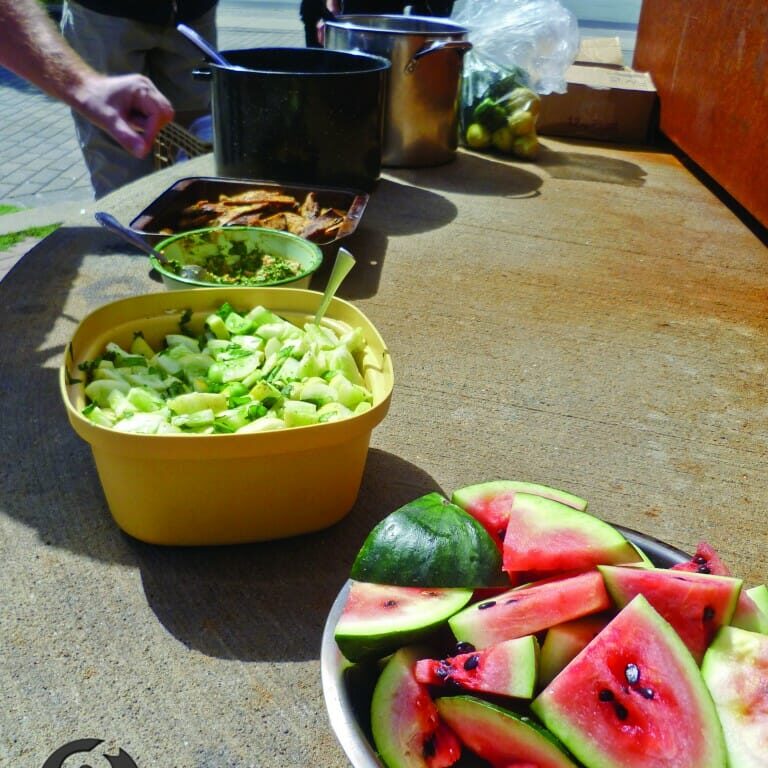
Food Not Bombs provides a communal alternative to fast food. (Photo by Matthew Murray)
My incisors barely miss the sticker on the pear. I peel off a label that reads USA. I imagine the pilgrimage of this produce—the oil spent for a pear to meet my teeth today. Students between classes, trying to equalize caffeine-depleted blood glucose levels, can find it hard to ward off scurvy, let alone make ethical food choices.
Food Not Bombs (FNB), an international movement with a presence on campus offering a warm scoopful of something beaned and tasty, demonstrates food context. And hungry students aren’t the only ones fed by Food Not Bombs, says Matthew Murray, a decade-long member.
“Being thanked by people for the meal because it’s the first thing they’ve eaten all day can really drive home the disparity between different groups in our society, and can put your own problems into perspective,” he says.
Food groups like FNB and Dalhousie society The Loaded Ladle aim to remind people that food comes from land. The Ladle’s blog (theloadedladle.blogspot.ca) invites students to join them in “hunting for plants and trying to figure out what we find.”
Creative approaches to gathering meals can open eyes to North American abundance, says Murray.
“I think that FNB does a good thing in attempting to show how wasteful our society is concerning food. FNB groups take donations of food that’s about to be thrown out from markets and stores, or dumpster dives food already in the garbage,” Murray says.
Franchise owners don’t always feel they have agency against regressive disposal policies due to liability laws for spoiled food. Rob Bennet, a manager of Sobeys on Windsor Street says, “Every department has their own policy for food disposal. Whether dry, produce or prepackaged, it’s decided by expiration date or quality.”
Murray points out how edible and unspoiled food is often discarded “for cosmetic reasons, such as bruising.”
Many campus food options come wrapped in individualized packages for solitary meals speed walking the quad—but slowing down to eat is good for your health as well as your sense of social well-being.
“One of the reasons I keep doing it because the people I’ve met all around the world have always been awesome” says Murray.
Even in a Dal cafeteria, where some food is sourced from Nova Scotian agriculturalist Vermeulen Farms, or nose deep in a dumpster with avocado-loving activists, it’s good to remind your frazzled brain it has a body, and your community that there’s enough for everyone to eat.

Read more from the gazette
Halifax’s thedottedline is here to finish what Kendrick Lamar started
The AUS to ACAA pipeline
Chartwells manages half of SUB food vendors after Abstract takeover
Africville tribute on display at Nocturne

Tigers defeat Moncton 3-2 in a dramatic overtime finish