How Dalhousie students have fought for change
A look through the Gazette’s archives shows student activism at Dalhousie is nothing new
This year at Dalhousie University was bookended by unrest and resistance, beginning with a faculty lockout and ending with a provincial student strike.
But student activism at Dalhousie University is nothing new. For decades, students have raised their voices for social justice issues.
Digging through the Dalhousie Gazette’s archives, history shows a pattern that Dalhousie students have always worked for a better future and pushed for change.
1965 – National Student Day
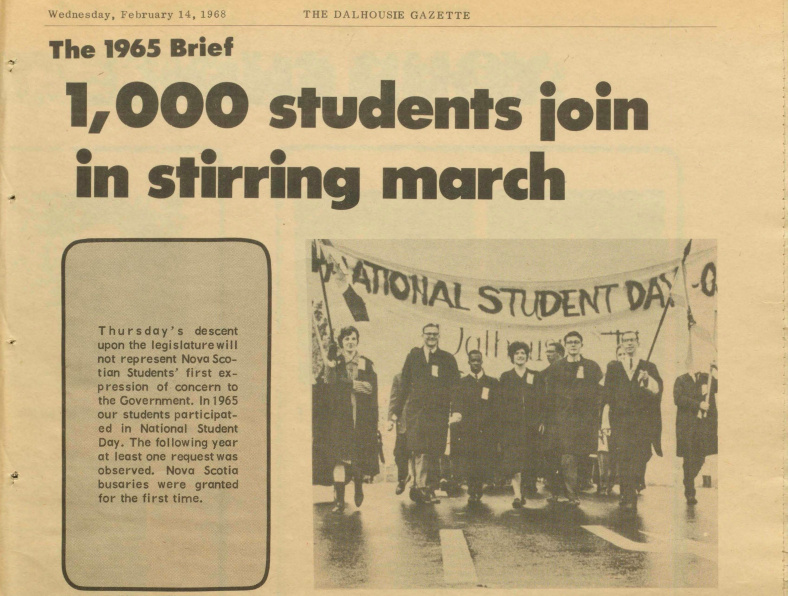
In 1965, approximately 500 Dalhousie students marched to the provincial legislature to mark National Students Day.
The Gazette’s news editor at the time, Tim Foley, reported on the march, during which students presented a letter calling for increased financial aid, reduced fees and greater student involvement in higher education decision-making. He also reported that it was a cold and wet day in Nova Scotia (some things never change).
Despite the march, neither the province nor Dal’s student government made immediate commitments to change. obbie Shaw, DSU president at the time, said that unless the government acted on the letter, there would be “a bigger and better march next spring.”
1977 – Students protest against tuition increases
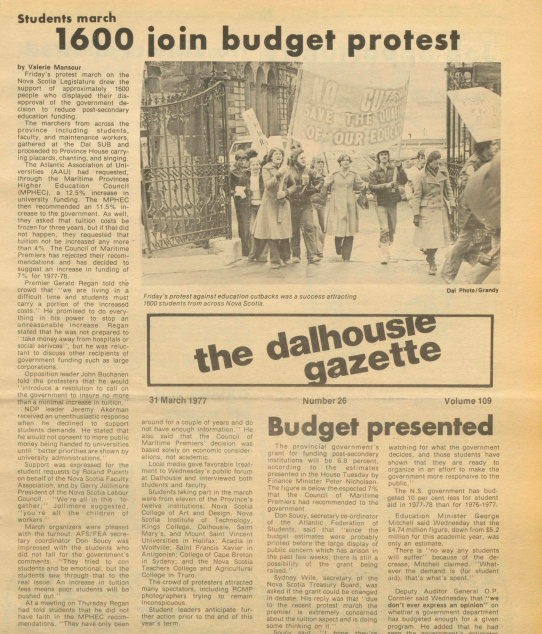
archives)
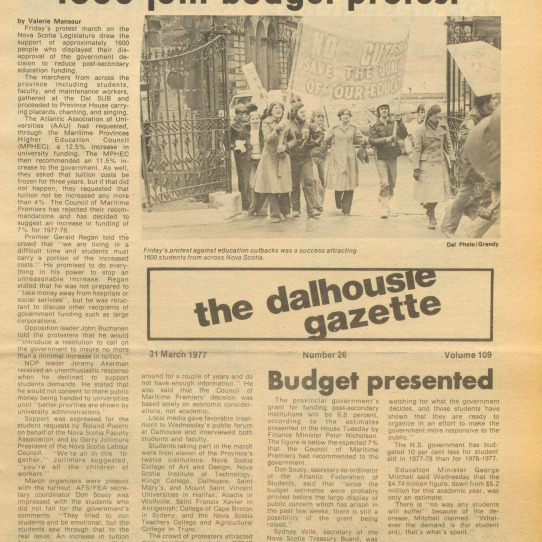
On March 25, 1977, about 1,600 students, faculty and workers from across Nova Scotia marched from the Dalhousie Student Union building to the provincial legislature to protest cuts to post-secondary education funding and potential tuition increases.
Premier Gerald Regan decided to raise post-secondary education funding by only about seven per cent, while the Maritime Provinces Higher Education Commission recommended 11.5 per cent.
Protesters argued that a lack of funding would lead to higher tuition, making university less accessible and more elitist.
In a Gazette article about the cutbacks, Bernie MacDonnel, the DSU’s arts representative, said, “Universities will soon become the havens of the rich.”
The government grant for post-secondary education ultimately stayed at 6.8 per cent.
2008 – Take Back the Night
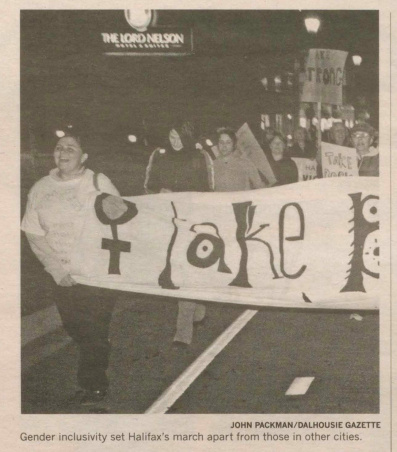
Dalhousie students march in Take Back the Night protest in October 2008. (John Packman/The Dalhousie Gazette)
While Dalhousie had been participating in Take Back the Night for years prior, one of the earliest accounts in Gazette archives is from October 2008.
Take Back the Night is a global effort to combat sexual violence and violence against women through protest and marches. The protests began in 1972 at the University of Southern Florida, before spreading across the United States and later into Canada.
At the time, the Dalhousie Women’s Centre hosted the event.
Janet Gillis wrote in the 2008 article that, “The march is meant to support and give courage to survivors of violence, but it is also intended to send a message to the local community.”
That year, the group rallied at Victoria Park, where professor and activist El Jones spoke about the importance of safe communities for women.
2011 – Cookout for tuition cuts
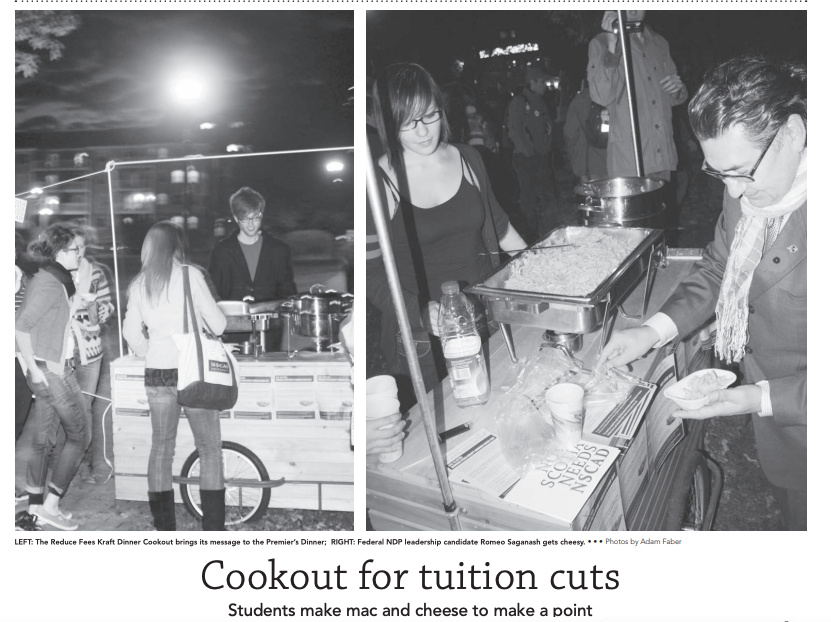
On Nov. 9, students protested in then-Cornwallis Park (now renamed Peace and Friendship Park) by serving free Kraft Dinner to highlight student poverty and rising education costs.
The event, led by students such as Gabe Hoogers, an executive member of the Canadian Federation of Students at the time, worked to raise awareness about student debt and advocate for more affordable post-secondary education.
Hoogers is quoted as saying, “The rationale is debt reduction. Ultimately, it’s our view that if you want to invest in the future and the economy and have an equitable society, it’s important to ensure that people get to attend post-secondary education.”
The organizers decided to use Kraft Dinner because it represented the reality of what some students could afford to eat.
There were close to 70 people present at the event, one being Romeo Saganash, a former NDP MP.
2023 – Law students walk out against racism
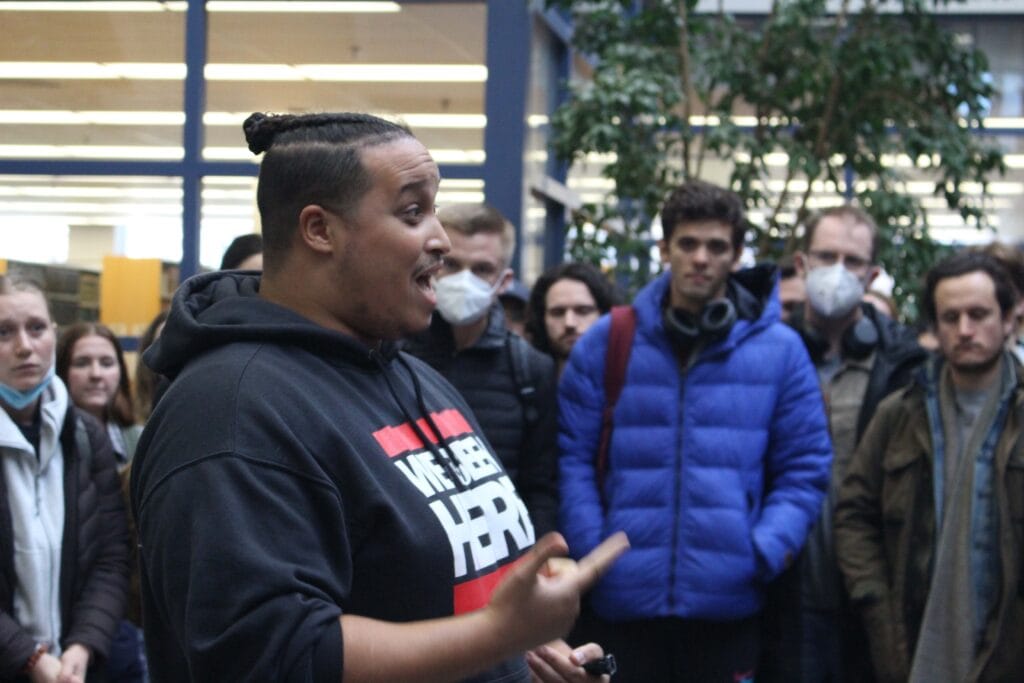
In 2023, students at the Schulich School of Law staged a class walkout in protest of ongoing racist comments made by a classmate. The walkout was organized in solidarity with affected students facing microaggressions and a lack of response from the university.
Students met with faculty for two hours to discuss their frustrations with the response to incidents in first-year law classes.
Global News reported that no solutions or promises came out of the meeting, but that law students came prepared with a list of ideas to improve response efforts to discrimination, such as adopting professional standards and increased transparency in how complaints are handled.
2024 – Pro-Palestine encampment
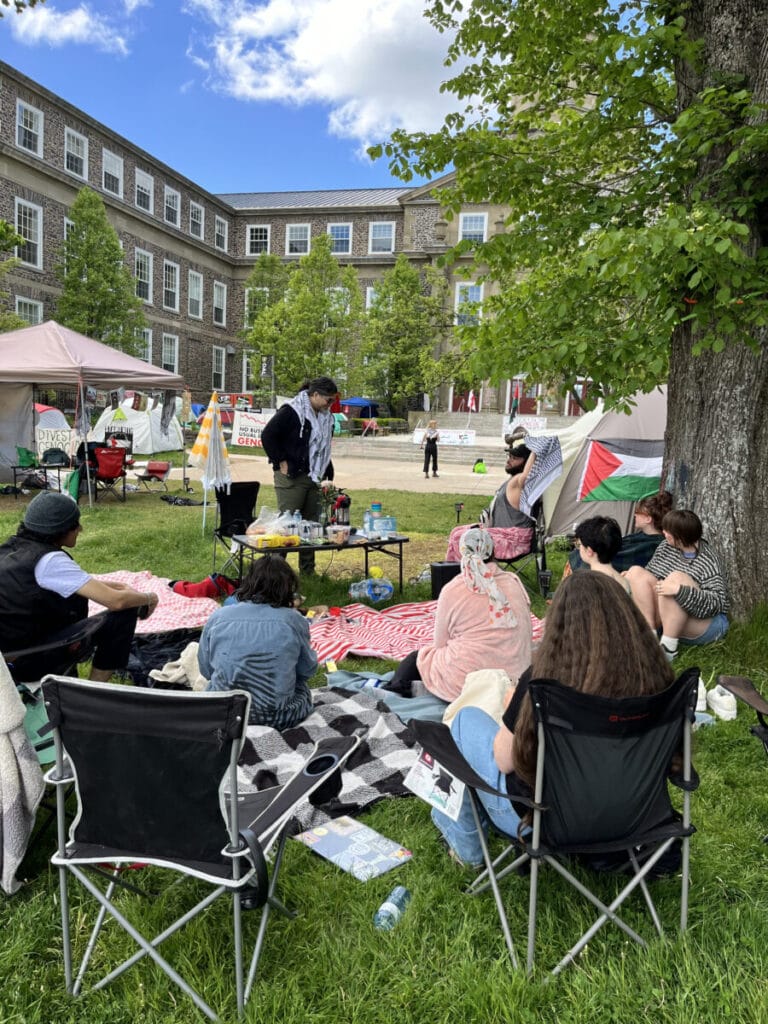
Life in the encampment organized by Students for the Liberation of Palestine in Summer 2024. (Contributed by a student the Gazette has granted confidentiality)
Over summer break, student activists from multiple Halifax universities formed an encampment, dubbed Al Zeitoun University, on Dalhousie’s quad to protest the university’s financial ties to Israel and demand divestment.
The encampment, organized by Students for the Liberation of Palestine, lasted 78 days.
Yousef AlSayyed Ahmad, president of the Dal Palestinian Society, told the Gazette, “Al Zeitoun University was the most educational experience of my life. I’ve been a student at Dal for five years, and I consumed more knowledge in those 78 days than I did in my five years at Dal.”
Eventually, the university issued a trespass notice, and security started to dismantle the site. Protesters then moved to the Kenneth C. Rowe Management Building, but police ended the protest.
Owen Skeen, the then president of the NSCAD student union, described the encampment as “a place for students to gather, talk about Palestine and be a part of a broader community of solidarity and respect and humanity.”
Student activism lives on
While not every event resulted in immediate change, the message is clear that Dalhousie students have challenged authorities, raised awareness and continued to push higher institutions.
Robert Huish, an international development professor at Dalhousie, has spent the last 16 years teaching students skills of activism in his class Development and Activism: Methods of Organization, Manifestation and Dissent.
Huish says that historically, university students have a strong passion for activism
“There is a certain amount of bravery that comes with being young,” says Huish.
In an ever-changing world with technology and social media, activism is also changing. But Huish says one thing is certain.
“As students, you’ve got a very precious combination of space to have access to so much information through the libraries, through the university system, and you’ve got ideas that generations in front of you didn’t have. You can outmanoeuvre them. That combination of knowledge with an appetite for innovation, that’s the power that no government can suppress.”