What I learned from visiting Nova Scotia for the student strike
An Ontario student organizer’s perspective on the N.S. strike
Abdullah Al-Jabji is a Palestinian student organizer at the University of Guelph and the founder and chair of Ontario Students Against Austerity, an organization founded in response to the Doug Ford government’s austerity measures.
I was initially set to speak online at the national student organizing panel during the Nova Scotia student strike. However, considering Ontario’s recent cuts to education, I wanted to visit Dalhousie University and observe the entire strike in person.
Students have previously pushed back against cuts to education and their universities’ continued refusal to divest from fossil fuel production, weapon manufacturing and genocide.
But there has never been a province-wide student strike in an anglophone Canadian province — not until this March.
Mighty little Nova Scotia held a week-long strike at four schools, and two other schools joined unofficially. The strike started on March 15. Nova Scotia students proved that a province-wide student strike is possible in this province and in anglophone Canada.
Regardless of whether the strike’s demands were met, the precedent for students to strike has been set, and that’s something Nova Scotia’s students should be proud of.
There are many lessons I will take home to Ontario as we prepare for a strike of our own.
Lesson 1: Money talks
Only last summer did student organizers start to co-ordinate closely across institutions in southern Ontario, where I go to school. To see Nova Scotia take up this movement and already carry out plans at such a high level has been inspiring.
First, a protest is a low-level individual action, while a strike is a highly co-ordinated collective action that relies on collective bargaining power. This is why students have continually failed while protesting for material change in the anglophone provinces, as opposed to Quebec, which consistently and successfully strikes to keep tuition fees low. After all, money talks.
If students threaten to cancel entire semesters (like the Quebec 2012 strike), the government loses out on billions. If it’s more expensive for the government to implement austerity measures than to properly fund education and other social services, students will win.
Lesson 2: Strike enforcement
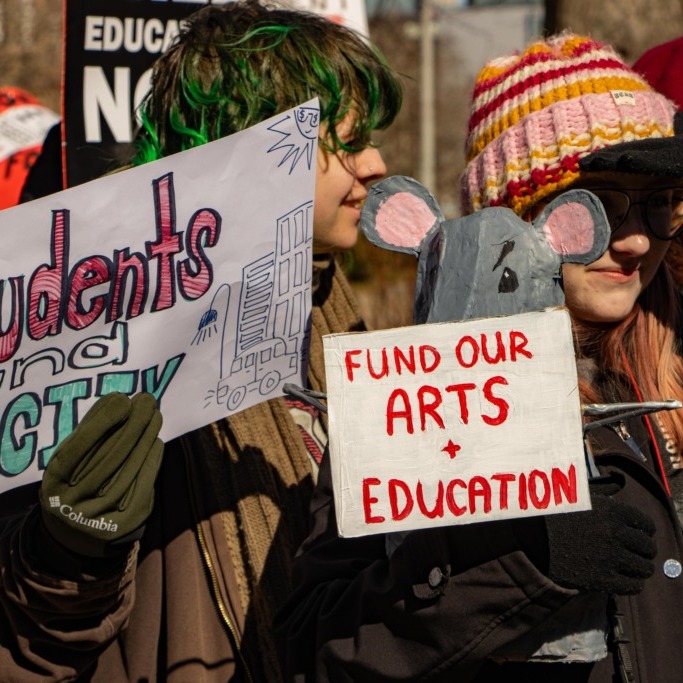
Shortly after I landed in Halifax on March 15, I arrived at the University of King’s College, and I didn’t see picket lines. At the time, there was only one protest happening at the Halifax Memorial Library downtown.
This was a theme throughout the entire week; few students took part in the strike at the participating post-secondary institutions due to a lack of understanding and awareness of the strike and its goals.
This wasn’t necessarily the fault of the strike organizers. They tried their best to mobilize students and were relatively successful compared to 2024 (when the Nova Scotia College of Art and Design attempted a strike vote, which failed).
This problem is a matter of culture, and the fact that students fail to perceive the effect that austerity measures have on them.
Many students would rather break the strike to focus on classes than fight for better material conditions. I know now to consider tactics like hard picketing and organizing at the department level, rather than the school-wide union, which will better enforce a strike. Quebec has proven that engaging students through a grassroots movement that starts at the organizations they’re closest to will have them engage with and support the strike more than through the distant student union.
Every student is affected by government austerity, no matter their personal financial situation. Larger class sizes, privatization and over-enrolment all have a significant impact on the quality of education students receive. Everyone is affected, so everyone should participate.
Lesson 3: Consistency, principles, patience and determination
For any strike to be successful, students must consistently and patiently organize and stay determined to achieve our goals: affordable (or free) tuition and divestment.
We need to seek something better than the status quo. Additionally, we must remain principled; we can’t diverge from the original demands to appease our neoliberal governments and institutions. It was so disappointing to see the Acadia Students’ Union remove divestment from their demands.
Year over year, the movement builds and learns from itself; it’s no surprise that last year’s NSCAD strike mandate failed, and this year’s was a success. It will also be no surprise if next year’s Nova Scotia student strike is more successful.
The organizers are already working toward building more strike capacity for next year. They didn’t give up their effort at NSCAD, and will not give up going forward.
This is the most crucial lesson I’ll take back to Ontario. While not as many students participated in this Nova Scotia strike as I would have hoped, we must organize and mobilize students — and now we’re more prepared.
This is a generational effort to equip future students with the tools needed to fight their institutions and governments.
Overall, the Nova Scotia student strike was one of the most incredible collective actions I’ve seen in my life. Never did I, as an organizer, think that a co-ordinated provincial student strike was possible in any province other than Quebec. I’m grateful to have been proven wrong.
I, and others, will be organizing a province-wide student strike in Ontario, hopefully for the end of next year, in co-ordination with Nova Scotia. It will be a challenge considering that Ontario has over 900,000 post-secondary students, sixteen times more than Nova Scotia.
However, Ontario Students Against Austerity has already passed a strike policy at McMaster University, with the Ontario College of Art & Design University and the University of Toronto set to follow.
Quebec then, Nova Scotia now, Ontario next, and the country will soon follow. See you next year, Nova Scotia!