Will the PWHL help bring checking to AUS women’s hockey?
Body checking is part of professional women’s hockey; it’s prohibited everywhere else
While U Sports women’s hockey prohibits body checking, the Professional Women’s Hockey League’s embrace of full contact is raising questions about whether similar rule changes could reach university hockey.
According to the Hockey Canada rule book, minor penalties are given to players who attempt to deliberately check an opposing player in women’s hockey. This can happen when a player “leaves their skating lane to make contact, or when a player extends an arm, shoulder, or hip after angling an opponent.” Players can receive game misconduct penalties and even suspensions, depending on the situation. The rule applies everywhere, from U7 to Atlantic University Sport to international play. Meanwhile, male hockey players can start checking in U15.
As women’s hockey continues to evolve, the game is getting faster, and players are getting more aggressive. Before the PWHL inaugural season, leagues in countries like Sweden already begun allowing body checking.
The PWHL has multiple players who spent a few seasons in U Sports, including Kelly-Ann Nadeau (Université de Montréal), Rylind MacKinnon (University of British Columbia) and Kendra Woodland (University of New Brunswick).
John Keefe, the president and interim CEO of AUS, said the rules are dictated by Hockey Canada.
“It really just comes down to the national body,” said Keefe. “We follow Hockey Canada rules.”
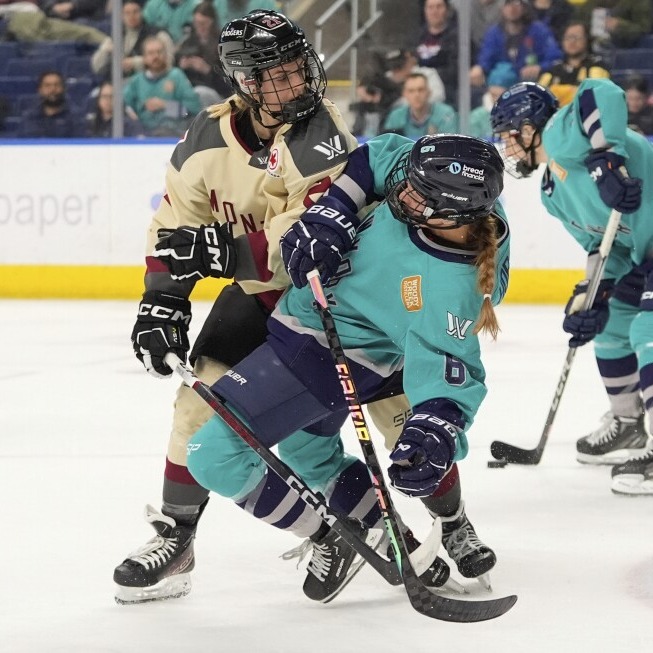
When the PWHL Takeover Tour arrived in Halifax, spectators watched players deliver heavy hits both in open ice and against the boards.
“Those types of conversations, or wishes of a membership, would be there to be a mechanism for them to have input into Hockey Canada,” Keefe said. Despite the PWHL bringing checking to the game, other leagues across the country are still following Hockey Canada’s safety regulations.
How do the Tigers feel?
Keifer House, the Dalhousie University women’s hockey head coach, said that when players are in motion, awareness should be second nature.
“There is an awareness factor that you need to have when you’re playing any kind of high-speed sport,” he said.
Looking ahead, House said he believes the AUS rules could eventually evolve.
“It’s probably more likely than unlikely that it’s going to happen at the collegiate level at some point,” he said.
Abby Larkin, a second-year psychology student and defender for the Dalhousie women’s hockey team, said the team would like to see the league consider changing the checking rule in the AUS.
“I think it’d be important to make sure we’re taught the dos and don’ts about it,” she said. “So it’s not necessarily brought into [the AUS] in a dangerous way,” she said.
Larkin attended the PWHL game in Halifax on Jan. 11 with some of her teammates and noticed how physical the game was.
“I think it would make even more people want to watch AUS, and it would better prepare those of us who do go to the PWHL,” she said.