
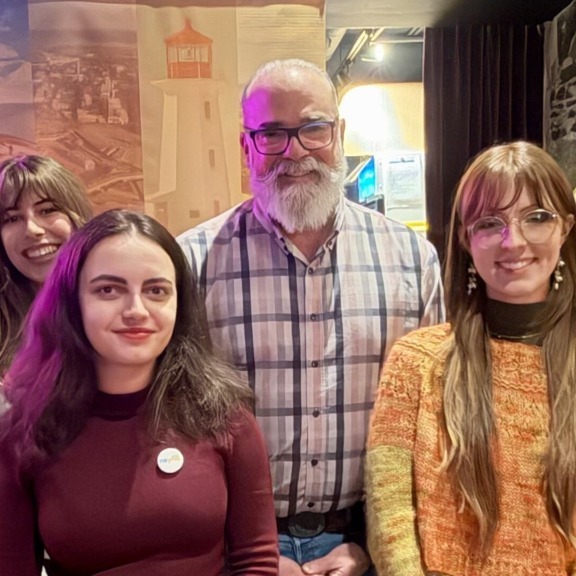
NDP leadership candidates make campaign stops at Dal
Political hopefuls looking to engage young voters ahead of March leadership vote
January 29, 2026 / Jonas May, Lily Van Beek
By: Jonas May and Lily Van Beek
Political hopefuls are recognizing Dalhousie University as a crucial stopping point during their national campaigns.
Three of the five leadership candidates in the ongoing federal NDP race attended Pints and Politics events hosted by the Dal & King’s NDP society.
Finn Geddes, the society’s Dalhousie vice-president, says she was surprised at how many students attended these events.
“We have always held events with local politicians, but this got a lot more attention,” she says. “People seemed really excited about it. I did not expect that many people to care about the federal leadership race.”
Nominees Avi Lewis, Rob Ashton and Tanille Johnston were each hosted by the Dal & King’s NDP society at different “Pints & Politics” events throughout December and January as a part of their national campaigns.
The other two nominees have been contacted by Dal & King’s NDP for future Pints & Politics events, says Geddes. Tony McQuail is planning to speak to students virtually, and Heather McPherson’s team has not yet responded to the society’s request.
The federal NDP will elect its next leader in late March at the party’s convention in Winnipeg. Jagmeet Singh, the party’s former leader, stepped down on the night of April’s federal election, when the NDP lost official party status and Singh his seat in Parliament.
Reflecting on the event, Johnston says small gatherings are important for developing connections between students and politicians.
“We need to reintegrate humanity,” she says. “The work [of rebuilding a party] needs to start from a place of relationship and trust.
“It seems like folks really valued that opportunity to connect in a way where everyone got to say everything they wanted to say … everyone left excited and happy with how things went.”
Since starting his campaign in October, Ashton says university students have expressed feeling “left out” from what is happening in federal politics.
“[Students] feel like they haven’t been engaged with enough, they haven’t felt like they’ve been talked to enough,” he says.
“We have to find out what students need to make their futures better.”
Both nominees say the best way to increase political student engagement is for politicians to come to universities and speak with students about their concerns.
The events helped to humanize the politicians and offered student attendees an educational experience, says Geddes.
She says many students who attended the events weren’t part of the NDP society. The group hopes that creating opportunities for students to interact with politicians will strengthen political conversations on campus.
“It was a particularly good way to get people involved who might not be thinking about politics,” says Geddes. “I feel like the students that came felt that they got something out of it, [they] had their questions answered and their issues addressed.”
Ashton, Johnston and Geddes all said the main concerns raised by students at the events were the high cost of living and affordability.
“Affordability is the biggest [issue],” said Ashton. “Tuition sucks. It’s incredibly expensive, which is something we’ll be fixing. There are no jobs to come out to.”
Ashton expressed the importance of students speaking out about issues they care about.
“Be unapologetically loud about your want and need to be a part of change … if they won’t give you a chair at the table, you bring your own — or hell, bring your own table.”

Read more from the gazette

The Gazette Reviews: The biggest blockbusters at AIFF

The Gazette Reviews: AIFF films shot in Atlantic Canada
The Gazette Reviews: AIFF Films Based on True Stories

The Student Chef – ‘Coffee Cake’

Sydney Sweeney’s ad isn’t ‘just sports,’ it’s a political statement