
Editorial Opinion: Whatever it was, it wasn’t a strike
The provincial student strike turned student indifference into annoyance
March 26, 2026 / Dalhousie Gazette Staff
This op-ed is a product of the Dalhousie Gazette’s editorial board, made up of the entire editorial team, debating a topic relevant to students until it comes to a consensus.
Last week’s Nova Scotia student strike was a strike in name only.
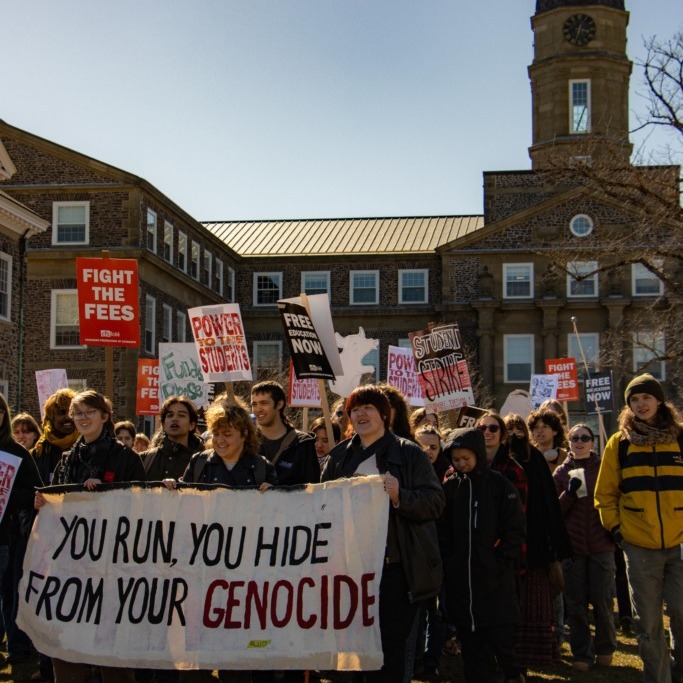
Ahead of the week-long event, the provincial strike’s organizers drew a clear line between a student strike and a student protest: collective action. But as most students sat in classrooms, hearing the faint cheers of their peers outside the Henry Hicks Building on Wednesday — and, essentially, Wednesday only — it became clear that the collective was nowhere to be found.
More students showed up at Durty Nelly’s at 4 a.m., in the pouring rain on St. Patrick’s Day, than showed up to the first day of picketing, which was cancelled due to weather.
The strike was plagued by disorganization from the start, but its bigger failure was turning student and faculty indifference into outright annoyance. Whatever the issues with organizing, advertising, messaging and timing, the collective didn’t show up. Instead, it was frustrated.
This frustration stemmed from several issues.
For one, if strike organizers wanted to get students on their feet in mid-March, the academic amnesty motion — which encouraged professors to grant academic amnesty for one class or assessment per course at their discretion — needed to be stronger.
While convincing students to skip class right before exams was always going to be difficult, asking them to do so without concrete protection for the grades they’ve worked toward all semester was never going to work at a school as apathetic to campus politics as Dalhousie University.
Despite being the largest university in Nova Scotia, Dalhousie saw some of the weakest strike engagement among the participating schools. Four to six people picketing on Robie Street doesn’t constitute a strike when most of the student body is sitting on the other side of the picket line.
The strike’s most effective day came on Wednesday, when roughly 300 students from across Halifax rallied in Dal’s Studley Quad.
Beyond picketing, Dal’s organizers also made a crucial messaging misstep. Unlike at other Nova Scotia universities, like NSCAD and Acadia, organizers failed to connect the strike’s broader goals of divestment and affordable tuition to a localized campus issue. If only there had been some unprecedented situation this year where Dalhousie students were completely fucked over…
Beyond initial messaging, Dal’s strike organizers didn’t return to rallying students around a fight for tuition refunds for the three weeks of classes lost to the faculty lockout — a cause students likely would’ve supported before the movement’s unrealistic goals.
In fairness to organizers, the Nova Scotia student strike was the first in Canada outside Quebec, and the Quebec strike took place almost 15 years ago. How often is the first attempt at anything good?
The more important question might be whether the provincial student strike movement is in a better position now than it was before March 15.
On one hand, it might be. The strike raised awareness for the movement; more students are aware of the strike than before. It also set a precedent. If another run is made, at least there’s some history of participation to build on.
On the other hand, is all press good press? Probably not when students are laughing you out the door, which happened when protestors interrupted a math class on Friday.
The strike also made little progress on its broader goals, with no response from the province or the university. While organizers acknowledged before that they didn’t anticipate immediate action, the strike was meant to build momentum. This lack of an institutional response does little to inspire students.
Organizers say they plan to hold a two-week strike next year. But a better approach might be to focus on one really strong week, one really strong day, even. To maintain credibility, they need to hold that strike.
To see success, organizers should focus on building momentum from the bottom up, not imposing it through a union mandate at a university where nobody cares about the student union.

Read more from the gazette

The Student Chef – Corn Chowder
BREAKING: KSU president resigns
BREAKING: Faculty union holds vote of no confidence in Dal president, others
Make-A-Wish partner society founded at Dalhousie

DSU rehires same security contractor for DalFest after alleged assaults last year, adds new safety measures