
Pythian Games brings school-sanctioned toga party to Dal
Classics students performed and competed for cash prizes
March 26, 2026 / Ashlyn Seanor, Sophie Bolan-Campbell
By: Ashlyn Seanor and Sophie Bolan-Campbell
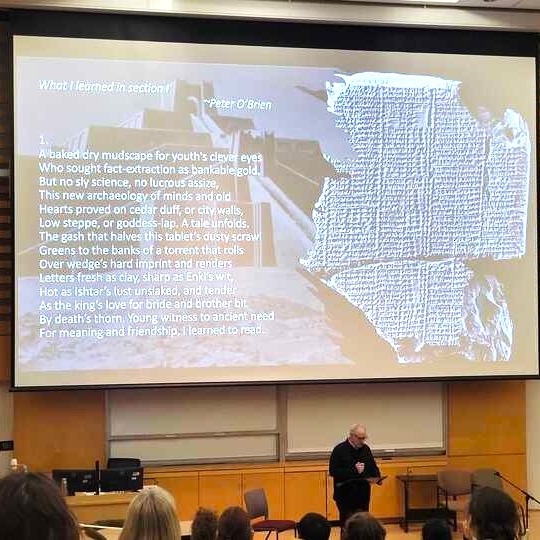
Students and faculty gathered to watch poetry, skits and re-enactments at the annual Pythian Games on March 17, hosted by the Dalhousie University classics department and Res Publica, an undergraduate classics student society.
The event, which was first held in 2011, is inspired by the ancient Greek Pythian Games, an athletic and musical competition first held in 582 BCE. Dalhousie’s version opened with a re-enactment of the Greek god Apollo slaying the Python at Delphi.
Students competed for cash prizes ranging from $50 to $250.
Olivia Colwell, a first-year classics student, took home the $250 prize. She performed a reading of a Latin poem by Lucan, a Roman poet, which she translated into English herself. Illustrations she made accompanied the reading on a projecting screen.
“Doing ancient languages can sometimes feel very serious, you’re translating very serious passages,” said Colwell. “But the games give some fun in a group setting.”
Tarquin Wrobel, a fourth-year classics student and president of Res Publica, said his favourite part of the games is seeing people show off what they’ve learned.
Naza Amyoony, one of the society’s vice-presidents, is “hoping to do more collaborative events with different societies.”
Professor Eli Diamond, chair of the classics department, kicked off the games with a reminder to the audience that studying languages is important if you study theology, philosophy and history.
Wrobel said keeping ancient languages alive, like Latin, is important. He said that these languages still exist in modern society, but mostly in law and academic writing.
“It teaches skills that are not often learned,” he said. “How to think within a logical system, and how to think outside the box. It is rigorous and conditions your brain.”
Amyoony said using present-day references and comedy in the games is important to make them accessible to the audience.
“It’s nice to see ancient languages that we constantly read, write and study for hours be spoken and celebrated for what we’re learning,” she said. “And to be in a room of people who understand what we’re saying, but also to include people who don’t necessarily know what’s being said.”
Attendee Meir Straus, a second-year classics student, said department unity is important in the context of university cuts to Latin classes.
“They are taking classes away from a department that is already struggling to assert itself, even though it’s a much beloved part of the university,” he said.
Kate Fleming, a third-year classics and contemporary student, attended the games for the first time. She said the greatest joys in life don’t come from productivity.
“It comes from art, philosophy and literature,” she said. “We could just see that by studying classics. Just people participating in the true joys of life, and expressing the full range of the human experience as far back as we can find record of it.”

Other Posts in this category

Make-A-Wish partner society founded at Dalhousie

DSU rehires same security contractor for DalFest after alleged assaults last year, adds new safety measures

Tony turns Provincetown into Hollywood

Meta’s AI glasses are for perverts

MacLeod is out of tune with Nova Scotians