
Irish Association of Nova Scotia hosts annual St. Patrick’s Day celebration
Members gathered to dance, learn and feast
March 26, 2026 / Ashlyn Seanor, Mia Phillips
By: Ashlyn Seanor and Mia Phillips, arts and culture editor
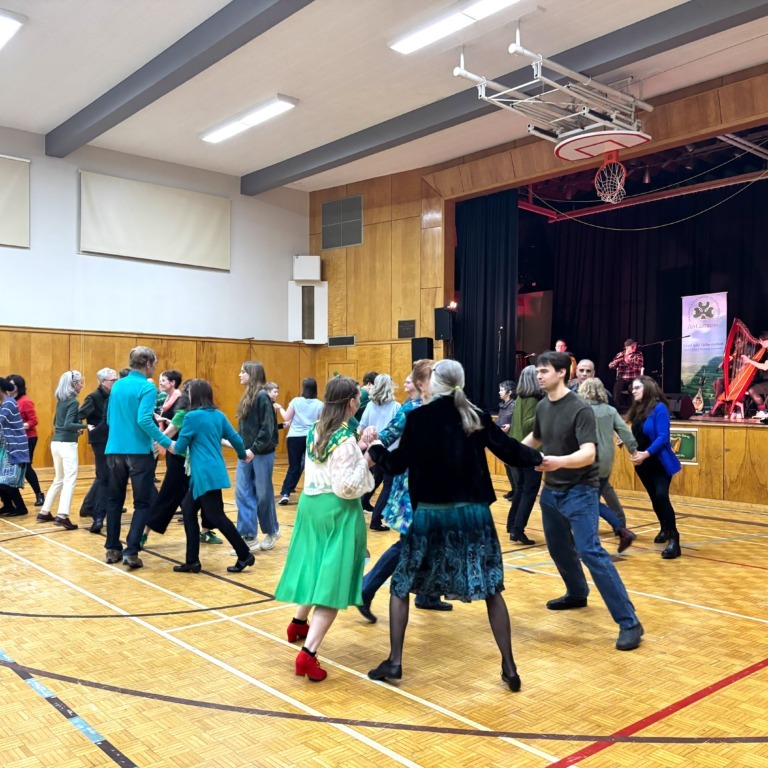
While some Haligonians celebrated St. Patrick’s Day with beer, green face paint and 6 a.m. bar line ups, others gathered at St. Agnes Church Hall on March 15, as An Cumann, the Irish Association of Nova Scotia, hosted its annual St. Patrick’s Day Céilí.
The celebration included traditional Irish stew, live Celtic music, Irish set dancing classes and performances from the Greene School of Irish Dance.
Community rooted in heritage
Ralph Curran helped found the organization almost 36 years ago. The association’s principal goal is to “foster knowledge and enjoyment of Irish customs, culture and heritage throughout Nova Scotia,” according to its constitution.
Pat Curran, Ralph’s son, says the biggest change since the association’s founding has been cross-generational participation.
“Having three of my children here is a big deal to me,” Pat says.
Clare MacDermott has been a member of An Cumann since she moved to Canada from Limerick, Ireland, 13 years ago. Being far from home, she finds connection through the association. She brought her two children to the event and says sharing and passing down the culture to the next generation is vital.
“When you leave Ireland, and you’re far from home, it’s lovely to have a place to connect,” says MacDermott.
Irish literature and language
Sue Wright, the association’s president, has been a member since 2021. Her favourite part of Irish culture is its literature. Particularly, James Joyce’s novel Ulysses.
On June 16, she celebrated Bloomsday, an Irish holiday honouring the book’s main character, Leopold Bloom, by participating in a Halifax-wide scavenger hunt.
“That brought Ulysses to me,” says Wright. “I couldn’t read the book, I admit, but I could enjoy it that way.”
Wright wishes more people understood the wit in Irish literature and language. Her favourite Irish expression is, “Is minic a bhris béal duine a shrón,” meaning, “Many a time a man’s mouth broke his nose.”
“It’s a very poetic way of speaking,” says Wright. “Everyone I know from Ireland speaks in poetic ways.”
Since its inception, the association has offered Irish language classes. Kieran Walker, the association’s Irish language lecturer, was told as a child he wouldn’t be able to learn a second language due to his dyslexia. He proved naysayers wrong out of spite.
“Now, I think Irish spelling is the best,” says Walker.
Walker’s Irish heritage initially sparked his interest in the Irish language. Through teaching, he found that other members learn the language for similar reasons.
“Lots of people who come to the lessons are either people who come as immigrants from Ireland looking to reconnect with the language, or there are lots of people who have Irish heritage and want to connect with it through the language.”
Connecting with Irish history
The association also offers Irish history lessons. Liam Mason, the association’s treasurer and history lecturer, says Irish history is Nova Scotian history.
“I find the Irish tend to be overlooked and almost melded into the general history of the area,” says Mason. “The Irish had a significant role in establishing the city we now live in, even before it was a city.”
Mason says that many people believe the potato famine was the main catalyst for Irish immigration to the province. The real history, he says, is that 1815-1845 was the principal period of Irish immigration to Nova Scotia.
“The timber trade brought a lot of people over [from Ireland], and then many people came over from Newfoundland,” says Mason. “It was called the two boat movement. That’s why there’s a very strong connection between the Irish here and the Irish in Newfoundland.”
Colonialism, says Mason, had a major impact on Irish culture and history.
“The colonial practices that the British then subjected other colonies to were first practiced in Ireland,” says Mason. “A large part of the language and culture is lost as a result of colonization and forced assimilation.”
Now, Mason finds it fascinating how much passion and enthusiasm there is for the Irish language and history.
Walker agrees; he finds there’s more mainstream representation of the Irish language online now.
“There’s a worldwide willingness in this generation to reclaim culture,” says Walker.

Read more from the gazette

KSU council to choose new interim president on Sunday
The Student Chef – Corn Chowder
BREAKING: KSU president resigns
BREAKING: Faculty union holds vote of no confidence in Dal president, others
Make-A-Wish partner society founded at Dalhousie