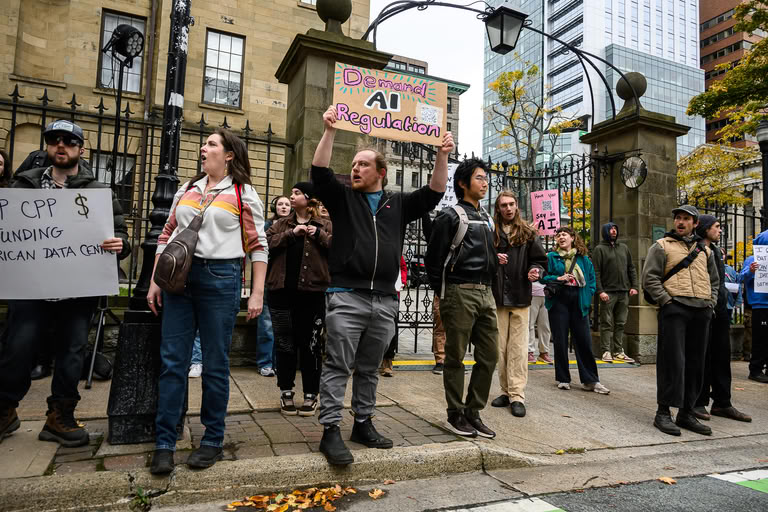
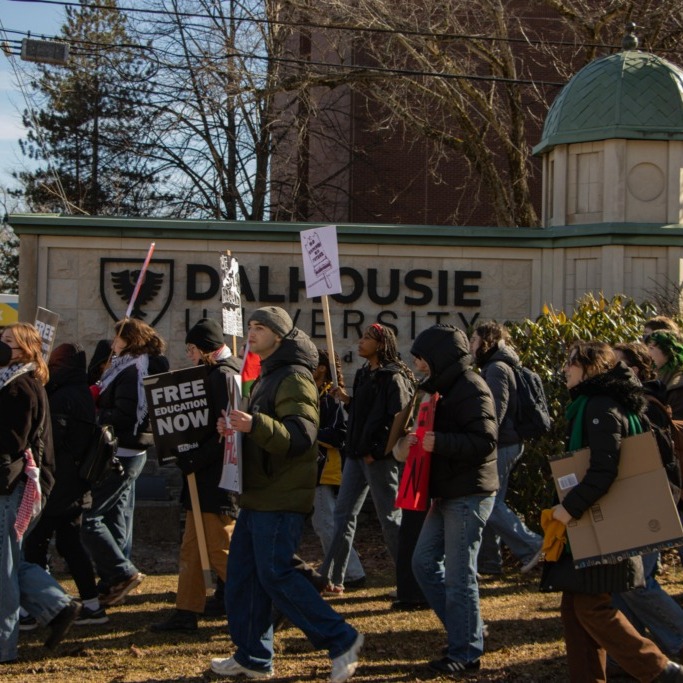
The student strike is a way to avoid passivity
It’s the principle of the thing
March 26, 2026 / Jack Amos
In many ways, a student strike is a fitting end to my education at the University of King’s College and Dalhousie University. It’s even more fitting that the King’s strike vote passed with a nail-biting margin of 86 in favour to 83 against, with four abstentions. I’ve always felt there’s been a repressed internal friction among students at King’s.
Almost immediately following the results of the vote, an unsigned letter was circulated in first-year lectures and the King’s dining hall. It questioned the “democratic legitimacy” of the vote due to the small margin and asked why students should participate in a strike that had “no expectation of winning.”
This letter was representative of a larger sentiment of resistance to the strike at King’s, where many students felt it would be disruptive to their academics, a sacrifice of their education, while achieving nothing.
This is a very valid attitude, righteous even. But it also makes me wonder if there’s something else at work.
While education is a right, in reality, it’s much more of a privilege — especially at the post-secondary level. As students at King’s and Dalhousie, we’re spending thousands of dollars each year, either our hard-earned money or someone else’s, to read books and write about them.
It’s awesome, but it’s also ridiculous. If I’d saved the money I spent going to school, I could afford a down payment on a house. Instead, I can quote four lines from Dante Alighieri’s Inferno, and I know the Marxist definition of history (class struggle).
Studying at a university is an incredibly privileged position to be in, and one that — rightly so — many of us are reluctant to suspend, even voluntarily, for any length of time. It stings to lose privilege, and even the potential loss can bring up a lot of emotional backlash.
Scholars like Peggy McIntosh have linked privilege loss with political and cultural division. If people have privilege, based on race, gender or other factors, they don’t want to lose it, and sometimes they don’t even want to acknowledge it.
When we’re called to be accountable for our privilege, it’s very normal to be defensive — that’s what growing up in a supposedly meritocratic society will do to you. But this is precisely what the strike movement is asking us to do: suspend our privilege, albeit only temporarily, in the name of something a little more important than reading books.
Criticism surrounding our present situation expresses that mid-March is not the best time to undertake a strike. But there rarely is a convenient time for activism.
Over the past four years, I, along with many other students, have seen increased governmental overreach in higher education, as well as budget cuts and slashed funding for Dal departments, if not their entire removal.
These completely avoidable institutional shortcomings ultimately culminated in the financial exploitation of students — Dalhousie charged full tuition for a semester that was cut three weeks short.
The university administration scammed the collective student body out of millions of dollars, and nobody seems to be surprised.
Have we really become so used to being jerked around by the institution that we’ll roll over at losing a thousand dollars? That’s a month of rent (if you’re lucky). It’s also two weeks of full-time labour.
That’s time from your life that Dalhousie stole from you, just to funnel it into investments tied to the defence industry. We can’t just stay passive and complicit in the face of this gross administrative misconduct.
The strike is a way to avoid passivity, not just in the face of financial exploitation but also against immoral and unethical investments of tuition money and governmental budget cuts that threaten the future of education in Nova Scotia.
The historical precedent of this strike also speaks to its importance. The provincial, national and global political stage isn’t looking bright, and it’s important we start practicing the skills for organization and resistance now, so when the stakes are higher in the future, we’ll know what to do.
We’re students after all. If we’re not resisting, who is?
My time at King’s has been an arc. First came love, enamoured with the Foundation Year Program. Then came commitment, a desire to study the art of communication, articulation and inquiry.
Suspicion came next. Beyond being able to refute a conservative uncle, regurgitate a Hannah Arendt quote in some heated discussion, and write a half-decent essay, what’s changed? Not a whole ton.
Disillusionment followed. Then rejection. Exasperation. Yes, King’s is special; it teaches important skills and knowledge, but there is so much more to being a person, to acting as a person, to putting abstract ideas into action.
University education can only teach you so much.
Without the trial of putting ideas into action, or even acting as part of a larger community outside of the insular bubble of the school, what’s the point of learning the things we do?

Read more from the gazette

Q&A with DSU Faculty of Architecture and Planning representative candidate Nermine Mokdad

Q&A with DSU Faculty of Arts and Social Science Representative Candidate Rory Laing-Gatehouse

Q&A with DSU Disabled Students Community Representative candidate Kenzy Bezeau
Only three candidates running across nine empty positions in DSU by-election
Ella Mowbray Chriske acclaimed as KSU president in by-election