Dal students reflect on Nova Scotia student strike
Some students say the strike was ineffective
April 9, 2026 / Lukas Kohler
Some students at Dalhousie University say the recent Nova Scotia student strike was ineffective and are hesitant about the movement’s future.
Nelle Gadsden, a first-year Dalhousie French and social anthropology student, said the strikers crossed a line.
At times, organizers antagonized students who attended class during the strike, calling them “scabs,” a term referring to individuals who cross the picket line.
“I can understand their feelings, but there are other factors that go into it,” said Gadsden. “They’re angry, I think it’s very fair, but it should be toward the institution.”
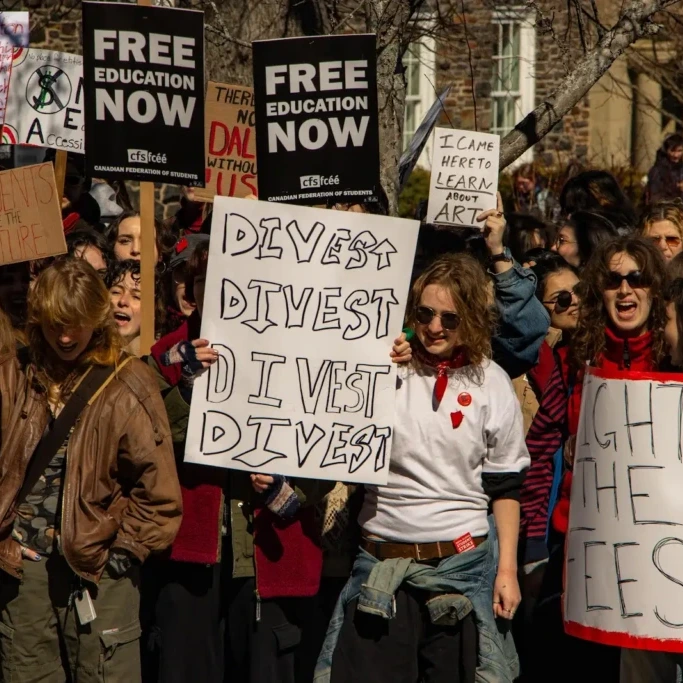
The goals of the strike were affordable tuition — including a 20 per cent tuition cut and the end of differential fees for international students — and divestment from entities invested in weapons manufacturing, fossil fuels production, genocide and the exploitation of sovereign Indigenous land.
The Dalhousie Gazette reached out to over a dozen professors at the university for their perspective on the strike, but didn’t receive any responses before publication.
Ricky McCoshin, a first-year student at the University of King’s College, said that he wasn’t aware of the movement’s goals until the strike was happening.
“If they can sell more students on what they hope to attain, I think myself and more people will join in,” said McCoshin.
McCoshin said he faced no problems receiving academic pardons in his King’s classes during the strike, which made it easier to participate.
Maggie Rodger, a fourth-year gender and women’s studies and sociology student at Dalhousie, said she also received support from professors, who moved assignment deadlines to after the strike and cancelled most of her classes.
Rodger believes in the goals set by strike organizers.
“University should be free, and I think [Dalhousie] has no business funding any sort of genocide or weapons manufacturing,” said Rodger.
Payton Smith, a third-year Dalhousie biology and environmental science student, said she couldn’t strike because her professors didn’t grant academic amnesty.
Smith said that for her to strike next year, the strike organizers would have to provide more information about what is happening beforehand, and she would need stronger amnesty guarantees for assignments.
She also said she would be more likely to strike at the start of the semester rather than at the end.
“At the end [of the semester], everything’s coming to a close where everything’s due at once, and there are big projects that are worth a lot,” said Smith.
Some students don’t believe they received enough academic amnesty to strike before exam season.
Leo Mile, a first-year kinesiology student at Dalhousie, said it would be better to strike for longer.
“None of my classes said they were going to excuse assignments or grades,” said Mile. “I felt kind of powerless.”
On March 20, students participating in the strike interrupted a class in the Marion McCain Building, demanding an early dismissal from class and telling students that their learning is on the backs of Palestinian children dying.
Some said more students may participate in upcoming strikes if organizers change their strategy.
“It kind of depends on how big the movement is and if professors give extensions,” said Mile. “Because if nobody’s going to class, they kind of have to.”

Read more from the gazette
BREAKING: Olivia Chaput chosen as KSU interim president
KSU council to choose new interim president on Sunday

The Student Chef – Corn Chowder
BREAKING: KSU president resigns
BREAKING: Faculty union holds vote of no confidence in Dal president, others