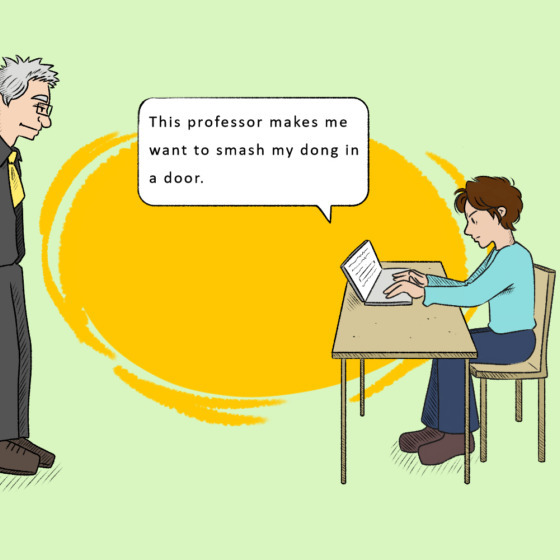
Does Rate My Professors do more harm than good?
Students use the popular site to gain insight into teachers and courses — but Dal profs question the anonymous ratings
In the coming weeks, students at Dalhousie University will select courses for the next academic year. After combing through required classes and electives, some may turn towards a familiar tool before finalizing their schedule: Rate My Professors.
The website, founded in 1999, allows students to leave anonymous reviews and ratings for their professors. The reviews include how tough the professor is, whether attendance is mandatory and whether a textbook is required for the course. Professors are scored out of five based on student submissions.
Neil Ross, a mathematics professor at Dalhousie, currently has a 4.9 rating on Rate My Professors.
“On the one hand, I think it’s a funny thing,” says Ross. “On the other hand, you would have hoped that it would act as a good thing, like keeping people accountable, getting students’ perspective on things and allowing students to share their experiences.
“But I find, like with all things internet, the reality falls short of the promises.”
Ross doesn’t regularly check his profile but did look it up prior to being interviewed. Most of the comments are positive and complimentary.
One student says, “Dr. Ross is genuinely the best math and overall professor I have had at Dal so far.” Another called him “The best math prof ever!”
Ross says his perspective on the site might be different if the comments weren’t as kind.
Sydney Davis, a fourth-year psychology student at Dal, has been using Rate My Professors since she started university. She uses the site to plan her courses.
“If I’m looking at random electives for departments that I’m not familiar with, and it’s a professor name I don’t recognize, or if it’s a subject I’ve never gotten into, it’s really helpful,” she says.
Davis has her own account and has written reviews. In second-year, a professor even asked her to write a positive review on their profile.
“I reached out, and I was like, ‘I really love your class,’ and then months later she reached out to me and was like, ‘I’m getting really awful reviews and you mentioned to me you really enjoyed my class,’” says Davis.
For professors like Rohan Maitzen, she doesn’t put much thought into what’s said on her Rate My Professors profile. She doesn’t think it accurately reflects a professor and the way they teach.
“It’s not that you don’t want to listen to feedback, it just tends to be kind of personal,” says Maitzen.
She also says that the anonymous online reviews stop students from being able to have conversations with professors when something is wrong.
“The thing is, if this was bothering you, why did you not come and talk to me,” says Maitzen. “This apparatus discourages people from treating us like we’re in it together collaboratively. Teaching is really a give and take.”
Both Maitzen and Ross noted that student evaluations are known to be biased and misogynistic. A 2014 Innovative Higher Education study found that students often evaluate and treat female professors more harshly than male professors.
Another analysis from a professor-led blog on Medium, found female professors receive poor reviews on Rate My Professors about 28 per cent more often than their male counterparts when compared to official teaching evaluations.
At the end of their courses for a semester, Dal students are encouraged to fill out the Student Learning Experience Questionnaires (SLEQs), in which students can leave feedback on teaching effectiveness and course design. Instructors can also use them to apply for tenure.
But both students and faculty say the system has its own problems.
“[SLEQs] are hard to navigate,” says Davis. “I’m like ‘I have nothing to say on this.’ I think Rate My Prof is easier in terms of being able to get your point across.”
Ross says students are fatigued with constantly having to rate their experiences, a possible reason for low SLEQ response rates.
“The student got here in an Uber, and they asked them to fill out a review, and yesterday they went to a massage therapist and they had to,” says Ross. “So, by the time SLEQs come around, of course people don’t want to fill it out because it’s so annoying.”
Jasper Goldie, a first-year student at the University of King’s College, has never used or checked Rate My Professors during his time at university. But he has looked up the profiles of his parents, who both teach at York University.
His dad didn’t have great reviews, and after bringing it up to him, Goldie learned that what was being said on Rate My Professors often didn’t match the formal feedback reviews.
“There’s a big disparity between those reviews versus the ones that are official,” says Goldie.
Goldie says it’s important students have an outlet to give feedback, but that maybe something in between Rate My Professors and SLEQ’s would be more beneficial.
“Any job having public reviews where it’s someone’s livelihood is a weird thing,” says Goldie.
Maitzen says the ratings can blur an important distinction.
“I work really hard for my students, and I am so fond of them,” says Maitzen. “But I think I’m aware that being a good teacher and being a popular teacher are not always the same thing.”