Going to horse school on Dalhousie’s Truro campus
The science credit you didn’t know you needed
Halfway through an arts degree, and still haven’t fulfilled those pesky science credits? Instead of pulling your hair out over math or biology, there’s a much better alternative: take a trip down to Truro, N.S., for a horse course at Dalhousie University’s agricultural campus.
I fall into the category of humanities students who feel slightly afraid of the scientific realm — my flight response kicks in at the thought of doing problem sets and chemistry labs — and throughout my degree, I’ve made it my mission to cut every scientific corner I can. So, last semester, in Truro, I took two classes on horses: Introduction to Equine Science and Equine Genetics and Reproduction Management.
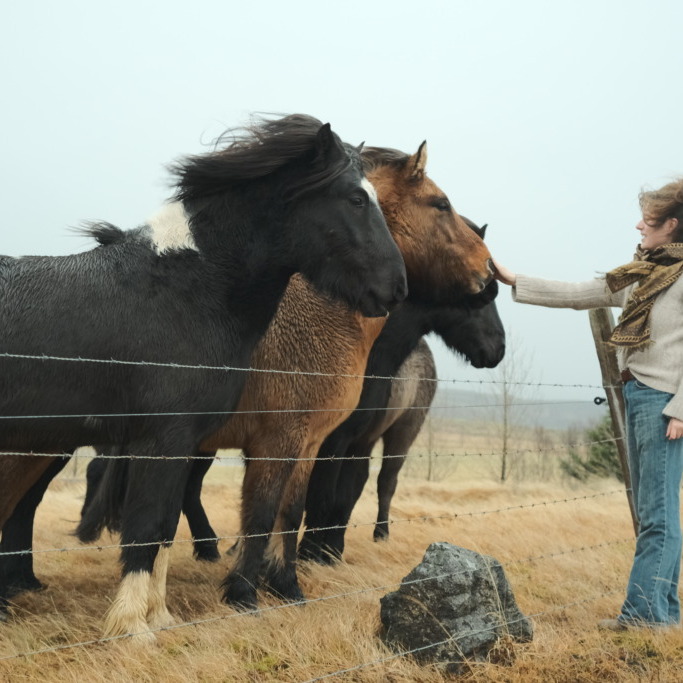
It’s the year of the horse, and I went to find the horses myself. I don’t know science, but I know equines. Before coming to university, I worked full-time as a horse wrangler and trail guide. My love of horses ultimately led me to embark on a 1,100km trek across Europe, and I lived on horseback for three months straight. Bringing these experiences to the classroom helped me on my journey to understand horses on a molecular level — the passion was already there.
The equine genetics course proved that, apparently, I can do science, if only under the conditions that Punnett squares and genotypes are contextualized by palominos, pintos and appaloosas. If you’re a closeted horse girl (guilty) or have always wanted to learn about the composition of horse semen (be it raw, frozen or cooled), Dalhousie’s horse courses are the perfect classes to take.
I attended lectures and labs in person once a week. My professor for both courses, the fantastic Dara Pelkey-Field, was kind enough to facilitate my distance learning as a Halifax student by offering the course in a hybrid format. The courses were two of the most exciting I’ve ever taken. I began to shed the reluctant scientist role when I realized that studying anatomy could mean reassembling an entire horse skeleton on the floor of the classroom, with each vertebra numbered and tagged. I sat near the neck, holding a beautiful and behemoth horse skull in my hands, awestruck.
One of the course labs was “barn duty,” where students were responsible for taking care of the horses at the Truro campus in rotating shifts, involving stall cleaning, daily grooming and behavioural analysis sessions where students monitored the horses and reported on the findings.
I had never been to the agricultural campus before taking these courses, and I was completely lost on my first day. It felt like showing up in another country where I didn’t know the language. I found myself keeping stride with a couple of students headed toward the “RAC,” which I thought was slang for some kind of hangout area.
“You in bio-vet?” they asked.
“I’m studying philosophy,” I replied.
They exchanged glances and led me to the classroom with no further questions. I decided that in the future, I would have to find ways to avoid admitting my major. Turns out it was the Ruminant Animal Centre. And yes, by the time my final exam rolled around, I knew what “ruminant” meant. Horses have a non-ruminant digestive system, so I’ve learned.
Running away to Truro once a week did wonders for my mental health. Studying horses not only tended to my budding scientific interest, but it also became a sort of academic therapy.
While my coursework in Halifax has sharpened my philosophical brain, it’s also made me more restless, as I’ve yearned to return to the hands-on work I did before university. I feel the absence of horses most acutely when I’m studying under fluorescent lights in windowless lecture halls, remembering the days when my singular purpose in life was to ride them, not study French continental philosophy.
It was a welcome reprieve to study hoof anatomy and Jacques Derrida at the same time. They’re not as different as you’d think.
If life in the city gets too trying, I recommend taking a trip to the farm. In the year of the horse, go learn about them on the Truro campus.