
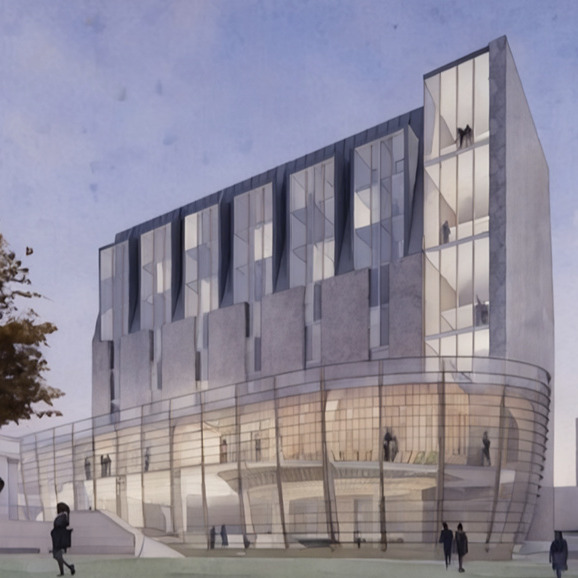
King’s needs $95 million for a new campus building. No one’s agreed to pay for it
Student union says the project “doesn't make financial sense,”
January 16, 2026 / Dylan Follett
The University of King’s College says its current budget deficit will not impact the construction of its first new building in more than two decades.
The Southeast Corner (SEC) project — projected to cost $95 million — would replace the school’s current gymnasium and border Dalhousie University’s campus. The new building will contain residence rooms for 100 students, a new gym and the journalism school.
William Lahey, the president of King’s, says a third of the price tag will come from government funding, a third from private donations and a third from the university itself.
But the government said they haven’t promised any funding.
“We are pleased to see the University of King’s College moving forward with plans for a new building that will support students and strengthen its campus,” said Chloee Sampson, the communications advisor for Nova Scotia’s advanced education department, in an email to the Dalhousie Gazette on Dec. 18.
“At this time, there are no commitments in place for provincial funding.”
King’s has met with the federal and provincial governments about the project throughout the process, but according to Lahey, the university’s application for a provincial grant to fund the building’s new residence rooms was denied. Lahey declined the Gazette’s request to access the application document.
Lahey was unable to predict how long it will take to reach the $95 million target.
Current financial struggles
King’s has a projected $1.8 million deficit for the current fiscal year, over $1 million more than the $750,000 deficit projected in June. The university attributes the increased deficit to the loss of revenue from a federal cap on international students.
The financial crisis has led to cost-saving initiatives across the school, including a current hiring freeze and an upcoming salary increase freeze beginning June 30, 2026, according to a letter sent by Lahey to King’s students on Dec. 5.
Lahey says the financial crisis and construction of the SEC are “separate from each other,” but that “the credibility of the project would be greatly assisted by the university making substantial progress on its current financial challenges.”
Ellie Anderson, president of the King’s Students Union, says she believes that the building won’t be built “while any of us are here” due to the school’s current “financial crisis.”
“It doesn’t make financial sense,” says Anderson, who is also a member of the King’s board of governors. “It’s going to be $95 million. We don’t have $2 million [to cover the deficit].
“Kings as an institution is going to have to survive the next however many years, and if we do that, then we can talk about building a new building.”
In an email to the Gazette, Adriane Abbott, the director of the King’s advancement office, said the university’s financial situation is “being well managed” and is similar to “most other Canadian universities.”
Where will the rest of the funding come from?
Lahey said it’s likely that the third of the building paid for directly by the school would come from loans and financing rather than the operating budget, and that it would be “highly advantageous” to have a balanced budget when considering financing.
Lahey hopes major contributions from “someone who identifies with the academic mission behind this building, which is journalism,” will kickstart the third of funding expected to come from private donations.
Abbott said she is “confident” that the school will find donors for the building, describing the project as “aspirational and very timely.”
“This is a tough project, it’s difficult, it’s challenging, but it’s also a huge opportunity,” says Lahey.
Construction timeline remains uncertain
While the project is still in its early stages, there is currently no established timeline for the construction of the SEC.
“It would be wonderful to imagine us breaking ground no later than two years from now and cutting the opening day ribbon six years from now,” said Abbott.
She said trying to predict a timeline before securing funding is “like looking into a crystal ball.”
Lahey, who is retiring at the end of this academic year, hopes the next president sees the project as important to the future of King’s and a priority for the university’s long-term well-being.
The King’s board of governors will review and modify the existing design of the project as it progresses to the construction stage. The board will have to vote on these modifications and whether or not to continue with the project, which will likely be in June, according to Anderson.
“King’s is confident that this project will move forward and equally confident that the conceptual drawings will undergo modifications as the project proceeds through the next design stages,” said Abbott. “We aim to fund the next phase of design this year.”

Read more from the gazette
Over 100 people protest against AI data centre at legislature

Halifax’s thedottedline is here to finish what Kendrick Lamar started

The AUS to ACAA pipeline
Chartwells manages half of SUB food vendors after Abstract takeover
Africville tribute on display at Nocturne