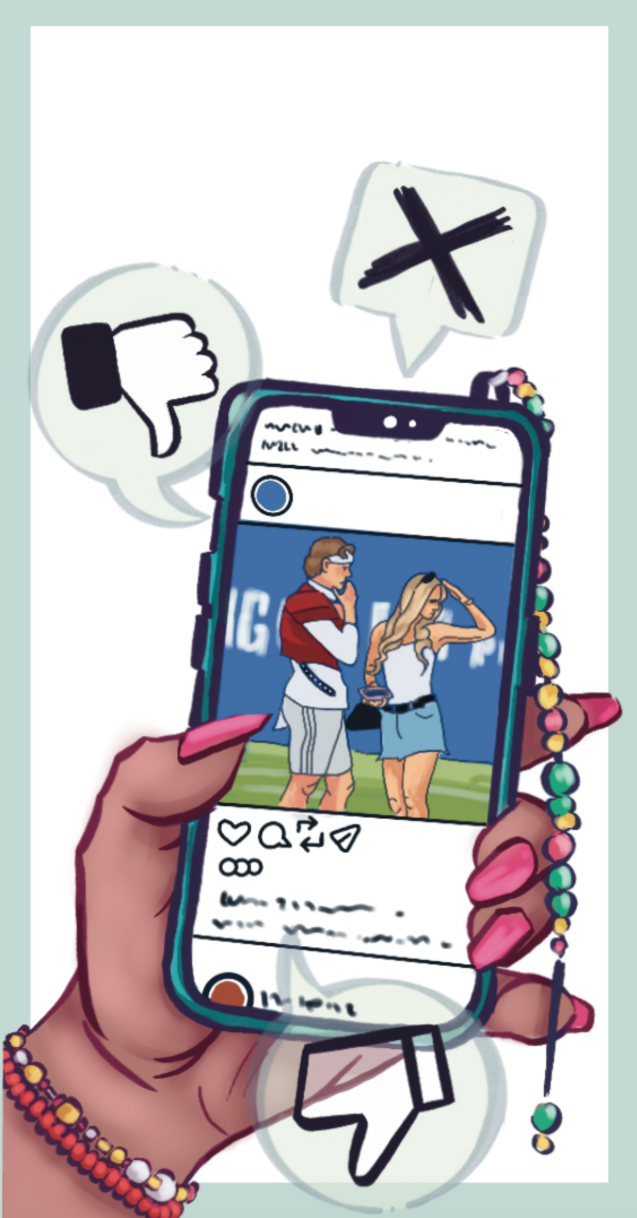

How are all these people getting together … When we need to know where everyone is?
Tracking a partner could once be considered stalking. Now, it’s expected
March 12, 2026 / Hannah Nekkers
There are a few things modern dating and real estate have in common.
They’re both increasingly straining young people’s incomes, they both require commitments we may feel nervous about, and they both include viewing multiple options until we find one we could imagine our life with.
Now, a new common factor between dating and real estate is emerging — the location.
We all have miniature tracking devices in our pockets, and our real-time location can be seen on several platforms.
It’s part of the reason I never ask for anyone’s Snapchat anymore, and when guys ask for mine, I offer my number instead.
A main reason I prefer texting to Snap is the latter’s “Snap Maps” feature. When I’m seeing someone whose location is visible, and something seems off, or they stop answering my messages, it becomes a habit to check what their Bitmoji is up to.
A flood of relief follows if they haven’t answered because they haven’t been active on the app, or a flood of anxiety if they’re active but still haven’t answered. Not to mention the rage that ensues if they’ve spent the night at an unrecognizable location.
Everyone I know in a relationship has their partner’s location.
This 24/7 access to another person’s whereabouts opens avenues for distrust to creep into a relationship, but it seems to be commonplace in modern dating.
How are all these people getting together when we need to know where everyone is?
The act of sharing your location can even act as a solidification of your status as a couple. Life360, a location-sharing app, surveyed 1,000 people in various types of romantic relationships and found that nearly 60 per cent say sharing their location makes their relationship feel more official.
It’s a little dystopian to think, “Yeah, I know about my partner’s family, goals and deepest insecurities, but we can’t call things serious until I know where they are 24/7.”
Yet the same Life360 survey also found that 95 per cent of American adults in relationships use some form of location-sharing technology. And 21 per cent said it would be a deal breaker if a partner wasn’t willing to share their whereabouts.
I understand why it’s so popular. If someone’s wondering what their partner’s up to, they can conveniently check the device already in hand, providing reassurance that their partner is right where they said they’d be.
Plus, it can be a safety feature. I’ll often share my location with friends before a first date, or if I know I’m going somewhere sketchy.
However, the growing expectation to immediately share our locations in a new relationship carries a sinister tone.
Demanding someone’s location can start a relationship on a note of immediate distrust. If you’re asking me for my location right away, you’re assuming all that’s stopping me from cheating is my icon on your map.
Location-sharing features act as an invisible dog leash attaching our phones.
A healthy relationship depends on trust. If people can’t trust their partners enough not to know where they are on a random afternoon, then location-sharing may be the least of their issues.
When entering a relationship, some people have a hard time dealing with the back-and-forth between being a couple and being autonomous individuals. Sharing locations can hinder this balance.
Being hyper-aware that someone has our location at all times can impede our independence. Suddenly, our every move around the city could be tracked or criticized.
An impromptu stop at a friend’s house on the way home from work can turn into a partner becoming suspicious. Now, everyone feels like they need to explain an innocent detour.
And, what happens when technology does the thing it’s bound to eventually do: glitch.
I’ve been around friends when their partner’s location won’t load. It gets scary.
Their minds immediately consider every reason they can think of — other than the possibility their partner might have powered off their phone. Maybe it died. Maybe the app isn’t loading. Maybe they’re in a tunnel.
Sometimes it turns retaliatory. One turned their location off, so the other does the same.
Now, everyone is suspicious and afraid to bring it up. Doing so would mean accusing the other of one of the worst things someone can do in a relationship, based on what could just be a tech blip.
It can be fun to share your location with friends. When they’re not where they’re supposed to be, we laugh about it later; we don’t yell.
With a relationship, it’s different. Location-sharing can turn harmless moments into suspicious ones.
When I hard launch a relationship, it won’t be because I have their location.
I’d rather have their trust.

Other Posts in this category

Make-A-Wish partner society founded at Dalhousie

DSU rehires same security contractor for DalFest after alleged assaults last year, adds new safety measures

Tony turns Provincetown into Hollywood
Meta’s AI glasses are for perverts

MacLeod is out of tune with Nova Scotians