Frankenstein’s Monster acquitted
Dal law shows off sense of humour in mock trial to support the humanities
Was Victor Frankenstein’s Monster a malevolent murderer or a victim of circumstance? The verdict is in.
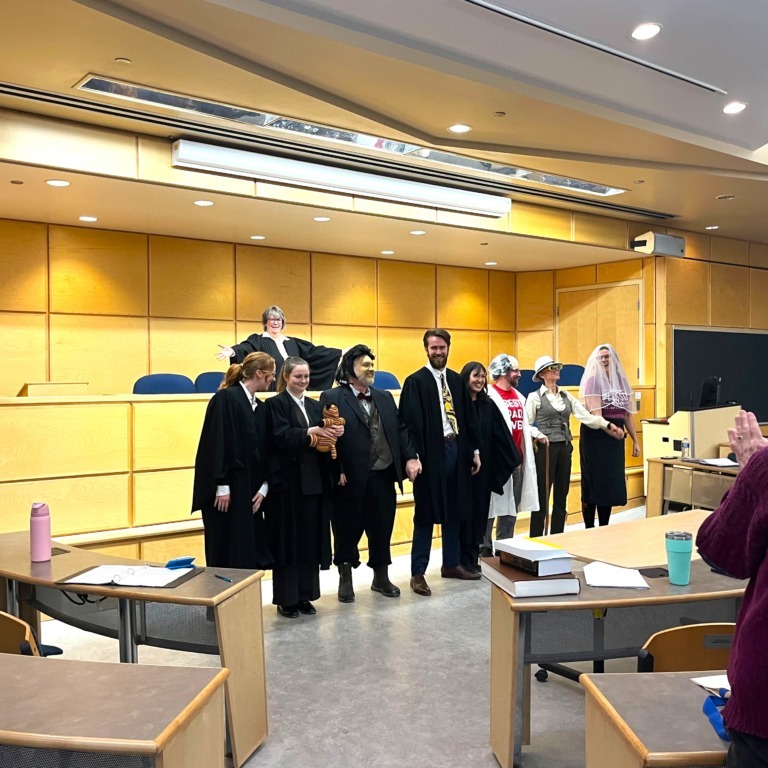
On March 11, at the Weldon Law Building, a court of Dalhousie University’s Weldon Literary Moot Society members put Frankenstein’s Monster on trial for murder.
The trial included deceptive witnesses, sharp zingers, a dramatic on-the-stand confession and very few facts.
Was the defendant, played by Mark Lewis, Dal’s chief law librarian, a monster? Or, as Sara Ross, an associate law professor and fictional witness, put it, “just a boy trying to find his way?”
Not even the cause of death was determined, despite the victim’s ghost, Suzzie Dunn, an assistant law professor, testifying before the court.
Such testimony would matter in a real court of law, but not in this one. The show must go on.
One by one, the witnesses, including the mad scientist Dr. Frankenstein himself — assistant law professor Matthew Dylag — stepped up to the stand, placed their hands on Mary Shelley’s Frankenstein and shared their own convoluted version of events.
The defence, law students Alexander Korski and Chaeyon Lee, tried desperately to stop the Monster from incriminating himself with his outbursts — they ultimately failed when he confessed to murder and cannibalism on the stand.
Meanwhile, the Crown, law students Laken Tucker and Leah Jadd, tried to get a word in while avoiding stink-eye from the judge, law professor Lucie Guibault.
After the case was presented, the attendees assumed the role of a jury and made a choice: did they wish to have the defendant banished and disassembled, or pardoned to walk free?
The audience’s cheers determined the verdict: not guilty.
The Weldon Literary Moot Society, composed of Schulich School of Law students, hosts a literary moot event once a year to raise funds for the humanities.
“We really depend on passionate individuals who just want to crack a joke here and there, and anybody who may be interested in some creative writing,” said Lee, the society’s president.
Once the preliminary script is done, they share it with interested law faculty. The professors, who also volunteer their time, share feedback on humour and voice, rather than legal questions.
“The focus is more on theatre and not so much on sticking to the soundness of the legal principles during the trial,” said Lee.
For Dal law students attending the event, the trial is a great opportunity to see their professors in a different light.
“I usually see them in a pretty serious context,” said Hannah Balba, a third-year Schulich student. “It was very fun to see them let loose and have fun.”
Proceeds from ticket sales and sponsorships support the Halifax Humanities Society, a charitable organization that offers non-credit university-level humanities classes to low-income adults. In the last 15 years, the event has raised at least $45,000, said Katie Carline, interim director of the organization.
“The humanities are incredibly valuable for helping people to understand the world that they live in, understand the forces that have shaped their lives and understand their own powers as an individual and as a community member,” Carline said.