Is that semen? No, it’s Roman: Dal’s infamous Marine Venus
The penis statue has stumped students since 1969
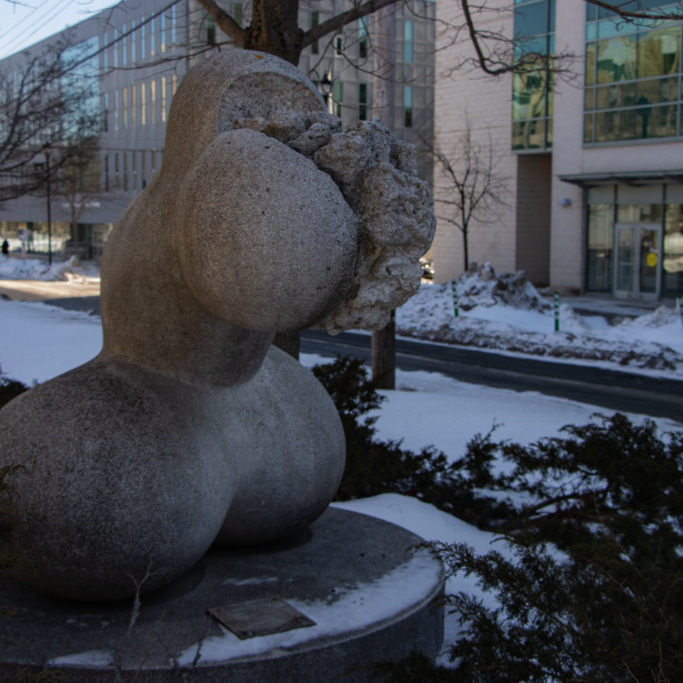
What purpose could the suspiciously phallic-shaped stone statue on University Avenue possibly serve? While it’s the reason for many giggles from Dalhousie University students, the suggestive shape is an abstract representation of the birth of Venus.
The rumours surrounding the statue are plentiful. Some say it’s a woman with breasts. Others are convinced it depicts stacked molecules. And of course, many cannot help but point out the penile shape and the perhaps infected tip of the statue.
“It does look like a penis,” said Ria Juurlink, a first-year resource and environmental management master’s program student, after looking at a picture of the statue.
The late Canadian artist Robert Hedrick created the statue for Montreal’s Expo 67. From there, the statue went into the hands of the Seagram Company Ltd., before being gifted to Dalhousie in 1969.
Emily Varto, a Dalhousie classics professor, said it was common for artists to experiment in the 1960s when the statue was created.
The eccentric nature of the statue “makes sense coming out of the ’60s, when they were turning a lot of traditions on their heads,” she said.
The statue was meant to be mounted in a reflecting pool, which would reflect the penile shape against the sky. On a sunny day, the water would have been clear, an abstract presentation of Venus rising out of the water.
However, due to financial costs, the pool was never constructed. Without a reflecting pool, much of the message is lost, and campus is left with a penis-shaped oddity.
“With a reflecting pool, you get that idea of Aphrodite emerging out of the water,” said Varto. “And that connection between the genitals and the sea, which is what makes Aphrodite.
“It’s those two elements in tandem that tell the story, not just the sculpture as we have it now.”
Like the duality of the statue, the source material also exists in twos.
“There are two stories of her birth,” said Varto. “Probably the most interesting one, the most popular one, we first see it in Hesiod.”
Hesiod was a Greek poet, thought to be active around the eighth century BC. He wrote the story of Aphrodite’s birth in the Theogony, a poem about the origins of different Greek gods.
In it, Uranus, the god of the sky, is castrated and his genitals are cast down, mixing with sea foam.
“Aphrodite emerges out of the foam of the sea onto the land of Cyprus,” Varto said.
Aphrodite, also known by her Roman name Venus, is often depicted emerging from a clam shell, imagery popularised by Sandro Botticelli’s Birth of Venus.
“Riding a clam shell has its own kind of sexual innuendo,” said Varto.
But while that innuendo is somewhat subtle, Marine Venus is not.
Mara Robinson, a fourth-year biology and history of science student, said the statue is funny.
“It looks like a kind of abstract penis.”