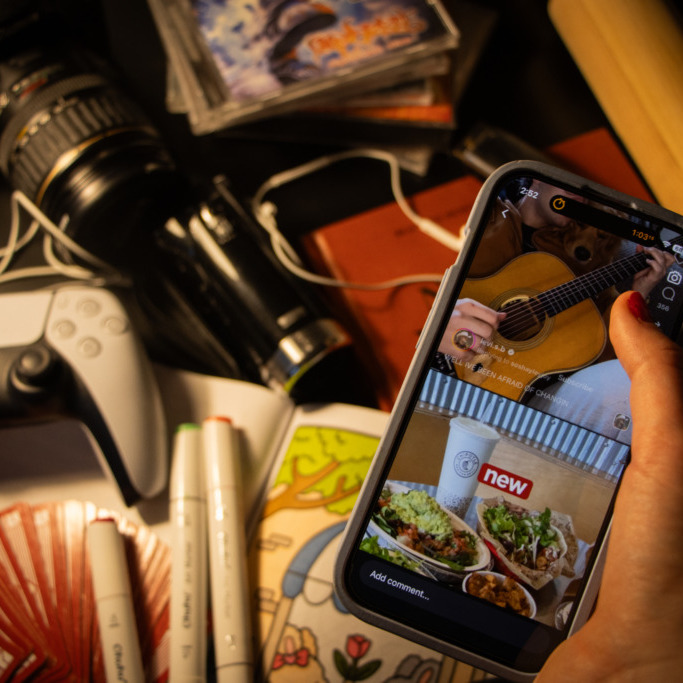
You are what you post? Hobbies in the social media age
If a hobby happens in isolation, and you don’t post about it, did you even do it at all?
If you asked me what my hobbies are, I’d tell you I love to paint. I haven’t touched a paintbrush in over a year, but I’d sooner lie than admit I spend my free time horizontal on the couch binge-watching a show, while scrolling through a lifetime’s worth of TikToks about that same show.
Don’t think I haven’t cycled through the usual excuses: I’m tired. Not now. Maybe tomorrow. But somewhere between “just a few minutes before bed” and desperately needing to know what type of cheese represents my birth month, I blinked and realized it’s been “tomorrow” for a year.
I know I’m not the only one guilty, so all I’m wondering is: When did we all get so lame?
Hobbies used to leave evidence: a half-finished scarf, a recipe book, sore muscles after one too many attempts at mastering a backflip. Tangible proof that time had been spent doing something. Now, our idle moments dissolve into pixels as we scroll through reels, tutorials and day-in-the-life videos, emerging with little more than the ability to say “I saw this,” “I heard this” or “I watched someone do this.”
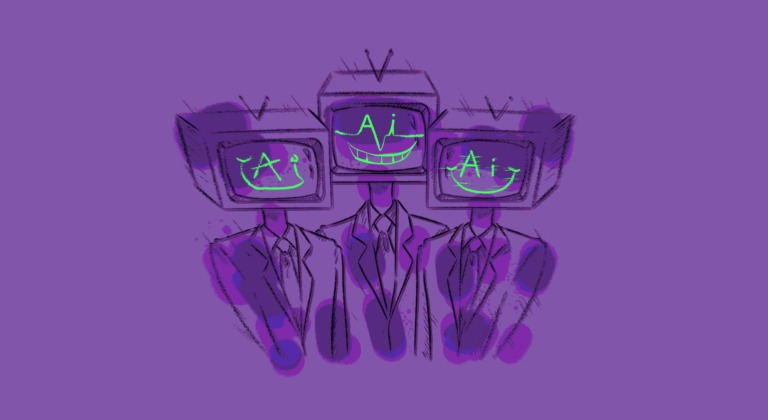
Walk into almost any room and you’ll see it: the sea of glowing screens, each person locked into their own algorithmic leisure. It raises the obvious, mildly panicked question, is media consumption the new hobby? Or worse, are we witnessing the death of traditional hobbies altogether?
Martha Radice, a sociology and social anthropology professor at Dalhousie University, says the shift from doing to consuming is not cause for concern. The amount of time people are spending on passive media consumption may overpower time spent on real-world hobbies, but this anxiety that hobbies will be eliminated altogether is just a recycled form of moral panic.
“Before we had smartphones, we had TV. Before we had TV, we had radio,” Radice says. “There’s been some form of media consumption available to people with varying degrees of ease of access since the early 20th century — and the same moral panic. Whenever a new technology comes in everyone’s like, ‘Oh no, this is going to ruin social life as we know it.’”
While hobbies themselves may not be disappearing, Christian De Vrij, a sociology PhD candidate at Queen’s University, argues that the digital arena we exist in has fundamentally changed what hobbies are.
“It’s not that people have stopped doing things. People still swim, people still bake, people still crochet,” he says. “What’s changed is how these practices are increasingly mediated through platforms where visibility, documentation and audience feedback become a part of the hobby itself.”
In other words, the point of knitting is no longer the scarf or even the quiet satisfaction of finishing the scarf. In fact, who cares about the scarf anymore! What matters is the performance of making it, the proof of competence and the demonstration of good taste. As De Vrij says, “Doing the hobby and being seen doing the hobby become intertwined.”
How many people would run a marathon if they couldn’t post about it?
Before the tsunami of apps like Letterboxd, Goodreads, Substack, Instagram and TikTok — platforms that let us publicly audit how others spend their time, what reels they like and what movies they watch — people didn’t have to justify their downtime. Now, media consumption, masquerading as a hobby, is tangled in cultural pressures around productivity and self-optimization.
Posting your interests, logging books and sharing what you’re doing or watching, De Virj says, “has become a way to signal competence, discernment or productivity.”
Welcome to the ultimate couch-potato competition, where I prove my thumbs have superior liking capacities to yours.
The constant awareness of being watched reshapes how people present their tastes, media consumption and, by extension, themselves.
“The appeal of these platforms is that you can demonstrate that you’re spending your leisure time well,” De Vrij says. You read serious books. You watch interesting films. You cook creative meals. Anything, as long as it’s proof that you didn’t just rot.
Leisure, once the opposite of work, now performs suspiciously like it.
In the race to appear productive, there’s also a parallel race to appear distinct. How are we not exhausted yet? It’s not enough to be perceived as different, but different in the right way. You can’t simply like music or films; you have to like the right artist, the correct foreign film, the podcast no one else has “discovered yet. There’s a word for this social currency that I’m sure has already surpassed its underground expiry date, and that’s “niche.”
Earlier periods of civilization offered fewer visible markers of intelligence, says De Vrij. Today, those markers are everywhere, so taste has stepped in to do the heavy lifting. The media you read, watch, listen to and post about has become the Coles Notes version for who you are and how seriously you should be taken.
“Our sense of identity becomes something that we co-produced with our imagined audience,” he says.
Maybe hobbies aren’t dead. Maybe they’ve just been absorbed into the performance economy where even rest has to prove it was done productively, intelligently and uniquely.
Now, if you’ll excuse me, I have a painting I should get back to. Or at least a TikTok about painting.