Halifax International Security Forum skips annual public panel with Dalhousie, SMU
Forum’s only public-facing event dropped for the first time since 2017
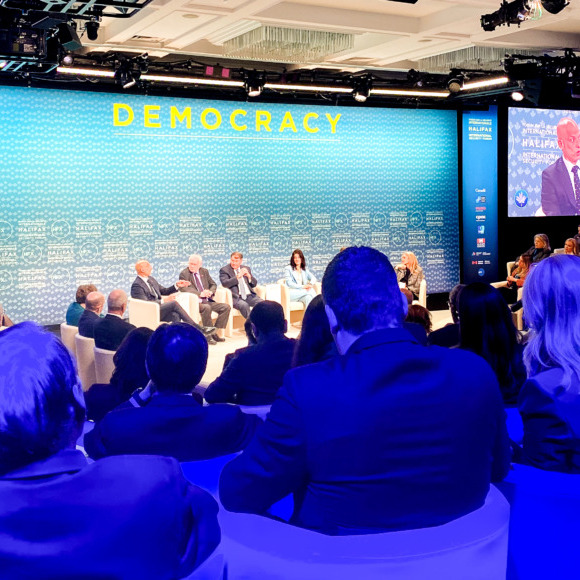
Government and military officials from around the world descended on Halifax last weekend for the Halifax International Security Forum — but for students and community members, one event was notably absent.
Since 2017, the forum has hosted a public panel in partnership with Dalhousie University and Saint Mary’s University ahead of its weekend events — except in 2020, when the event moved online due to the COVID-19 pandemic. This year, however, the panel — typically the conference’s only public event — didn’t take place.
The forum brought together more than 300 international government and military officials, academics, journalists, businesspeople and politicians, according to its website, but attendance was by invitation only.
In an emailed statement to the Dalhousie Gazette, Janet Bryson, Dalhousie’s media relations director, said HFX — the non-partisan, Washington, D.C.-based organization that hosts the event — informed both Dalhousie and SMU that it would be unable to hold a public panel due to “difficulty securing panelists early enough to maximize promotion of the event and attendance.”
In a separate emailed statement to the Gazette, Dan Dugas, director of communications for HFX, said the decision was due to “organizational realities within HFX,” also adding that the forum faced difficulties securing panellists early enough to run a well-attended event.
“This decision was taken reluctantly, but we felt that we could not put on a meaningful event that would do Dalhousie and HFX justice,” said Dugas.
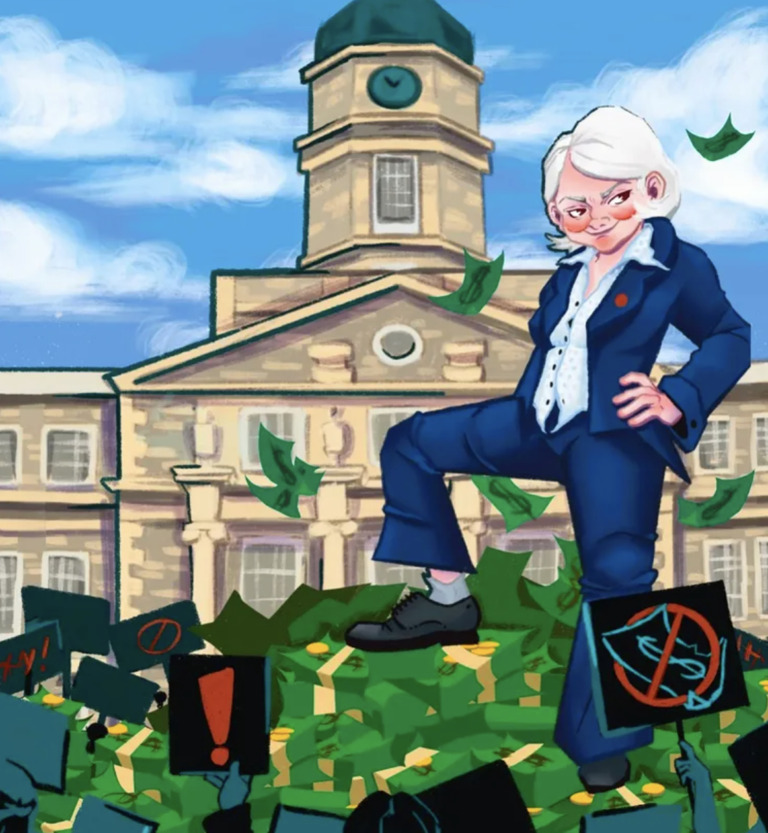
Dalhousie President Kim Brooks was listed as a participant on the forum’s website, but did not attend due to “another commitment,” according to Dugas. Brooks was the only Dalhousie representative listed.
Jalal Khan, a first-year Dalhousie political science student, said the forum should “definitely bring back” the public panel event.
“It’s a great way for students to know about the [forum] and participate in the event,” he said.
While Dalhousie did not host the panel, approximately 25 students from the university volunteered at the forum, according to Khan, who also volunteered.
“It was phenomenal,” he said. “You really got to see how the event shapes our world.”
Bryson said the faculty of arts and social sciences is “instrumental in supporting the forum” and encourages students to volunteer.
“[The forum provides] those students with an exceptional experience, as well as sharing the expertise of a variety of speakers and participants from the university, including Dr. Brooks,” the statement read.
Both Bryson and Dugas said Dalhousie and HFX value their partnership despite the elimination of the panel this year.
“Volunteers from the student body are an important part of our Forum each year,” Dugas said in the statement. “We will continue to work with the Deans to strengthen those ties.”
Dal’s previous involvement
Ahead of last year’s security forum, HFX organizers hosted the seventh public panel in collaboration with Dalhousie and SMU at the latter’s McNally Theatre Auditorium.
Prior to last year’s panel, both HFX and Dalhousie expressed their satisfaction with the partnership in a statement posted to the forum’s website.
“We’re excited to once again partner with SMU and the Halifax International Security Forum, offering our local communities a unique chance to engage with international delegates on issues that shape our world,” Brooks said in the statement.
In the same statement, Peter Van Praagh, president of HFX, called Dalhousie and SMU “steadfast community partners.”
Both Dalhousie and SMU have previously faced criticism from student organizations over their participation in the forum.
Ahead of last year’s panel, 13 student societies from Dalhousie, SMU and the University of King’s College issued a joint statement on the Dalhousie Palestinian Society’s Instagram account, condemning the universities’ decision to host the panel.
“We, as students, demand that war propaganda be kept off our campuses and these war criminals not be given a platform at our schools,” the statement read.
An Instagram video posted by Students for the Liberation of Palestine – Kjipuktuk on Nov. 23, 2024, shows protestors at last year’s panel shouting and banging on the auditorium door while attempting to enter.
SLPK is an autonomous coalition of students from local post-secondary institutions, including Dalhousie, the University of King’s College, SMU, the Nova Scotia College of Art and Design and Mount Saint Vincent University.
Dugas said the forum “welcome[s] peaceful demonstrations,” but did not respond to questions about whether last year’s protest impacted the decision not to hold a panel this year.
Local advocacy groups protest
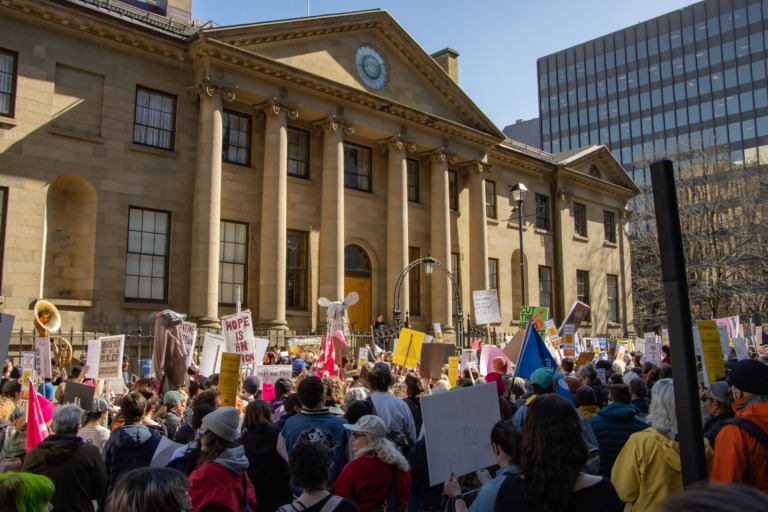
On Nov. 22, the second day of this year’s forum, protestors gathered across the street from the Westin Nova Scotian, where the event was underway.
Local advocacy groups, including the grassroots student organization Nova Scotia Student Strike, shared a joint Instagram post ahead of the protest. The statement provided details about the demonstration and criticized the forum’s presence in Halifax, particularly the attendance of former Israeli Prime Minister Ehud Barak.
Malcolm Mealey, a third-year Dalhousie bachelor of arts student and Nova Scotia Student Strike member, says the security forum is “an inherently evil thing,” promoting war, militarism and genocide around the world.
“It’s absolutely ridiculous that these people are not only allowed into Canada, and specifically to Kjipuktuk/Halifax, but are also given a platform and such legitimacy to speak,” says Mealey.
Dugas didn’t comment directly on this year’s protest.
“[Peaceful demonstrations are] a hallmark of a free, democratic society,” he said in a statement.