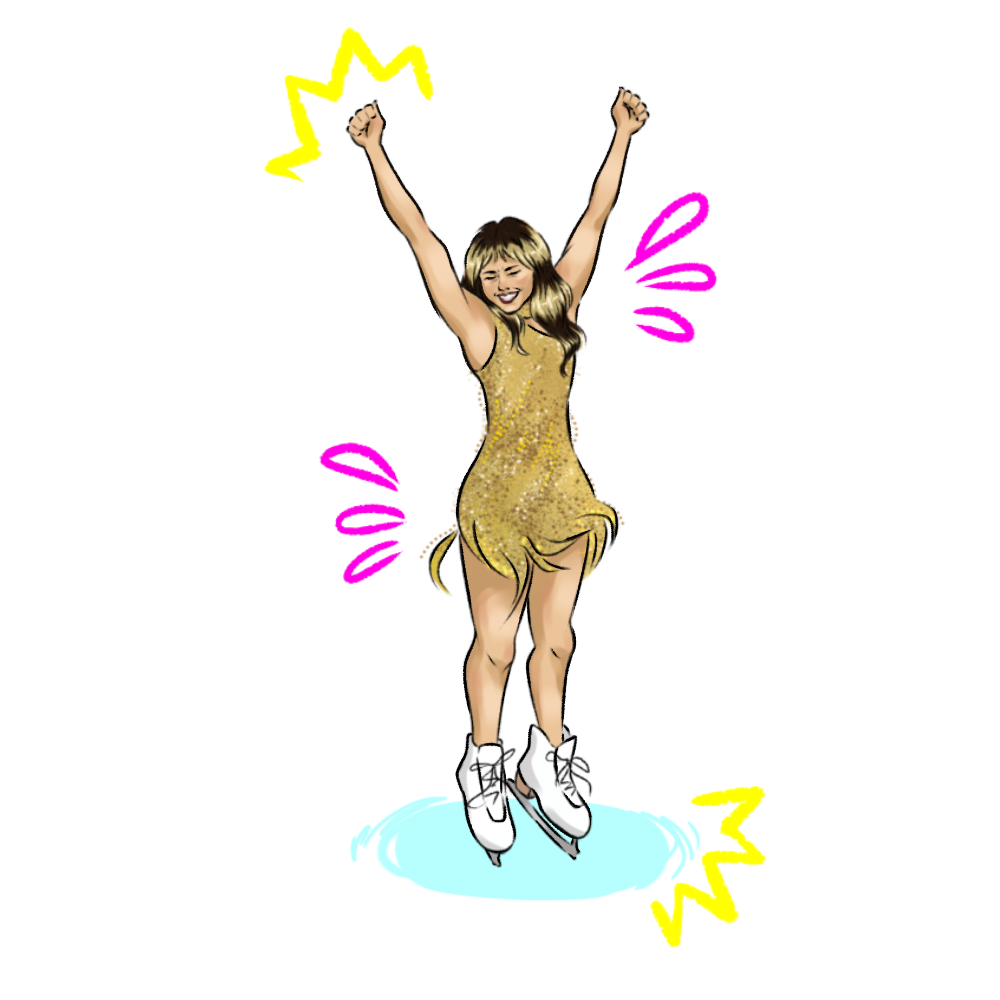
What I learned from Alysa Liu
The figure skating champion has the best relationship with her sport
Being from England, I’m not familiar with figure skating. Yet over the past two weeks, I’ve fallen down a rabbit hole to “Stateside” by PinkPantheress and Zara Larsson.
Images of a two-time Olympic figure skating gold medallist with halo highlights and a frenulum piercing have taken over my thoughts — her medal-biting grin has flooded my algorithm.
It’s no exaggeration to say Alysa Liu changed my life. There’s so much we can learn from figure skating’s newest it-girl.
As someone who fell out of love with a sport that I believed gave me purpose, Liu has shown me that you can return to something you once loved on your own terms, without having to prove anything.
Liu began her impressive skating career at age five, and, in 2019, at just 13, became the youngest U.S. figure skating champion ever. She shockingly announced her retirement just a few years later, at 16.
But last season, Liu returned to competitive skating.
She’s made it clear she returned on her own terms: self-directed, healthy and in creative control.
“I get to pick my own program music. I get to help with the creative process of the program,” Liu said in an interview on CBS’s 60 Minutes.”
“No one’s going to starve me or tell me what I can and can’t eat.”
At the Olympic Winter Games in Milano Cortina, Liu became the first U.S. woman to win an individual figure skating gold since 2002, capturing the hearts of audiences worldwide.
From a young age, I ran competitively, representing my club, county and region with pride. It was my passion, and I loved it. Until I didn’t. I didn’t know who I was if I wasn’t “the girl who runs,” but I no longer wanted it to be my sole priority. It interfered with my social life and led to race outcomes determining my happiness.
The lack of commitment brought a decline in ability that my ego couldn’t take. So, I quit. However, it didn’t take long for me to realize just how much I missed running.
Still fearful of the anxiety-inducing experience that is the starting line of a competitive race, I now run recreationally. I’d be lying if I said I don’t still struggle with comparing my abilities now to those of my running-crazed 14-year-old self, but Liu has shown me that passion, enjoyment and input are significantly more important than any outcome.
I’ve long operated under the idea that I need to suffer to achieve greatness. With “hustle culture” and “the grind” flooding my algorithms, I’ve buckled under the narrative that success requires constant sacrifice.
Liu challenges this perspective. She’s proof that joy and excellence are not mutually exclusive, and success shouldn’t come at the price of isolation.
Liu’s decision to take a break from the sport that defined her early life couldn’t have been easy. Despite criticism and disappointment, at 16 she made the brave decision to step back for her own happiness.
In a sport where young athletes are frequently pushed past their breaking point, Liu refused to comply. By returning, she reclaimed authority over her body, her art and her timeline — a stark contrast to the pressure-filled, coach-driven approach to her early career.
Liu stopped trying to be what the sport expected of her and became unmistakably herself, showing the world that success doesn’t have to be linear and excellence doesn’t have to come at the cost of your identity.
And her quirks are what make her so captivating. In performance, the artist and their art are inextricably linked, and Liu doesn’t attempt to shy away from emotion, expressing her true self.
The crowds at this year’s Winter Olympic Games adored her. They were moved to tears by her emotional performance of “Promise” by Laufey, and on their feet dancing and clapping along to her gold-winning routine to “MacArthur Park” by Donna Summer.
Liu’s focus throughout the Games was not on the outcome, but on enjoying every moment and trusting the process.
“What is there to lose?” She said in an interview with Time magazine days before the Games. “Every second you’re there, you’re gaining something.”
This mindset isn’t common in professional athletes, and it’s deeply motivating. Following Liu has been a breath of fresh air. If I had her to look up to while struggling with my sport, I might have been able to cultivate a better relationship with it. Maybe I still can.