Dalhousie swimming: a living dynasty
Swim team wins first two meets of the season
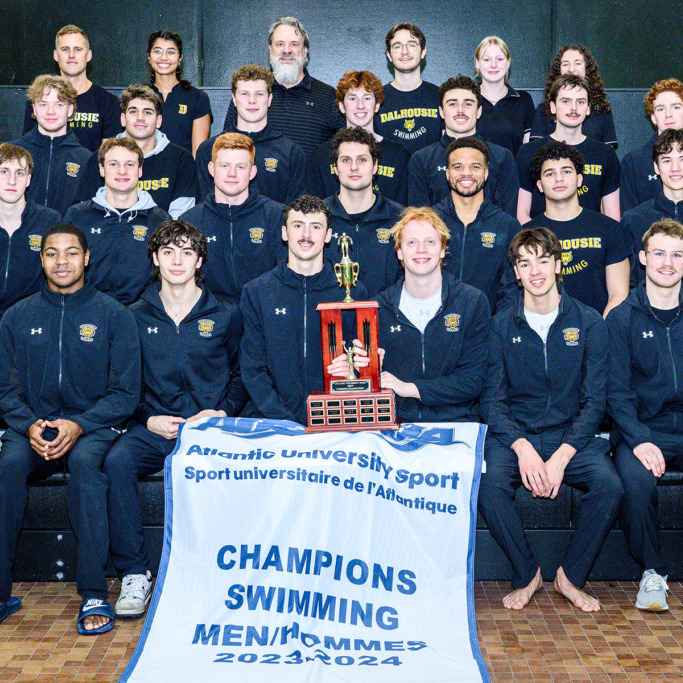
Since 2000, only two other East Coast university programs have won the Atlantic University Sport swimming championship besides Dalhousie University.
That’s 48 Atlantic banners hung up in the Dalplex.
David Fry and Lance Cansdale are the architects of those winning teams. The coaches racked up 38 AUS Coach of the Year awards for Dal since the turn of the century. The men’s coaching award is now called the David Fry Award. The legacy goes back even further to Nigel Kemp, the first coach in Dalhousie swimming history, who won 27 Atlantic Universities Athletic Association championships, before it was called AUS.
“I think it’s the consistency of programming we’ve had,” Cansdale said, reflecting on why the Tigersexcel. “People know what they’re getting here in the last two coaches.”
Just as Kemp did to Fry, the more than 40-year coaching veteran passed the torch to Cansdale in 2012. Fry left behind 30 AUS championships before passing away in 2015 after a battle with cancer. He had just completed the first year as the interim head coach at one of his four alma maters, Acadia University.
Fry and Cansdale coached at the Halifax Trojan Aquatic Club together. Then, when Cansdale was in a management role with Swimming Canada, Fry called to ask if he wanted the Dalhousie job.
“You never want to think about trying to follow a legend,” Cansdale said. “His ability to coach was great, but his ability to develop young adults and teach was probably his greatest strength.
“For me, I felt comfortable sort of stepping into that role. I mean, we’re different personalities: he’s a little soft, I’m a little goofier.”
Cansdale said the team developed a winning culture and tradition that has been “passed down from group to group to group.” Since swimming is a training-intensive sport, with athletes training all year-round for a handful of swim meets, rather than weekly games, Cansdale says it is different from other sports.
“There’s a lot of uniqueness around swimming,” he said. “Having a bunch of like-minded people that want to go in a positive direction, it’s contagious.”
Emilie Schofield, a fifth-year kinesiology student and a team captain, said that the team’s culture and dynamic have gotten them where they are.
“The culture has been pretty similar,” Schofield said. “But it’s also been adaptable to a lot of changes, especially when COVID hit. That was a big fluctuation, but our team dynamic has always been pretty positive and supportive of each other.”
Schofield is just one of the Dal swimmers demonstrating excellence at the U Sports level. At the Tigers’ most recent meet, the AUS Kemp-Fry Invitational, she earned four individual gold medals and had three races rank inside Dalhousie’s all-time top 10. She already won the 2024-25 women’s swimming team’s Most Valuable Person the year Dal swept the AUS championship.
Outside of swimming, Schofield organizes Hear Me Roar, a program built by Dal swimming coaches and players to motivate underprivileged youth to join sports.
Cansdale said other swimmers do similar activities in the community, including volunteering at the Ronald McDonald House Charities, participating in the Women’s March and facilitating youth activities, such as Tigers PLAY. The team even had its first Rhodes Scholar in November. Isaac Bahler earned a fully funded graduate education at the University of Oxford for his work on climate innovation projects.
“They get to experience something that’s maybe totally different than something that they would experience if they were just a normal student attending the university,” Cansdale said.
He says that extra work outside of the pool has been a real part of their excellence and one that can carry throughout the student athletes’ lives.
“Learning how to win and how to be successful in the things that you do is something that if you can spread it to the other parts of your life, you can really find a path for yourself going forward,” Cansdale says. “Find your success in life and find your fulfillment and your contentment and stuff like that.
“That’s what sports does, and that’s what, you know, we try to teach here.”