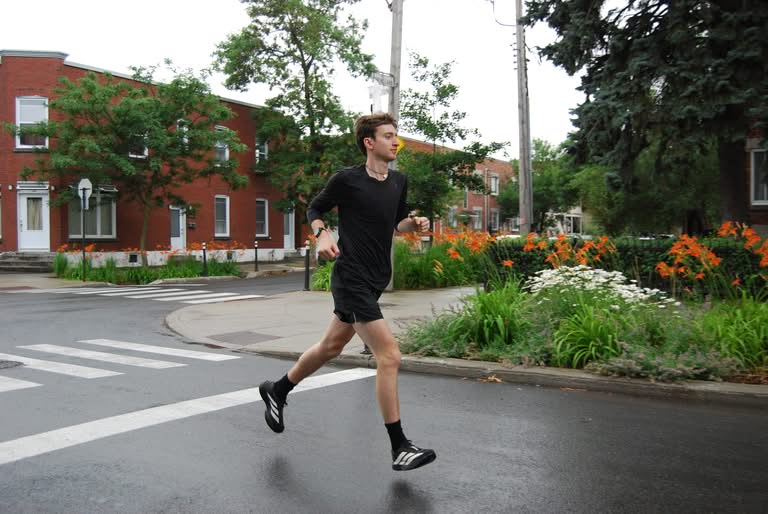

Kennedy MacLean. (Alice Hebb photo)
Kennedy MacLean laces up her navy and silver track shoes. Her 600-metre race is drawing near. A friend walks over, shares a laugh and wishes her luck, leaving MacLean alone to continue stretching and listening to music. She then proceeds to the track to loosen up.
She’s focused. She’s healthy. She’s ready.
This pre-race ritual was a lot different only two years ago for MacLean. For the majority of her teenage years, she suffered from depression, anorexia, anxiety and bulimia, all common mental illnesses that she says some varsity athletes deal with every day.
The 20-year-old from Dartmouth, who competes in middle-distance events, showed symptoms of a mental illness when she was just 13, but only came to terms with it as of late.
“I always had a hard time admitting that I had a mental illness because I always thought that there was someone out there that was sicker than me,” she says. “But then things really started to go downhill and I thought, ‘maybe there’s something wrong.’”
MacLean made frequent appearances at the hospital when her illness was at its worst. Her most recent trip was a year ago when she was severely dehydrated. She says her experiences in the hospital were frightening.
“You don’t know what’s going on and it’s scary to think that it can’t be fixed with medicine.”
After being rushed to the emergency room four or five times, MacLean knew something had to be done.
When MacLean came of age, she took a program through the QEII Health Sciences Centre where she learned how to eat healthier and rebuild confidence through individual therapy.
Her parents were supportive throughout the healing process, but MacLean says she found immense support from her teammates and coaches.
“My training partner Morgan Hawkes has been amazing,” she says. “I also live with people on my team and they’ve just been great.”
MacLean is now healthier than she’s ever been in her life. She’s able to focus better, not only on the track but in her everyday life as well.
“I was talking to one of my teammates and I told her about the amount of energy I had and she told me this is what healthy is like,” she says with a laugh.
MacLean says mental health issues are something many athletes at Dal deal with. She believes the most relevant illness is anxiety, due to the pressure placed on athletes to always compete at their best.
“It’s crazy how prevalent it is,” she says. “I know a lot of varsity athletes who suffer from anxiety issues, and I don’t blame them. I’d be surprised if someone said that they didn’t have difficulty coping with some of the things that go on.”
There are services on campus for people who think they might be suffering from a mental illness, but MacLean is disappointed about how the services are publicized.
“Nobody knows about it,” she says. “I didn’t even know until this year that our Dal health plan covers therapy. People don’t know that there’s an option to get help and that’s so frustrating.”
But MacLean says support is out there, referencing the recent mental health fundraiser by Bell that raised over $4.8 million. She hopes awareness doesn’t only last for one day.
“It’s getting the word out there,” she says, “and it was amazing to see my whole Twitter feed filled with ‘Bell Let’s Talk.’”
MacLean decided to tell her story to show athletes and the Dal community that it’s OK to talk about mental illnesses and to admit that something is wrong.
“It really upsets me, the stigma that’s around mental health. A lot of people view it as a weakness and it’s not.”